Anubias afzelii
Anubias afzelii
Robust West African epiphyte native to fast-flowing streams. Thrives in strictly low light without CO2; highly prone to algae under intense illumination.
Temperatura da água
12 - 30 °C
Valor de pH
6 - 8.5
Tipo de água
Água doce
Luz
Da bassa ad alta
CO2
Baixa
Altura esperada
40 cm
Largura esperada
40 cm
GH
2 - 20 dGH
KH
0 - 15 dKH

Descrição da espécie
Geographical Origin and Habitat: Anubias afzelii is strictly endemic to the deeply shaded, humid tropical rainforests of West Africa, with primary populations found in Senegal, Guinea, Sierra Leone, and Mali. It is a highly specialized rheophyte, meaning it has evolved specifically to survive and thrive in fast-flowing, frequently flooded jungle rivers and streams. In its natural habitat, it does not root into soft mud; instead, it uses its immense, creeping rhizome to anchor itself violently to submerged boulders, rock crevices, and massive pieces of sunken driftwood. The dense canopy of the African jungle overhead ensures that it receives only highly diffused, dappled sunlight, a critical evolutionary trait that permanently adapted the species for extreme low-light environments.
Taxonomy & Genetics: This is one of the oldest and most historically significant plants in the aquarium hobby. It was one of the very first Anubias species to be officially described by science, classified by Heinrich Wilhelm Schott in 1857. While modern aquascaping is dominated by the squat, round-leaved Anubias barteri complex (like 'nana' or 'petite'), A. afzelii is genetically distinct and programmed to produce a much taller, radically more upright, and imposing architectural silhouette. It is completely distinct from the barteri family, representing a unique lineage of narrow-leaved African epiphytes.
Physical Structure: The physical architecture of Anubias afzelii is staggering and highly structural. It boasts a colossal, creeping horizontal rhizome that acts as a massive energy storage battery. Unlike the creeping dwarf variants that stay close to the wood, the incredibly thick, fibrous leaf stems of A. afzelii shoot almost perfectly vertically. The entire plant structure is incredibly dense, wiry, and built with immense tensile strength, designed by nature to withstand brutal, torrential water currents without tearing, snapping, or uprooting.
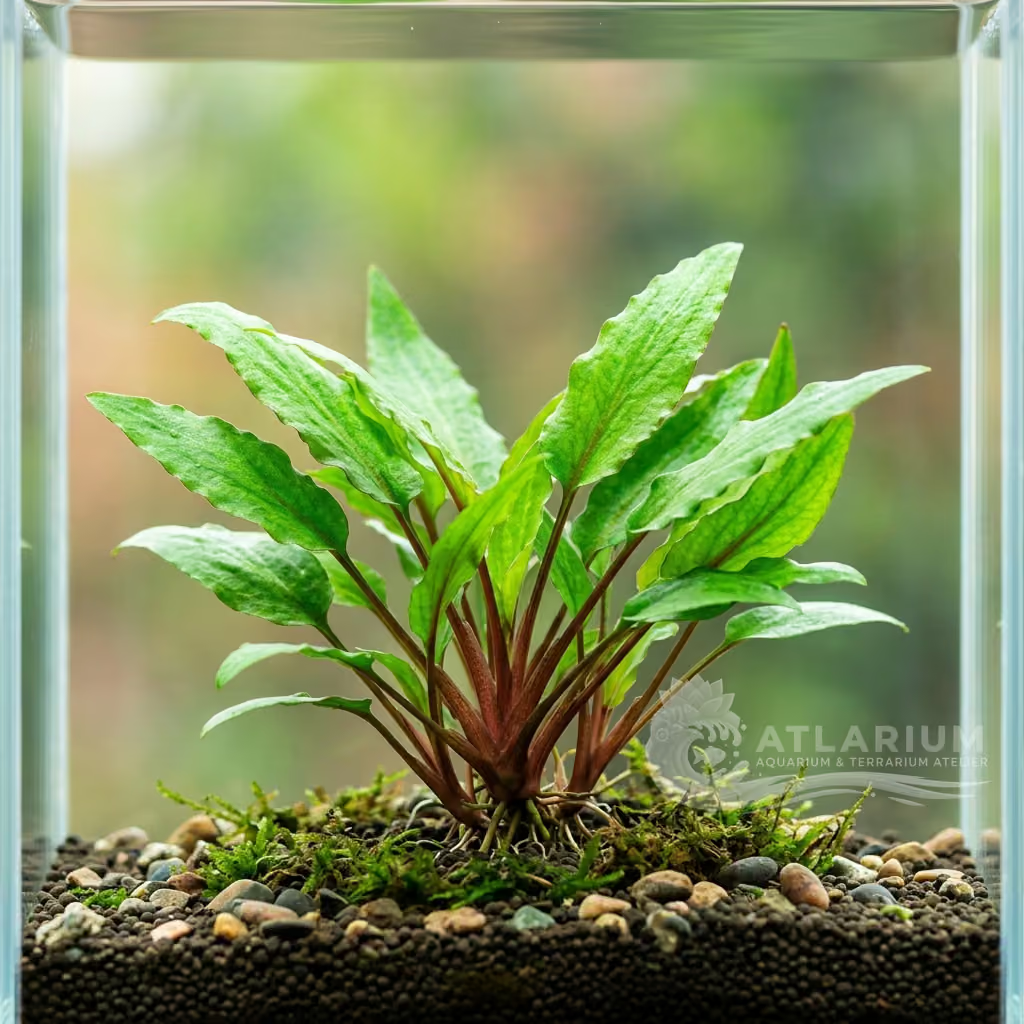
Color & Texture: The leaves of Anubias afzelii are distinctly narrow, elongated, and lanceolate (spear-shaped or sword-shaped), standing in stark contrast to the egg-shaped leaves of common Anubias. They are colored a deep, solid, completely opaque leathery emerald green. The texture of the plant is legendary: the leaves are notoriously rigid, thick, and feel almost exactly like hard plastic or thick cardboard. This extreme biological toughness makes the plant completely immune to being grazed upon or destroyed by even the most aggressive, herbivorous fish like large African Cichlids or massive Goldfish.

Cuidado, criação e companheiros de tanque
Lighting & CO2: Anubias afzelii is strictly an obligate low-light epiphyte and absolutely requires zero CO2 injection to thrive. Because its biological metabolism operates at a glacial, almost imperceptible pace, it physically cannot utilize high amounts of light energy. Exposing this colossal plant to intense, high-end RGB LED lighting or direct sunlight is the most common and fatal error an aquascaper can make. The slow-growing leaves will act as static solar panels, and within weeks, they will become completely smothered and permanently choked by aggressive Black Beard Algae (BBA) and Green Spot Algae (GSA). It must be kept deeply shaded.
Nutrition & Substrate: This plant is exclusively a water-column feeder. The single most critical rule in its care is that the massive, creeping rhizome MUST NOT be buried under gravel, sand, or aquasoil. If the rhizome is suffocated by substrate, it will rapidly rot, turn to mush, and the entire plant will melt away. It requires no substrate whatsoever to survive. Instead, it absorbs all of its required macro and micro nutrients directly through its massive leaves and exposed, free-floating root system via standard liquid fertilization dosed directly into the water column.
Water Chemistry: Anubias afzelii is an unkillable titan. It thrives in standard tropical temperatures (22-28°C) but can tolerate significantly cooler water. More importantly, it is completely indifferent to water chemistry parameters. It completely ignores wild fluctuations in pH, survives ammonia spikes, and thrives in extreme water hardness. It can live in soft, acidic blackwater setups just as easily as it lives in the hard, highly alkaline water of a Rift Lake Cichlid tank. It is the ultimate survivalist plant for beginners with unstable water.
Space Management & Placement: Despite being an epiphyte, its massive, towering height (often reaching 25-40 cm) dictates that it must be used as a dominant midground or background centerpiece. The massive rhizome must be aggressively attached—using cyanoacrylate superglue, heavy zip ties, or thick nylon thread—to a massive piece of driftwood or a heavy rock. It is not suitable for the foreground, as its towering spear-like leaves will completely block the view of anything behind it.
Pruning: Pruning is almost non-existent due to its incredibly slow growth rate. Propagation is the only real reason to prune the plant: simply use a pair of heavy, sharp pruning shears to cut the massive rhizome completely in half, ensuring both halves retain a healthy root system and leaves. For cosmetic maintenance, you should occasionally remove any ancient, yellowing, or heavily algae-choked leaves by cutting the thick stem as close to the main rhizome as physically possible.
Risks & Diseases: The plant suffers from virtually no biological diseases, melting, or nutritional deficiencies. Its extreme longevity and glacial growth rate make it the absolute perfect host for algae. Because a single leaf can live for several years, it will inevitably collect microscopic algae spores over time. If the aquarium has poor water quality, high organics, or too much light, the beautiful green leaves will be ruined by an unbreakable crust of algae. Strict shading and a clean tank are mandatory.

Origem e distribuição geográfica
Anubias afzelii is strictly endemic to the deeply shaded, humid tropical rainforests of West Africa, with primary populations found in Senegal, Guinea, Sierra Leone, and Mali. It is a highly specialized rheophyte, meaning it has evolved specifically to survive and thrive in fast-flowing, frequently flooded jungle rivers and streams. In its natural habitat, it does not root into soft mud; instead, it uses its immense, creeping rhizome to anchor itself violently to submerged boulders, rock crevices, and massive pieces of sunken driftwood. The dense canopy of the African jungle overhead ensures that it receives only highly diffused, dappled sunlight, a critical evolutionary trait that permanently adapted the species for extreme low-light environments.
Origem
África e Madagascar

Perfil da planta
- Posicionamento
- Fundo
- This species works exceptionally well in the midground or background of the aquarium, depending on the overall tank size. It should ideally be attached to hardscape materials such as driftwood or rocks using thread or aquarium-safe glue. If planted in the substrate, it is absolutely critical to keep the rhizome exposed above the soil to prevent it from rotting.
- Forma botânica
- Rizoma
- Anubias afzelii features elongated, lanceolate leaves that stand out in any planted aquarium. The leaves grow from a thick, creeping rhizome that anchors the plant to various surfaces. Its sturdy, leathery foliage is highly resilient, making it a great option for aquariums with herbivorous fish.
- Crescimento
- Very slow
- Like most Anubias species, Anubias afzelii exhibits a notably slow growth rate. You can expect it to produce only one or two new leaves per month under standard aquarium conditions. Providing slightly higher carbon dioxide levels and optimal fertilization can marginally speed up this process, but it remains a slow grower. This slow pace makes it an excellent choice for low-maintenance setups.
- Substrato
- Nenhuma
- Anubias afzelii is a robust epiphyte that naturally anchors itself to wood, rocks, or porous hardscape rather than requiring traditional substrate. Its thick, creeping rhizome must remain fully exposed to the water column to prevent rotting and ensure proper gas exchange. While the sturdy roots may eventually burrow into coarse gravel or sand for additional stability, the plant absorbs the majority of its nutrients directly from the water column. Providing a nutrient-rich water column rather than a specialized soil is ideal for its long-term health and steady growth.
- Fertilização de coluna
- Necessária
- Liquid fertilization in the water column is the primary and most effective method for feeding Anubias afzelii. A comprehensive liquid fertilizer applied weekly or bi-weekly will provide all the necessary trace elements and macronutrients. Since it is a slow grower, lean dosing is highly recommended to avoid excess nutrients accumulating in the water.
- Fertilização radicular
- Nenhuma
- Root tabs or nutrient-rich substrates are generally unnecessary for Anubias afzelii. Because it is an epiphyte that prefers to be attached to hardscape, its roots primarily serve an anchoring function rather than a nutrient-absorbing one. Even if planted in the substrate, the plant relies more heavily on water column fertilization than root feeding.
- Corte
- Ocasional
- Trimming is rarely required due to its very slow growth rate. When pruning is necessary, simply cut the leaves as close to the rhizome as possible using sharp aquascaping scissors. Always remove any yellowing, damaged, or algae-covered leaves to maintain the plant's aesthetic appeal and overall health.
- Propagação
- Rhizome division
- Propagating Anubias afzelii is a simple and straightforward process. You simply cut the main rhizome into two or more pieces, ensuring each new section has at least three to four healthy leaves attached. These new sections can then be tied or glued to new pieces of hardscape, where they will eventually develop into full plants.
- Sensibilidade
- LOW
- This plant is incredibly hardy and tolerates a wide range of water parameters and temperatures. However, its slow-growing, broad leaves are particularly susceptible to spot algae and black beard algae if light intensity is too high. It is recommended to place it in shaded areas of the aquarium to mitigate this risk.
- Função de layout
- Plano intermediário, Fundo, Epífita
- Its unique leaf shape makes it an excellent focal point or contrasting element in the midground. It is often used to bridge the gap between different aquascaping elements or provide shelter for small fish and shrimp. The rich green foliage provides a strong visual anchor and adds a sense of maturity to the aquascape.

Galeria de imagens
Imagens licenciadas vinculadas à espécie ou, quando marcadas, ao táxon representativo mais próximo.

Espécies relacionadas
Recomendações agrupadas por parentes próximos, escolhas de acompanhantes e cuidados semelhantes.