Shovelnose Catfish
Sorubim lima
Unmistakable 'Shovelnose Catfish'. Exhibits an elongated upper jaw, flat like a duck's bill, crossed by a broad and bold black band on a woody/silvery body.
Température de l’eau
23 - 30 °C
Valeur du pH
6 - 7.5
Type d'eau
Eau douce
Niveau dans le bac
Milieu
Taille adulte
45 cm
Volume minimal du bac
>= 400 L
Groupe minimal
>= 1
GH
2 - 15 dGH
KH
4 - 15 dKH
TDS
70 - 375 ppm
Conductivité
109 - 586 uS/cm

Description de l'espèce
Geographical Origin and Habitat: Very wide distribution in the entire South American continent (Magdalena River, Amazon, Orinoco, Paraná basin). A swamp predator that inhabits slow coasts and reed beds clogged with intertwined roots and overhanging vegetation.
Taxonomy and Morphology: Lima Shovelnose Catfish (Sorubim lima). Extraordinary predatory catfish. Very dorso-ventrally compressed "hydrodynamic" body shape with the particularity of the very long "shovel" snout equipped with very extensive and elegant barbels.
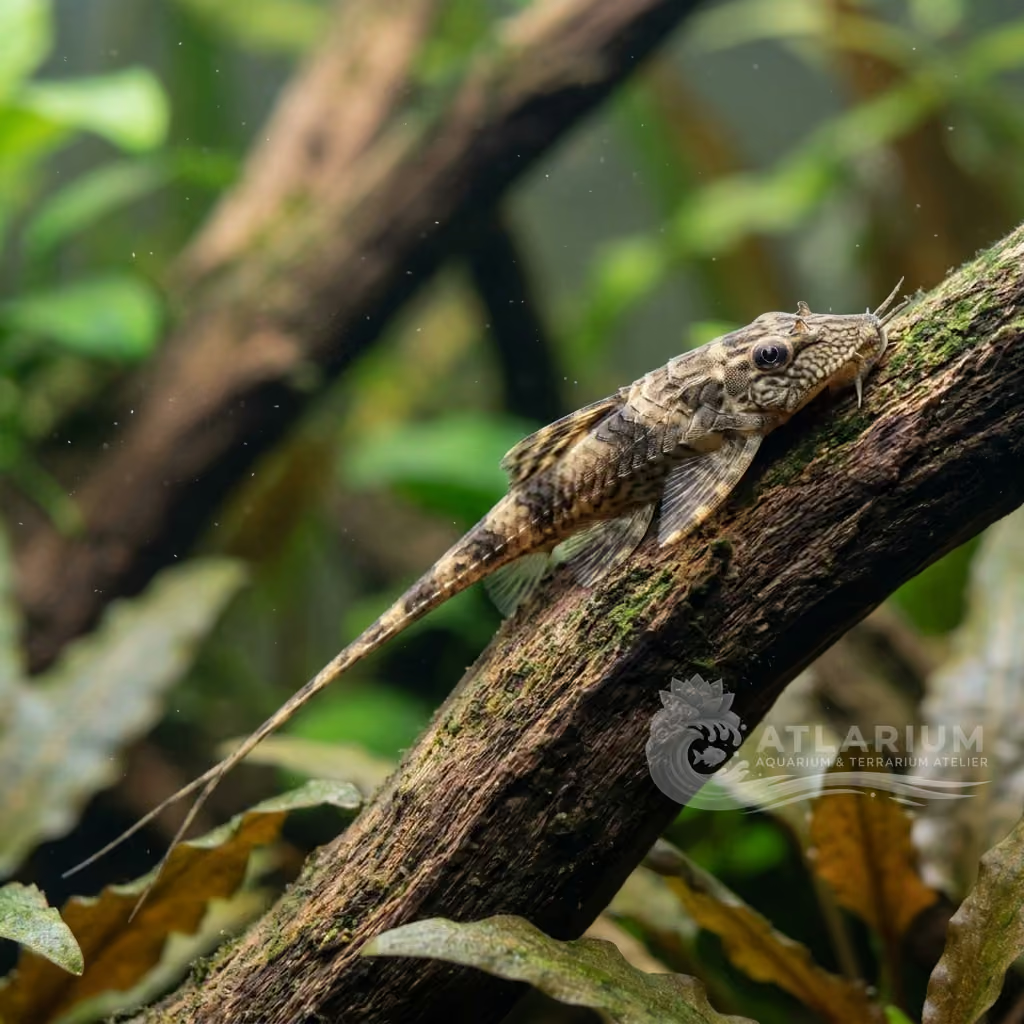
Social Behavior: Unlike almost all huge solitary predatory Pimelodids, the Sorubim lima is highly sociable in its youth: it loves to hang vertically (upside down) in large groups, camouflaging itself among the aerial roots of the woods.
Coloration and Sexual Dimorphism: The back is a fascinating gray/green or dark brown, divided by a very bright white lateral band surrounded by a thick lower black line ("tuxedo"). Adult males tend to be more slender than females.

Soins, reproduction et cohabitation
Aquarium Setup: Requires "Monster" aquariums starting from 180-200 cm (72-80 inches) in length. Essential to install numerous and large branched woods oriented upwards in which they can station vertically. Dimly lit tank with few furnishings that hinder swimming.
Diet and Feeding: Greedy piscivore. Will not hesitate to devour any fish that enters its large "spatula" mouth. Accustom it immediately to inert feed (otherwise it will demand live fish): squid steaks, perch fillet, and large spongy pellets. Feed 1-2 times a week as adults.
Water Quality: Due to the immoderate carnivorous diet, superlative mechanical filtration is needed, combined with heavy weekly water changes. Likes high temperatures and a preferably neutral pH.
Compatibility and Cohabitation: A calm companion for "Big Fish": rays (Potamotrygon), Oscars, large Severums, Arowanas and Datnioides of equal size. Any small or medium tetra (e.g. Neons, Cardinals, juvenile Angelfish) represents exclusively an expensive nocturnal meal.
Aquarium Breeding: Totally absent. They are potamodromous migratory fish that in nature swim for hundreds of kilometers along the river to reach the breeding sites in the flooded plains. Unfeasible in closed aquariums.
Risks and Diseases: Categorically avoid sharp obstacles or small narrow refuges in which, fleeing suddenly, it could irremediably amputate its majestic barbels, condemning it to fatal stress. Avert toxic ammonia spikes post-meal.

Origine et répartition géographiques
Very wide distribution in the entire South American continent (Magdalena River, Amazon, Orinoco, Paraná basin). A swamp predator that inhabits slow coasts and reed beds clogged with intertwined roots and overhanging vegetation.
Origine
Amazonie, Orénoque et GuyanesAsie de l'Est

Profil de poisson
- Tempérament
- Semi-aggressive
- They are peaceful giants towards appropriately sized tank mates but are ruthless predators to smaller fish. They can be somewhat skittish when young but become confident and bold as they grow. Providing vertical driftwood pieces allows them to exhibit their natural resting behavior.
- Régime alimentaire
- Carnivore
- They are carnivorous predators that naturally feed on smaller fish and crustaceans. In the aquarium, they can be trained to accept meaty foods such as earthworms, market shrimp, fish fillets, and large sinking pellets. Live feeder fish are not required and should be avoided due to disease risks.
- Espérance de vie
- 10-15 years
- Taille adulte
- 45 cm
- Ratio des sexes
- Solitary
- Sexing is nearly impossible without observing the fish internally. In a home aquarium, the sex ratio is generally irrelevant, and they can be kept singly or in small groups if the tank is large enough. They are mostly indifferent to conspecifics.
- Fréquence d'alimentation
- Twice daily
- Juveniles should be fed daily to support their rapid growth rate. Adult specimens only need to be fed a large meal 2 to 3 times per week. Overfeeding adults can lead to obesity and poor water conditions.
- Charge biologique
- High
- The Lima Shovelnose Catfish grows quite large and produces a heavy bioload. Because they consume substantial, protein-rich meals, their waste output is significant. A large aquarium with oversized, powerful filtration is absolutely necessary to maintain water quality.
- Courant
- Stagnant
- They enjoy moderate to strong water flow, replicating the riverine habitats of South America. Good circulation is important to keep oxygen levels high for these large active fish. Powerheads can be used to create an appropriate current.
- Risque de saut
- Yes
- They are strong swimmers with a moderate risk of jumping, especially if startled. A large fish hitting the lid with force requires a heavy, tightly secured cover. A heavy glass or heavily weighted lid is highly recommended to prevent escapes.
- Reproduction
- Oviparous
- Breeding the Lima Shovelnose in a home aquarium has not been documented. They are believed to be migratory spawners that require specific seasonal changes and massive volumes of water. Commercial breeding is achieved using hormone injections in large aquaculture facilities.
- Compatibilité et compagnons
- With caution
- They are peaceful towards fish that are too large to swallow, but highly predatory toward anything smaller. Good tank mates include large cichlids, pacus, large characins, and similarly sized catfish. Any fish small enough to fit in their deceptively large mouth will eventually be eaten, often at night.
- Niveau dans le bac
- Middle
- They are unusual for catfish in that they often spend time swimming or hovering in the middle and upper levels of the tank. They use a unique vertical "head-down" posture to camouflage themselves among vertical roots or plants. They will also rest on the substrate when inactive.

Modèles et paramètres scientifiques
FishBase
Fenêtre sur les données scientifiques officielles de l’espèce
FishBase v25.04Données synchronisées le : 15/06/2026
- Niveau trophique
- 4,1 ± 0,71 se
- Résilience
- Moyenne (1,4 - 4,4 ans)
- Temps de génération
- 4,1 ans
- Singularité phylogénétique (PD50)
- 0.5312
- Relation bayésienne longueur-poids
- a = 0.00468, b = 3.13
- VulnérabilitéVulnérabilité modérée (39 / 100)

Espèces associées
Recommandations regroupées par proches parents, compagnons et soins similaires.