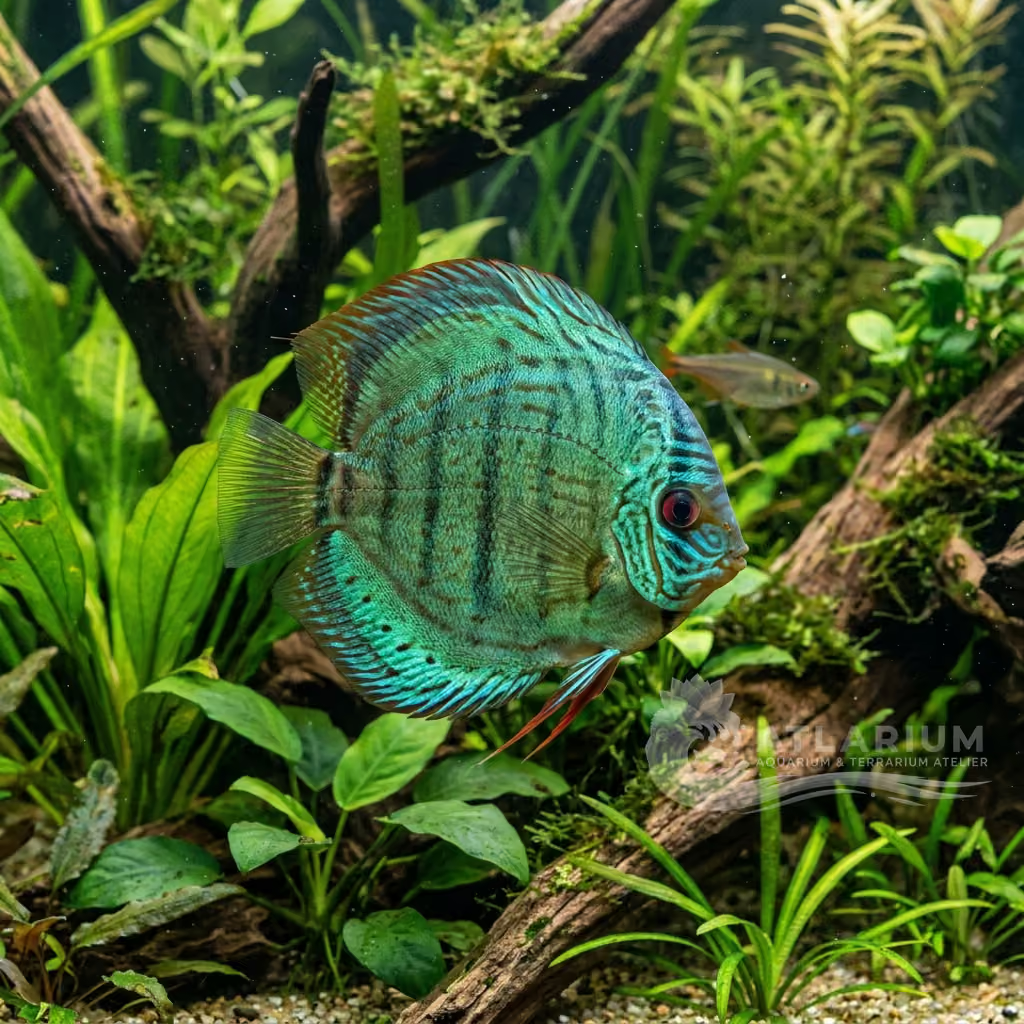
Partipentazona Barb
Puntigrus partipentazona
Often mistaken for the Tiger Barb, this peaceful schooling fish thrives in calm, darkly lit waters and easily succumbs to extreme aggression.
Température de l’eau
22 - 26 °C
Valeur du pH
5 - 6.5
Type d'eau
Eau douce
Niveau dans le bac
Milieu
Taille adulte
5 cm
Volume minimal du bac
>= 60 L
Groupe minimal
>= 1
GH
1 - 8 dGH
KH
1 - 4 dKH
TDS
25 - 160 ppm
Conductivité
39 - 250 uS/cm

Description de l'espèce
Geographical Origin and Habitat: Widely distributed in mainland Southeast Asia: Mekong and Chao Phraya river basins (Cambodia, Laos, Thailand, Vietnam). It is a typical inhabitant of slow-flowing waterways, oxbows, and lakes dominated by very turbid waters, dense marginal plant covers, and water lily carpets, rarely found in clear mountain waters.
Taxonomy and Morphology: Deep-bodied, compact, diamond-shaped Cyprinid. Commonly confused in the trade with the Tiger Barb (P. tetrazona), but the Partipentazona is distinguished by an irrefutable trait: it has 5 (rather than 4) vertical black bars, of which the central one is typically broken or present only as a distinct dark blotch on the base of the dorsal fin.
Social Behavior: The opposite of the quarrelsome Tiger Barb. The Partipentazona is a very shy, fearful, and extremely peaceful fish that rarely engages in conflict. Being strictly a schooling animal, a group of at least 8-10 individuals is the absolute minimum requirement; in smaller numbers they isolate themselves among vegetation refusing even to swim and feed.
Coloration and Sexual Dimorphism: The pale golden body is slashed by its glossy black vertical stripes. Dorsal and ventral fins feature intense blood-red spots. Healthy adult males show a pinkish salmon background coloration and are distinctly smaller and more slender than females, which appear pale, bulky, and with a very pronounced abdomen.

Soins, reproduction et cohabitation
Aquarium Setup: A dark Asian aquarium is the ideal setup. Prime requirement: abundance of hiding places created by dense thickets of Cryptocoryne, Hygrophila, and rocks tangled with wood. Intense light terrifies them; dim the lamps with floating plants (Salvinia, Phyllanthus fluitans). A dark sandy bottom helps enhance the pinkish pigmentation of males.
Diet and Feeding: Micropredator in the wild, scouring tiny crustaceans and diatoms from foliage and the muddy bottom. It is totally omnivorous in the aquarium: it voraciously accepts quality crumbled dry food, but to maintain its immune system at maximum levels and encourage spawning, it must be fed alternately with live or frozen (Daphnia, Brine shrimp, Bloodworms).
Water Quality: Prefers rather acidic and soft waters compared to the Tiger Barb. The optimal pH is between 5.0 and 6.5 (maximum 7.0), and hardness must not exceed GH 8.0. Comfortable temperature between 22.0 and 26.0 °C (72-79 °F). The insertion of Catappa leaves to release soothing tannins is highly recommended.
Compatibility and Cohabitation: It is not a fin-nipper! Its tiny mouth and shy character make it an ideal companion even for fish with flowing fins like Betta splendens. Excellent coexistence with small Loaches (Pangio), peaceful Rasboras (Trigonostigma, Boraras), and small Loricariids. Incompatible with large fish, predators, or aggressive cichlids.
Aquarium Breeding: Free spawner. After furious and incessant courtship displays, males drive females into the meanders of the thickest bushes (Java Moss) where they expel clusters of eggs. Parental cannibalism is systematic: once spawning is complete, parents meticulously patrol the area eating every egg in sight. Separate tank with a protective net on the bottom is necessary.
Risks and Diseases: The main risk is rapid immune drop due to "chronic social stress" in the case of sparse schools, bright tanks, or boisterous tankmates, leading to the instantaneous onset of Velvet (Oodinium) or Ich. They are also intolerant of high nitrate levels in the water.

Origine et répartition géographiques
Widely distributed in mainland Southeast Asia: Mekong and Chao Phraya river basins (Cambodia, Laos, Thailand, Vietnam). It is a typical inhabitant of slow-flowing waterways, oxbows, and lakes dominated by very turbid waters, dense marginal plant covers, and water lily carpets, rarely found in clear mountain waters.
Origine
Océans tropicaux et récifsAsie du Sud et du Sud-Est

Profil de poisson
- Tempérament
- Semi-aggressive
- They possess an active, bold, and highly engaging temperament. They interact playfully within their own species constantly. They bring a vibrant and dynamic energy to any aquascape.
- Régime alimentaire
- Omnivore
- They are straightforward omnivores that accept most commercial diets. Crushed flakes and small pellets are eagerly consumed daily. Frozen cyclops helps maintain their striking black and red coloration.
- Espérance de vie
- 3-5 years
- Taille adulte
- 5 cm
- Ratio des sexes
- School
- Maintain them in a sizable mixed-sex shoal of eight or more. Males display intensely vibrant colors when competing for female attention. Large groups ensure a visually spectacular and peaceful display.
- Fréquence d'alimentation
- Twice daily
- Feed them twice a day with very small portions. Their tiny stomachs cannot handle massive singular feedings. They constantly forage among plants between their main meals.
- Charge biologique
- Low
- This smaller barb creates a moderate, easily manageable bioload. A standard filtration system keeps their water perfectly clean. They benefit greatly from consistent, small water changes.
- Courant
- Stagnant
- They naturally inhabit sluggish streams and prefer moderate flow. Gentle currents encourage them to school tightly together beautifully. High turbulence makes them skittish and prone to hiding.
- Risque de saut
- Yes
- They present a moderate jump risk if the tank lacks cover. Keep a lid securely fastened to prevent accidental losses. Floating vegetation makes them feel significantly more secure.
- Reproduction
- Oviparous
- They are typical egg-scatterers that breed quite readily. Fine-leaved plants or spawning mops are necessary for egg attachment. They will ravenously eat their own eggs if left in the tank.
- Compatibilité et compagnons
- Peaceful
- They are slightly more peaceful than the standard Tiger Barb. They still require robust tankmates to prevent minor fin-nipping. A spacious community tank suits their active lifestyle well.
- Niveau dans le bac
- Middle
- They are predominantly mid-water dwellers in the aquarium. They actively swim back and forth across the open spaces. They use tall background plants to rest during the night.

Modèles et paramètres scientifiques
FishBase
Fenêtre sur les données scientifiques officielles de l’espèce
FishBase v25.04Données synchronisées le : 15/06/2026
- Niveau trophique
- 2,9 ± 0,34 se
- Résilience
- Élevée (moins de 15 mois)
- Singularité phylogénétique (PD50)
- 0.5312
- Relation bayésienne longueur-poids
- a = 0.00955, b = 2.96
- VulnérabilitéVulnérabilité faible (10 / 100)

Espèces associées
Recommandations regroupées par proches parents, compagnons et soins similaires.