Jerdon's Pitviper
Protobothrops jerdonii
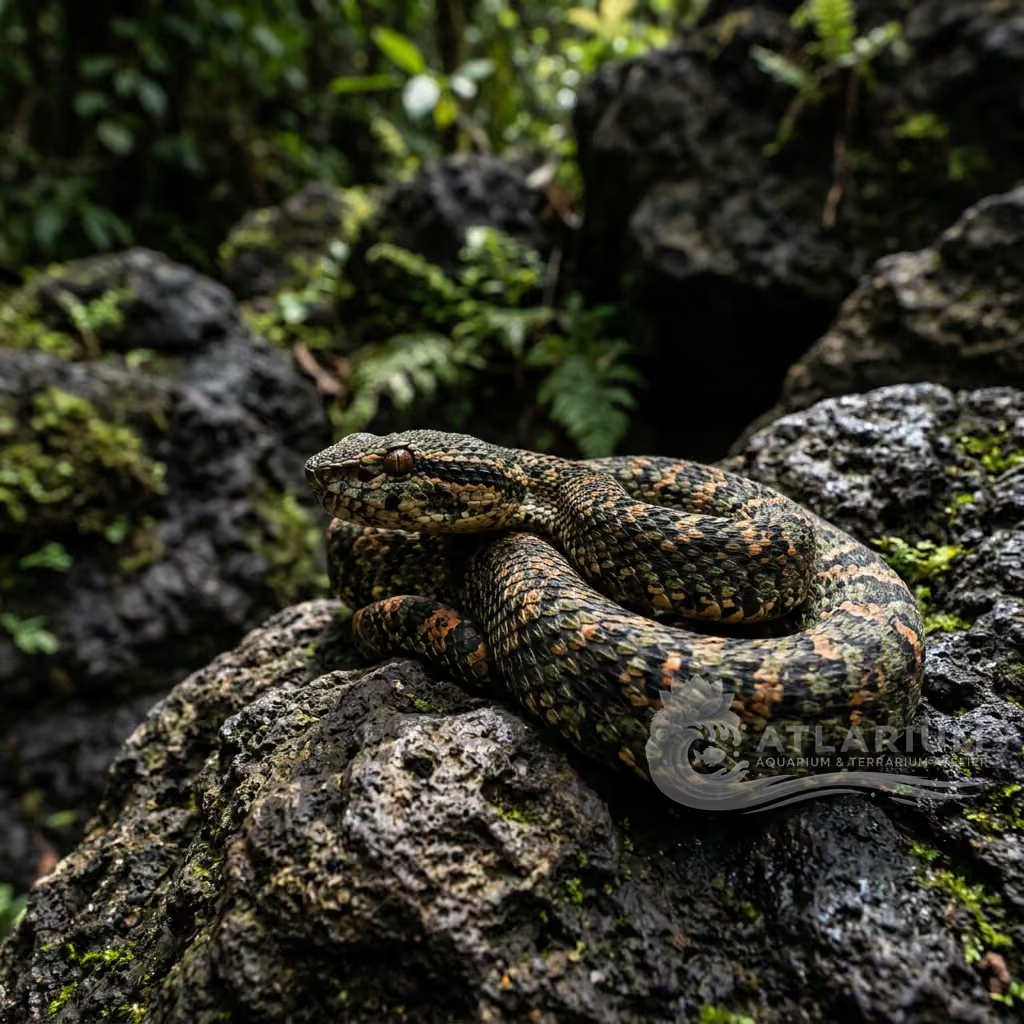
A venomous and visually striking Asian pit viper, deeply renowned for its contrasting yellow and black mosaic body pattern seamlessly blending into complex montane habitats.
Umgebung
Terrestrisch
Luftfeuchtigkeit
65 - 85 %
Tagestemperatur
16 - 26 °C
Umgebungstemperatur
16 - 26 °C
Nachttemperatur
18 - 20 °C
Sonnenplatz
26 °C
Erwachsenengröße
100 cm
Mindestgehäuse
>= 200 L

Artbeschreibung
Geographical Origin and Habitat: Protobothrops jerdonii is native to the mountainous regions of Southern and Eastern Asia, with populations widely distributed across southern China, northeastern India, northern Myanmar, Nepal, and northern Vietnam. It primarily inhabits cool, high-altitude montane forests, wooded river valleys, and rocky slopes at elevations ranging from 1,000 to 3,000 meters above sea level, where the climate is humid and temperate.
Taxonomy and Genetics: Belonging to the Viperidae family and the Crotalinae subfamily (pit vipers), it was scientifically named in honor of the naturalist Thomas Caverhill Jerdon. Three subspecies are recognized: P. j. jerdonii, P. j. bourreti, and P. j. xanthomelas, which vary in geographical range and yellow-color intensity. Its genetic adaptation is tailored to survive in cooler highlands.
Behavior and Habits: This species is nocturnal and crepuscular, exhibiting a secretive and ambush-based hunting strategy. It is semi-arboreal, spending daytime hours coiled in low branches, dense vegetation, or rock crevices. It uses its highly sensitive heat-sensing loreal pits to locate warm-blooded prey, such as small rodents and birds, in complete darkness.
Morphology: It features a slender yet strong body with a distinctly triangular head covered in small, fragmented scales, and vertical slit pupils. Adults typically reach a total length of 80 to 120 cm. The dorsal scales are strongly keeled, giving the snake a rough texture and a characteristic matte finish that prevents light reflection.

Pflege, Zucht und Mitbewohner
Terrarium Setup: A tall, well-ventilated enclosure is required, with minimum dimensions of 80x50x80 cm for an adult specimen. The setup must feature strong climbing branches, live or artificial broad-leaf plants to provide cover and visual barriers, and a moisture-retaining substrate such as a peat moss and coconut fiber mix.
Lighting and Heating: Being a high-altitude species, it is highly sensitive to heat. Maintain a temperature gradient of 20-22 °C on the cool side, and a basking spot of 25-26 °C. Nighttime temperatures should drop to 16-18 °C. Exposure to constant temperatures above 28 °C can be fatal. A low-output UVB light source is highly recommended.
Humidity and Hydration: Relative humidity must be kept high, between 75% and 85%, which is achieved by misting the terrarium once or twice daily. A large water bowl containing clean, fresh water must always be available at the bottom of the enclosure, though the snake will regularly drink droplets from leaves after misting.
Feeding and Supplementation: Feed appropriately sized mice once every 10 to 14 days for adults. Due to the cool enclosure temperatures, their metabolic rate is relatively slow, and overfeeding must be avoided to prevent regurgitation. Prey should always be offered using long feeding tongs to maintain a safe distance.
Compatibility: Because this is a highly venomous snake with medically significant venom, it must be housed individually. Co-housing with conspecifics is only appropriate for monitored breeding attempts conducted by experienced keepers, and they should never be housed with other reptile species.
Health and Common Diseases: Thermal stress due to elevated temperatures is the most critical threat, leading to rapid dehydration and respiratory issues. Suboptimal ventilation can cause skin infections and mouth rot (infectious stomatitis). Handling must be avoided unless strictly necessary, using snake hooks and secure shift boxes.

Geografische Herkunft und Verbreitung
Protobothrops jerdonii is native to the mountainous regions of Southern and Eastern Asia, with populations widely distributed across southern China, northeastern India, northern Myanmar, Nepal, and northern Vietnam. It primarily inhabits cool, high-altitude montane forests, wooded river valleys, and rocky slopes at elevations ranging from 1,000 to 3,000 meters above sea level, where the climate is humid and temperate.
Ursprung
Süd- und SüdostasienOstasien

Reptilienprofil
- Diät
- Carnivore
- Jerdon's pitviper thrives on a diet consisting primarily of small rodents, insectivores, and occasionally small birds. It is an opportunistic ambush predator that uses its highly camouflaged pattern to remain unseen among the rocks and leaf litter of its high-altitude habitat. The thermal sensors on its face guide its precision strikes against warm-blooded prey in the cool, mountainous air. Once bitten, the prey succumbs rapidly to the snake's powerful hemotoxic venom.
- Erwachsenengröße
- 100 cm
- Lebensstil/Mikrohabitat
- Terrestrial
- A terrestrial to semi-terrestrial snake, it typically dwells on the forest floor, utilizing leaf litter, root systems, and low-lying vegetation for camouflage and ambush hunting. While they may occasionally ascend low shrubs, their enclosure should prioritize maximum floor space with abundant terrestrial hideouts to foster a sense of security.
- Aktivitätszyklus
- Nocturnal
- This species is primarily nocturnal, remaining hidden during the daylight hours to avoid extreme heat and predators. As dusk approaches, the Protobothrops jerdonii becomes active, emerging from its diurnal retreat to forage and hunt. Enclosure lighting should reflect a natural day-night cycle, but the snake will exhibit its most natural active behaviors after the lights go out.
- Sozialität
- Solitary
- This pitviper is highly adapted to montane environments, often found near rocky streams, forest edges, and agricultural fields at significant elevations. It exhibits a blend of terrestrial and semi-arboreal habits, occasionally climbing low bushes to bask or hunt. It is typically reclusive and slow-moving, relying on its striking yellow and black patterning for disruptive camouflage. However, it is easily agitated and will fiercely stand its ground, striking repeatedly if provoked.
- Reproduktion
- Viviparous
- Unlike some of its congenerics, Jerdon's pitviper is live-bearing, an adaptation that helps it reproduce successfully in colder, high-elevation environments where eggs might not survive. Females gestate their embryos internally, basking frequently to regulate their body temperature and support fetal development. They give birth to small litters of independent, fully venomous neonates during the warmer months of the year. The young must immediately fend for themselves and hunt small frogs or lizards.
- Handhabungstoleranz
- Display only
- Due to its highly potent and medically significant venom, the Protobothrops jerdonii is strictly a display-only species. Under no circumstances should this snake be free-handled. All interactions, enclosure maintenance, and feeding must be performed using professional snake hooks, secure lockable terrariums, and strict safety protocols to prevent life-threatening envenomation.
- Brumation
- Nicht erforderlich
- To replicate its natural seasonal cycles, a winter brumation period is highly recommended, especially if breeding is desired. Temperatures should be gradually reduced to roughly 12-15°C (53-59°F) over several weeks, during which feeding is completely halted to prevent rotting of undigested food in the gut. This cooling period typically lasts 2 to 3 months.
- Häutung
- Regular
- Shedding cycles occur periodically as the snake grows. During the shedding phase, bumping the ambient humidity by lightly misting the enclosure and ensuring access to a large water bowl helps hydrate the skin. A healthy molt should peel off entirely in one piece; retained spectacles or skin patches indicate insufficient hydration.

Verwandte Arten
Empfehlungen gruppiert nach nahen Verwandten, Auswahl von Begleitern und ähnlicher Betreuung.