Yellow-tail Acei
Pseudotropheus sp. "acei"
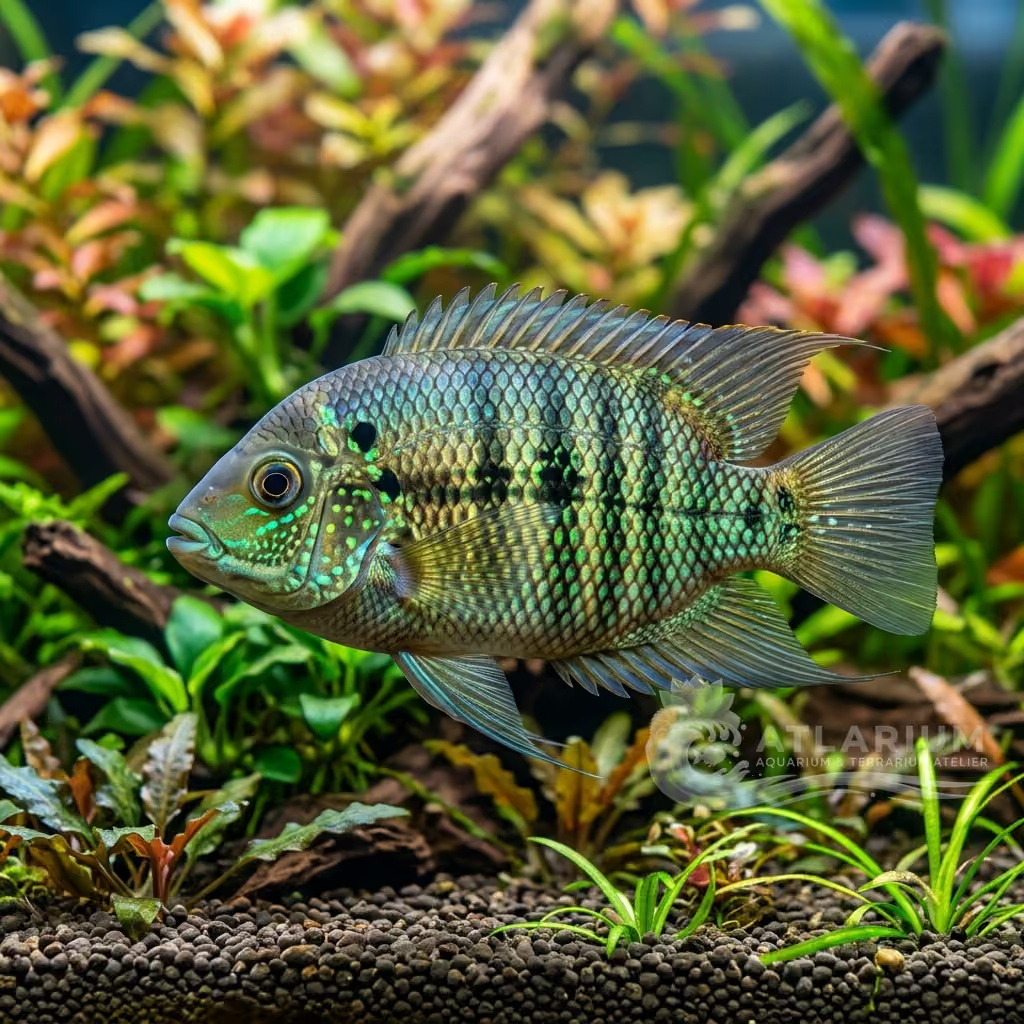
The 'Yellow-tail Acei' (15 cm). Totally atypical Malawi Mbuna: it is not confined to the rocks, but loves to swim freely in open schools and is famous for its exceptionally peaceful and tolerant character. Neon purple color with bright yellow fins.
Température de l’eau
24 - 28 °C
Valeur du pH
7.8 - 8.6
Type d'eau
Eau douce
Niveau dans le bac
Surface
Taille adulte
15 cm
Volume minimal du bac
>= 180 L
Groupe minimal
>= 1
GH
10 - 25 dGH
KH
5 - 12 dKH
TDS
200 - 495 ppm
Conductivité
313 - 773 uS/cm

Description de l'espèce
Geographical Origin and Habitat: Sandy coasts of Lake Malawi (popular variants come from Msuli or Luwala). Despite being an "Mbuna" (which literally means "rock-beater"), the Acei has colonized a different habitat: it stations in immense schools on expanses of sand around large trees fallen into the water or submerged forests of trunks, not among the sharp rocks of the cliff.
Taxonomy and Morphology: Classified in the Pseudotropheus group (although often reclassified in Gephyrochromis or Chindongo), it is a slender, tapered and very hydrodynamic cichlid, perfect for open and prolonged swimming. It has a mouth equipped with specialized teeth not to scratch stones, but to remove soft epiphytic algae from the bark of wet wood. It easily reaches 13-15 cm (5-6 inches), being one of the most massive but elegant Mbunas.
Social Behavior: The "Gentle" schooling Mbuna. Its behavior is a rarity: in nature it travels in gigantic peaceful gatherings of hundreds of individuals. Even in the aquarium it hates loneliness and is not a fanatic cave territorial. Rather, it will happily swim for hours back and forth along the front glass, in the upper half of the tank, in small dense and choreographic schools, completely ignoring the furious territorial struggles of the other cichlids in the rocks below.
Coloration and Sexual Dimorphism: A hypnotic chromatic contrast in motion. The "Msuli" strain (the most famous) presents a body entirely wrapped in a silky and compact NEON BLUE-PURPLE or metallic periwinkle, completed by the dorsal and caudal fins painted in a bright and clear phosphorescent SUN YELLOW. There is almost no sexual dimorphism visible to the naked eye: females and males share the same stunning colors, although alpha males are slightly larger and with more marked ocelli (fake eggs) on the anal fin.

Soins, reproduction et cohabitation
Aquarium Setup: Demands "Free swimming tracks and Woods" (Tank min. 120 cm / 48 inches long). Unlike the other Mbunas that require impenetrable stone walls, two scenic boulders are enough for the Acei, but it necessarily demands a clean bottom of fine sand, the insertion of some large fake branches or well-smoothed purged woods and above all the entire medium and high water column totally clear for the parades of the school. Does not uproot plants (anchored Vallisneria or Anubias are excellent).
Diet and Feeding: Omnivore / Specialist Herbivore (Epiphyte grazer). In nature it scrapes tender algae from submerged trunks. In the aquarium the diet MUST be predominantly plant-based (70% Spirulina, Kelp, sinking or soft green flakes and blanched zucchini). An excessive intake of animal proteins or blood binges will cause lethal and putrescent deadly intestinal occlusions (Bloat).
Water Quality: Rigorous Great Lakes water: extremely alkaline pH (7.8 - 8.6) and very high GH (10-25). Needs very pure water, super oxygenated by rippled surface movement pumps and with zero nitrates to maintain the exuberant liveliness of the school and the bright flashy happy colors.
Compatibility and Cohabitation: Aquarium model: "Malawi Haven of Peace". Obligatory to keep it in large groups (minimum 5-6 specimens, ideal 8) to make it thrive. It is the perfect "Dither Fish" (reassuring fish) for Malawi. Can peacefully coexist both with placid Haps (Placidochromis, Aulonocara) and to dampen aggressiveness and fill the upper floor of tanks dominated by less bellicose Mbuna (Labidochromis caeruleus, Iodotropheus sprengerae). Absolutely unadvisable to pair it with fierce psychopathic territorial smashers (Melanochromis auratus, Pseudotropheus lombardoi).
Aquarium Breeding: Furious and prolific maternal oral incubation (Maternal Mouthbrooder Polygamous). Once reached estrus, the male temporarily detaches from the school, digs a slight pit near a branch and invites the female with the classic trembling "T" dance. The female prodigiously incubates dozens of eggs in her mouth for 3 or 4 weeks of iron asphyxiating fasting. Once spat out, the swarming and compact young will already form a fascinating lively bluish gray micro-school, self-sufficient and very voracious.
Risks and Diseases: Excellent hardiness, but lethality deriving from the deadly ascitic dropsy "Malawi Bloat" (occlusive and asphyxiating swelling) induced solely by dietary ignorance or diets for American cichlids with a high rate of fleshy adipose animal protein, which irreversibly and sadistically clogs their long and delicate rotting intestines. Acute loneliness wasting stress if kept as a single solitary exiled specimen, refusing anti-social terrified faded treatments.

Origine et répartition géographiques
Sandy coasts of Lake Malawi (popular variants come from Msuli or Luwala). Despite being an "Mbuna" (which literally means "rock-beater"), the Acei has colonized a different habitat: it stations in immense schools on expanses of sand around large trees fallen into the water or submerged forests of trunks, not among the sharp rocks of the cliff.
Origine
Afrique et Madagascar

Profil de poisson
- Tempérament
- Semi-aggressive
- Mbuna are notoriously aggressive, territorial, and hyperactive. They will fiercely defend their chosen rocky caves. Carefully planned rockwork and controlled overstocking help mitigate extreme violence.
- Régime alimentaire
- Omnivore
- They are primarily herbivores that graze on algae (aufwuchs). Their diet must be high in spirulina and vegetable matter. High-protein meaty foods will cause fatal digestive issues like Malawi bloat.
- Espérance de vie
- 8-10 years
- Taille adulte
- 15 cm
- Ratio des sexes
- Harem
- Keep one male with at least three or four females. Males are relentlessly aggressive towards females during courtship. Harem setups distribute this aggression effectively.
- Fréquence d'alimentation
- Twice daily
- Feed them small amounts once or twice a day. They are greedy eaters and will consume whatever is offered. Fasting them one day a week helps prevent digestive blockages.
- Charge biologique
- Medium
- Mbuna cichlids produce a relatively high bioload. They are typically kept in overstocked conditions to manage aggression. Heavy biological and mechanical filtration is absolutely critical.
- Courant
- Stagnant
- They enjoy moderate to high water flow. Brisk currents help keep the tank clean and mimic their rocky lake habitats. Good surface agitation is necessary for high oxygenation.
- Risque de saut
- Yes
- They carry a moderate jump risk, especially when fleeing from dominant tank mates. A secure, tight-fitting lid is essential. The heavy rockwork can also sometimes spook them to the surface.
- Reproduction
- Oviparous
- They are prolific maternal mouthbrooders. Females carry eggs and fry in their mouths for several weeks. Providing plenty of rocky caves ensures fry survival.
- Compatibilité et compagnons
- Community
- They are highly aggressive and territorial. They must only be kept with other similarly aggressive African Rift Lake cichlids. Avoid peaceful community fish at all costs.
- Niveau dans le bac
- Top
- They primarily inhabit the lower and middle regions. They spend their time actively darting in and out of complex rock formations. They rarely swim openly at the very top of the tank.

Espèces associées
Recommandations regroupées par proches parents, compagnons et soins similaires.