Green Scat
Scatophagus argus
A disc-shaped, voracious omnivorous scavenger decorated with spots, requiring full marine conditions as an adult and highly spacious tanks.
Température de l’eau
22 - 28 °C
Valeur du pH
7.5 - 8.5
Type d'eau
Eau douce
Niveau dans le bac
Milieu
Taille adulte
30 cm
Volume minimal du bac
>= 300 L
Groupe minimal
>= 1
GH
15 - 30 dGH
KH
7 - 15 dKH
TDS
295 - 600 ppm
Conductivité
461 - 938 uS/cm

Description de l'espèce
Geographical Origin and Habitat: Indo-Pacific (Kuwait, Japan, Fiji). Estuary par excellence. Lives in dense mangrove forests, polluted ports, muddy river mouths and currently swims up into freshwater sections.
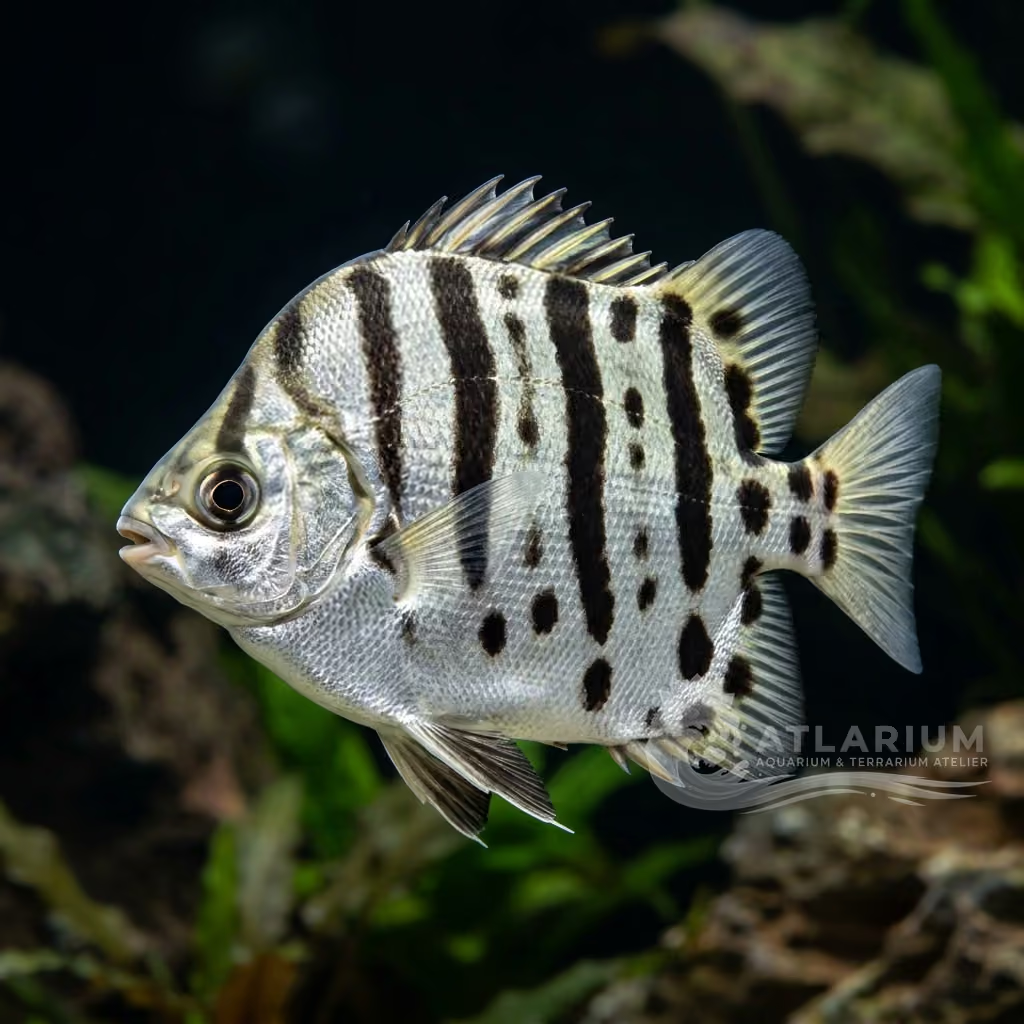
Taxonomy and Morphology: Spotted Scat (Scatophagus argus). Scatophagid. Compressed and tall disc body (almost square), with a very small head compared to its size. The first rays of the thick dorsal fin are robust (and slightly venomous) spines.
Social Behavior: Demolition squad. Very sociable and schooling fish, swims constantly up and down the glass waiting for food. Extremely active, curious and fearless; explores every element of the tank with its mouth.
Coloration and Sexual Dimorphism: The "Leopard" (Argus). Silvery, bronze or bright olive green background, densely covered (especially in youth) with large black circular spots (polka dots). As an adult (at 30 cm / 12 inches) the spots fade and merge, making it a dark bronze color. There is a variant with a reddish head (Red Scat).

Soins, reproduction et cohabitation
Aquarium Setup: Huge Brackish Tank (Minimum 150 cm / 60 inches). Freshwater tolerated only by juveniles. Plants forbidden (they eat all of them except Java fern and fake ones). Layout with large intertwined trunks (mangroves) and solid rocks. A lot of empty space for swimming is needed.
Diet and Feeding: The Everything-Grinder Omnivore. Its Latin name literally means "Feces eater" (because it sweeps port drains). Devours algae, salad, peas, floating pellets, minced fish, shrimp. Greatly appreciates filamentous algae.
Water Quality: Saline Transition. Juveniles in stores are kept in freshwater (high GH, alkaline). As they grow (beyond 10 cm / 4 inches), they MUST be brought to heavy brackish water (Specific Gravity 1.010 - 1.015) up to pure marine water, otherwise they will waste away irremediably.
Compatibility and Cohabitation: Brackish Community. The perfect companion for estuary fish: Monodactylus (Argenteus and Sebae), Toxotes (Archerfish), and Brackish Pufferfish (Tetraodon biocellatus). Devours any small fish or crustacean.
Aquarium Breeding: Never documented in private closed systems. They require migration from the estuary (where they grow) to the open sea (where they lay pelagic eggs), and vice versa for the larvae. Space and chemical variations impossible to replicate.
Risks and Diseases: Freshwater Syndrome. Many buy them as "freshwater fish". After a year in water without marine salt, their immune defenses collapse: the fish becomes, develops white clouds on its eyes (Eye Cloud), stops eating and dies from hepatic-osmotic block.

Origine et répartition géographiques
Indo-Pacific (Kuwait, Japan, Fiji). Estuary par excellence. Lives in dense mangrove forests, polluted ports, muddy river mouths and currently swims up into freshwater sections.
Origine
Océans tropicaux et récifsAsie de l'Est

Profil de poisson
- Tempérament
- Semi-aggressive
- They are active, bold, and somewhat boisterous. They are not afraid of the aquarist and quickly learn to beg for food. Venomous spines on their dorsal fin warrant extreme caution during maintenance.
- Régime alimentaire
- Omnivore
- They are enthusiastic omnivores with a strong preference for vegetable matter. They will quickly eat all aquarium plants. Feed them a base of spirulina pellets, blanched vegetables, and occasional meaty foods.
- Espérance de vie
- 10-15 years
- Taille adulte
- 30 cm
- Ratio des sexes
- Solitary
- They should be kept in groups of 4 or more to spread out aggression. Solitary individuals can become overly aggressive to other tankmates. The sex ratio is not critical as long as the group is large.
- Fréquence d'alimentation
- Twice daily
- Feed them 2 to 3 times a day. They have voracious appetites and will constantly beg for food. Ensure a large portion of their diet consists of greens.
- Charge biologique
- Extreme
- This fish grows very large and produces a massive bioload. Extremely powerful filtration is mandatory to keep the water safe. They are very messy eaters that require large, regular water changes.
- Courant
- Stagnant
- They prefer strong water movement and high oxygenation. Simulating estuarine currents with powerheads is highly beneficial. They are strong swimmers that enjoy swimming against the flow.
- Risque de saut
- Yes
- They are robust fish with a moderate jump risk. A heavy, tightly fitting lid is strictly required. They can easily knock off flimsy tank covers.
- Reproduction
- Oviparous
- Breeding has never been accomplished in home aquariums. They require complex transitions between fresh, brackish, and full marine water to spawn. Their larval stages are completely unknown in captivity.
- Compatibilité et compagnons
- Peaceful
- They are semi-aggressive and can nip the fins of slower fish. They are best kept in brackish communities with Monos and Archerfish. They will quickly devour any fish small enough to fit in their mouth.
- Niveau dans le bac
- Middle
- They utilize all levels of the aquarium. They are constantly on the move, patrolling the entire tank. A very large footprint is required for their swimming space.

Modèles et paramètres scientifiques
FishBase
Fenêtre sur les données scientifiques officielles de l’espèce
FishBase v25.04Données synchronisées le : 15/06/2026
- Niveau trophique
- 3 ± 0,35 se
- Résilience
- Élevée (moins de 15 mois)
- Temps de génération
- 0,9 ans
- Singularité phylogénétique (PD50)
- 0.8125
- Relation bayésienne longueur-poids
- a = 0.03236, b = 2.92
- VulnérabilitéVulnérabilité faible (20 / 100)

Espèces associées
Recommandations regroupées par proches parents, compagnons et soins similaires.