Pretty tetra
Holopristis pulchra
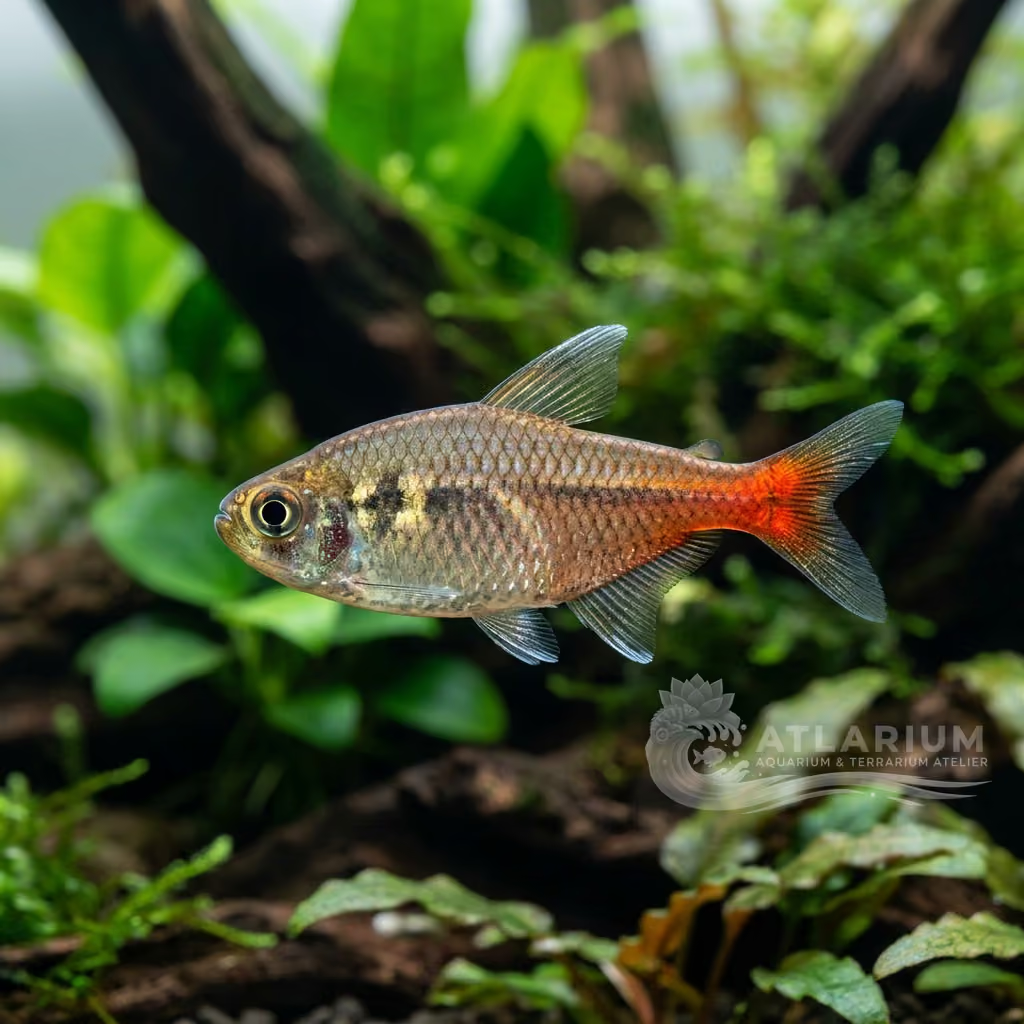
Small, highly ornamental South American characin, famous for the brilliant golden-copper patch at the base of its tail and peaceful nature. A jewel for any blackwater aquarium.
Température de l’eau
23 - 27 °C
Valeur du pH
5 - 7
Type d'eau
Eau douce
Niveau dans le bac
Milieu
Taille adulte
4,5 cm
Volume minimal du bac
>= 60 L
Groupe minimal
>= 6
GH
3 - 12 dGH
KH
2 - 8 dKH
TDS
65 - 260 ppm
Conductivité
102 - 406 uS/cm

Description de l'espèce
Geographical Origin and Habitat: Holopristis pulchra is native to the upper Amazon basin, widely distributed across Peru, Colombia, and western Brazil. It primarily inhabits slow-flowing tributaries, forest streams, and flooded areas characterized by soft, acidic blackwaters rich in tannins from decaying vegetation.
Taxonomy and Morphology: It belongs to the family Characidae. It features a laterally compressed, relatively deep body compared to other Hemigrammus species, complete with a small adipose fin. Adults typically reach a maximum length of 4 to 5 cm.
Social Behavior: A peaceful and somewhat shy schooling fish. It must be kept in groups of at least 6-8 individuals to encourage natural shoaling behavior and minimize shyness. When kept in smaller numbers, they become stressed and remain hidden.
Coloration and Sexual Dimorphism: Features a silvery body with green and copper reflections. The standout feature is a bright golden-orange iridescent patch at the upper base of the caudal peduncle, bordered by a black wedge below it. Sexual dimorphism is subtle: mature females are slightly larger and rounder.

Soins, reproduction et cohabitation
Aquarium Setup: Requires an aquarium of at least 60-80 liters, densely planted along the sides and back, leaving the center open for swimming. Dark substrate, driftwood roots, and dried leaves (like Catappa or beech) on the bottom are highly recommended to replicate natural blackwater conditions.
Diet and Feeding: An opportunistic omnivore. In captivity, it readily accepts high-quality dry flakes or micro-pellets. Its diet should be supplemented with live or frozen foods such as daphnia, brine shrimp, and bloodworms to maintain vibrant colors and vitality.
Water Quality: Prefers soft, acidic water conditions. Ideal parameters are pH 5.5 to 7.0, water hardness dGH below 10, and a stable temperature between 23°C and 27°C. Filtration should be efficient but gentle, avoiding strong currents that might exhaust the fish.
Compatibility and Cohabitation: Excellent for Amazonian community tanks. It coexists peacefully with other small tetras, pencilfish, dwarf cichlids (like Apistogramma), and peaceful bottom dwellers like Corydoras. Avoid housing with large, predatory tankmates.
Aquarium Breeding: Spawning is possible but requires a separate breeding tank with very soft (dGH 1-2), acidic (pH 5.5-6.0) water under dim lighting. Eggs are scattered among fine-leaved plants. Parents must be removed immediately after spawning to protect the eggs.
Risks and Diseases: Susceptible to common freshwater diseases such as ich (white spot disease) and fungal infections if water parameters fluctuate rapidly or if tank hygiene is neglected. Regular, small water changes are essential to prevent health declines.

Origine et répartition géographiques
Holopristis pulchra is native to the upper Amazon basin, widely distributed across Peru, Colombia, and western Brazil. It primarily inhabits slow-flowing tributaries, forest streams, and flooded areas characterized by soft, acidic blackwaters rich in tannins from decaying vegetation.
Origine
Cosmopolite ou introduitAmazonie, Orénoque et GuyanesOcéans tropicaux et récifs

Profil de poisson
- Tempérament
- Aggressive
- They are peaceful, somewhat shy schooling fish that must be kept in groups of at least six. Larger schools encourage them to be more outgoing and display their interesting group dynamics. They interact peacefully with other species and do not nip fins or harass tank mates.
- Régime alimentaire
- Omnivore
- As adaptable omnivores, their natural diet consists of small invertebrates, crustaceans, and plant matter. In the home aquarium, they will readily consume standard dried flakes and pellets. For the best health and breeding conditioning, live or frozen foods like brine shrimp and bloodworms should be fed multiple times a week.
- Espérance de vie
- 3-5 years
- Taille adulte
- 4.5 cm
- Ratio des sexes
- Solitary
- A mixed group of males and females works perfectly, as they do not form pairs or display significant aggression. Keeping a higher number of females to males can help spread out male breeding attention. A larger school size generally masks any gender-based behavioral issues.
- Fréquence d'alimentation
- Twice daily
- Feeding them small, manageable portions twice a day is recommended for proper digestion. They are enthusiastic eaters, so caution must be taken to prevent overfeeding. Any food that remains uneaten after a couple of minutes should be removed to maintain water quality.
- Charge biologique
- Low
- The Garnet Tetra is a small species with a correspondingly low bioload impact on the aquarium. While a school adds to the overall waste production, a standard appropriately sized filter handles them easily. Consistent partial water changes keep their environment optimal and their beautiful colors vivid.
- Courant
- Moderate
- They naturally inhabit sluggish waters, oxbows, and slow-moving tributaries in the Amazon basin. Consequently, they strongly prefer a gentle water flow over strong, turbulent currents. Driftwood and broad-leaved plants can be used to create calm resting areas within the tank.
- Risque de saut
- Yes
- Like many closely related tetras, they have a moderate risk of jumping out of open-top aquariums. A secure lid is necessary to keep them safe, especially when initially introduced or during aquarium maintenance. Floating vegetation provides overhead cover, which significantly reduces their skittish jumping behavior.
- Reproduction
- Oviparous
- They are typical egg-scattering tetras that provide no parental care. Breeding is best achieved in a dedicated setup with very soft, acidic water and fine-leaved plants like Cabomba. The parents are notorious egg eaters and must be separated from the eggs as soon as spawning is complete.
- Compatibilité et compagnons
- Peaceful
- They are ideal residents for peaceful community aquariums containing other small South American species. Good companions include dwarf cichlids, Corydoras, hatchetfish, and peaceful characins. They are defenseless against large or aggressive species, which should be strictly avoided as tank mates.
- Niveau dans le bac
- Middle
- These tetras primarily occupy the middle and lower-middle sections of the aquarium. They enjoy hovering near plant thickets and driftwood structures where they feel protected. They will quickly rise to the mid-upper levels during feeding time but generally avoid the extreme surface.

Modèles et paramètres scientifiques
FishBase
Fenêtre sur les données scientifiques officielles de l’espèce
FishBase v25.04Données synchronisées le : 15/06/2026
- Niveau trophique
- 2,8 ± 0,31 se
- Résilience
- Élevée (moins de 15 mois)
- Singularité phylogénétique (PD50)
- 0.502
- Relation bayésienne longueur-poids
- a = 0.01738, b = 3.05
- VulnérabilitéVulnérabilité faible (10 / 100)

Espèces associées
Recommandations regroupées par proches parents, compagnons et soins similaires.