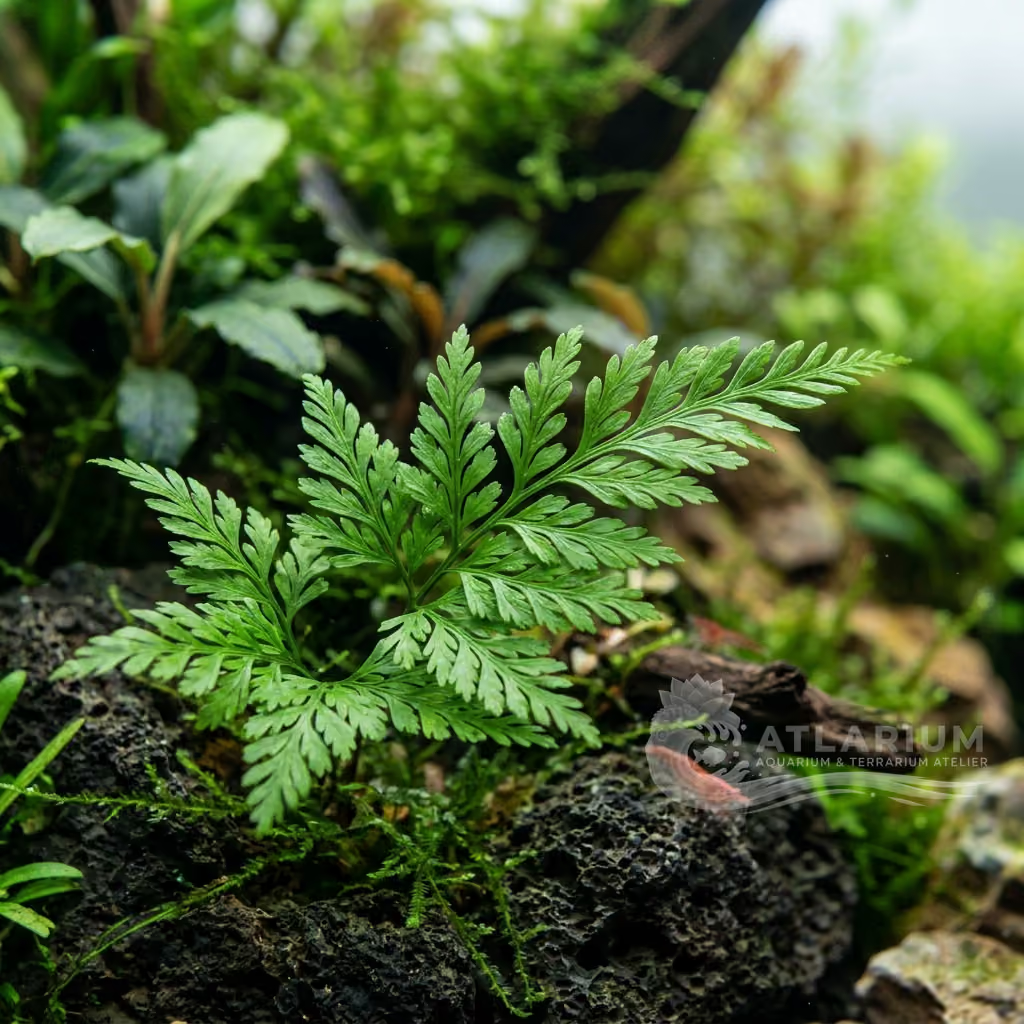
Java Fern 'Windelov'
Microsorum pteropus 'Windelov'
A distinctive lacy cultivar of the Java Fern named after Tropica's founder, Holger Windeløv. It features finely branched, curly leaf tips resembling staghorns. Requires hardscape attachment (wood or rock) and shade.
Wassertemperatur
18 - 30 °C
pH-Wert
5 - 8
Wassertyp
Süßwasser
Licht
Bassa
CO2
Bassa
Erwartete Höhe
20 cm
Erwartete Breite
20 cm
GH
4 - 20 dGH
KH
2 - 15 dKH

Artbeschreibung
Geographical Origin and Habitat: Microsorum pteropus 'Windelov' is an artificially cultivated variety developed in the laboratories of Tropica in Denmark, based on the nominal species native to Southeast Asia. It does not exist in the wild as a wild cultivar, but is derived from rheophilic tropical forest strains.
Taxonomy & Genetics: Belonging to the Polypodiaceae family, it is named after the founder of Tropica, Holger Windeløv. It is a patented and commercially registered cultivar. Genetically, it is stable and maintains its typical branched leaf tips across successive generations.
Physical Structure: It features a creeping horizontal rhizome structure, identical to that of the parent species. The leaves grow erect and exhibit a characteristic dichotomous branching at their upper extremities, with finely dissected and lacy tips.
Color & Texture: The leaves are medium to dark glossy green. The leaf texture is finely structured at the tips, creating an airy and curly appearance, resembling staghorns, which gives the plant a dense and three-dimensional texture.

Pflege, Zucht und Mitbewohner
Lighting & CO2: Requires low to moderate light levels. It adapts very well to partial shade, whereas direct high light can burn the lacy fronds. It does not require CO2, but benefits from low-level supplementation.
Nutrition & Substrate: Being an epiphytic plant, the rhizome must never be buried in the substrate to prevent rot. It should be tied or glued to hardscape elements. It requires a regular supply of potassium and microelements dissolved in the water.
Water Chemistry: Thrives in temperatures between 18 and 30°C (64-86°F), with an optimal pH range of 5.0 to 8.0. Tolerant of both soft, acidic water and moderately hard, alkaline water.
Space Management & Placement: Placed in the midground anchored to driftwood or rocks. It is ideal for hiding joints or technical equipment. The curly tips tend to collect debris if placed in areas with poor water circulation.
Pruning: Pruning is done by removing old or damaged leaves, cutting the petiole close to the rhizome. It propagates by dividing the rhizome or harvesting adventitious plantlets that form on the leaf tips.
Risks & Diseases: Rhizome rot due to burial is the main danger. The lacy tips can accumulate organic debris, promoting the growth of Black Beard Algae (BBA) if filtration is not optimal.

Geografische Herkunft und Verbreitung
Microsorum pteropus 'Windelov' is an artificially cultivated variety developed in the laboratories of Tropica in Denmark, based on the nominal species native to Southeast Asia. It does not exist in the wild as a wild cultivar, but is derived from rheophilic tropical forest strains.
Ursprung
Süd- und SüdostasienSelektive Züchtung und Sorten

Pflanzenprofil
- Platzierung
- Mittelgrund
- Must be attached to hardscape such as driftwood or rocks rather than planted in the substrate. Its compact size and unique leaf tips make it an excellent choice for the midground. The rhizome should be placed in an area with good water flow and left exposed.
- Botanische Form
- Rhizom
- Famous for its uniquely branched, finely split leaf tips that look like delicate lace or small antlers. The plant remains relatively small, usually maxing out at about 15-20 cm in height. It features a sturdy rhizome and bright green, leathery foliage.
- Wachstum
- Very slow
- Has a very slow growth rate, maintaining its dense and compact form for long periods. It is highly manageable and requires very little intervention from the aquarist. It will slowly expand its rhizome to cover the surface it is attached to.
- Substrat
- Keiner
- Microsorum pteropus 'Windelov' is famously adaptable to almost any hardscape, largely because it does not require, nor tolerate, planting in a substrate. Burying the rhizome deprives it of oxygen, leading to rapid decay. It is best attached to rocks, driftwood, or even artificial decorations with thread or glue, where its tenacious root system can securely latch on and draw nutrients from the surrounding water.
- Säulendüngung
- Erforderlich
- Draws all its necessary nutrients directly from the water column. A comprehensive liquid fertilizer applied weekly will ensure optimal health and prevent the leaves from yellowing. Good water circulation is key to delivering these nutrients to the dense foliage.
- Wurzeldüngung
- Keine
- Does not benefit from nutrient-rich substrates or root tabs. The roots function solely as anchors and will rot if buried in gravel or soil. Focus all fertilization efforts on liquid dosing.
- Trimmen
- Gelegentlich
- Trimming is infrequent and simple; cut any old, dying, or heavily algae-covered leaves at the base. This improves the overall appearance and allows light to reach the newer growth. Never trim the lacy tips of the leaves, as they will turn brown and die.
- Ausbreitung
- Rhizome division
- Easily propagated by cutting the horizontal rhizome into smaller pieces with a few leaves attached. It also frequently produces tiny plantlets on the finely split tips of mature leaves. These can be removed and tied to new hardscape once they have developed small roots.
- Empfindlichkeit
- Mäßig
- An incredibly hardy plant that withstands a wide variety of water conditions and is rarely eaten by herbivorous fish. It is, however, very prone to rotting if the rhizome is buried. It can sometimes attract hair algae on its finely split tips if nutrients are imbalanced.
- Layoutrolle
- Aufsitzerpflanze, Mittelgrund, accent, group
- Serves as a perfect midground accent, adding a highly intricate, lacy texture to the aquascape. It is small enough to be used in nano aquariums but detailed enough to stand out in large tanks. It looks especially stunning when attached to the branching arms of spider wood.

Verwandte Arten
Empfehlungen gruppiert nach nahen Verwandten, Auswahl von Begleitern und ähnlicher Betreuung.