Limnobium spongia
Hydrocharis spongia
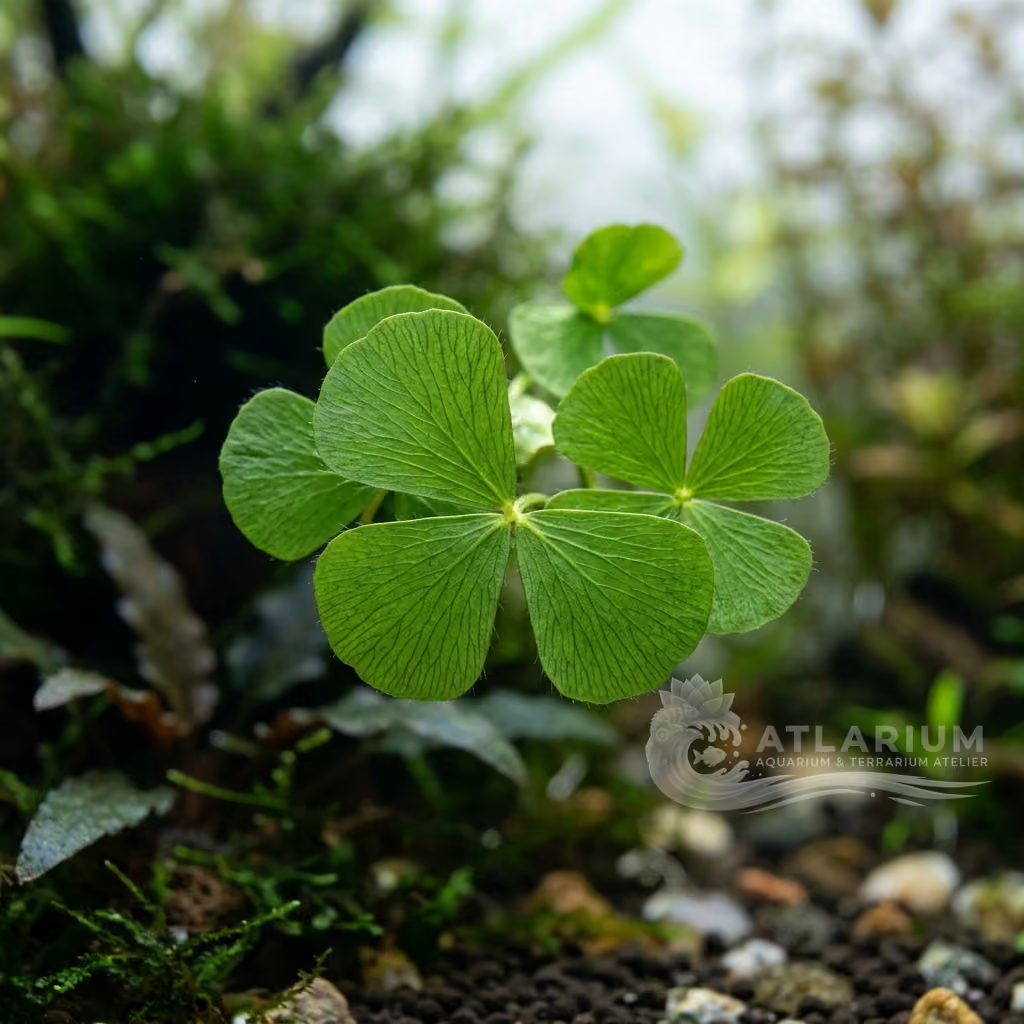
American Frogbit is a floating plant known for the unique spongy tissue under its leaves. It rapidly multiplies in warm, nutrient-rich water, providing shade and shelter for aquatic life.
Wassertemperatur
4 - 27 °C
pH-Wert
5 - 8
Wassertyp
Süßwasser
Licht
Mittel - Hoch
CO2
Niedrig - Hoch
GH
0 - 21 dGH
KH
0 - 14 dKH

Artbeschreibung
Geographical Origin and Habitat: Limnobium spongia, commonly known as American Frogbit, is native to the eastern and southern regions of the United States. It populates stagnant or slow-moving water bodies such as swamps, ponds, ditches, and sheltered lake bays. The plant adapts perfectly to areas rich in organic matter and fully exposed to direct sunlight.
Taxonomy & Genetics: It belongs to the family Hydrocharitaceae, genus Limnobium. Genetically, it develops a remarkable spongy aerenchyma on the underside of its leaves, which acts as an air reservoir to enable buoyancy and gas storage. The species is hardy and capable of tolerating cold temperate climates.
Physical Structure: It presents as a floating rosette of fleshy leaves. Lateral runners branch off from the center of the rosette, generating new plantlets. The root system is feathery, branched, and descends vertically into the water column for several centimeters, providing exceptional stability for the floating rosette.
Color & Texture: The leaves show a bright green or olive green color on the upper page, with a smooth and waterproof texture. The underside is characterized by a spongy, swollen, and whitish tissue. The roots are grayish-white and covered with dense hairs that trap microparticles and offer shelter to aquatic fauna.

Pflege, Zucht und Mitbewohner
Lighting & CO2: Requires medium to high lighting as it grows on the surface. It does not require CO2 injection in the aquarium as it has direct access to atmospheric carbon dioxide through the leaf stomata of the upper page.
Nutrition & Substrate: Does not require any substrate. As a floating plant, it absorbs huge amounts of nutrients (nitrates, phosphates, and ammonium) directly from the
Water Chemistry: Tolerates water temperatures between 4°C and 27°C, pH from 5.0 to 8.0, and carbon hardness (KH) between 0 and 14 dKH. It prefers stable water surfaces with little movement; strong water jets can submerge the leaves, causing them to rot.
Space Management & Placement: Its ideal placement is in the foreground of the aquarium. It should be planted in small clumps spaced 2-3 centimeters apart, allowing new underground runners to gradually fill the empty spaces and form an even carpet.
Pruning: Pruning consists of manual removal of excess runners and old yellowed rosettes. The roots can be shortened periodically with sharp scissors if they become too invasive for the fish space.
Risks & Diseases: The main risk is condensation droplets falling from closed aquarium lids, which can rot the leaves. Nutrient deficiencies (especially nitrogen) manifest as rapid leaf yellowing.

Geografische Herkunft und Verbreitung
Limnobium spongia, commonly known as American Frogbit, is native to the eastern and southern regions of the United States. It populates stagnant or slow-moving water bodies such as swamps, ponds, ditches, and sheltered lake bays. The plant adapts perfectly to areas rich in organic matter and fully exposed to direct sunlight.
Ursprung
Nordamerika

Pflanzenprofil
- Platzierung
- Schwimmend
- This plant naturally floats on the water's surface, creating a beautiful canopy over the aquarium. It should be placed in areas with gentle surface agitation, as strong currents can flip the leaves and cause them to rot. Because of its broad leaves, it casts significant shade, making it ideal for covering light-sensitive species like Anubias or Java Fern. Aquarists often use floating rings to contain Limnobium spongia in specific areas, ensuring that light still reaches the plants below.
- Botanische Form
- Rosette
- The botanical form of Limnobium spongia features distinctive heart-shaped to rounded leaves with a pronounced spongy, inflated underside that aids in buoyancy. The leaves are generally thicker and larger than those of its South American relative, L. laevigatum, giving it a more substantial presence. From the underside of the rosettes, thick, hairy roots trail down into the water, sometimes growing several inches long. These robust root structures provide excellent hiding spaces for shrimp and small fish fry.
- Wachstum
- Schnell
- Limnobium spongia exhibits a very fast growth rate when provided with adequate light and an abundance of water column nutrients. It rapidly multiplies by sending out runners, capable of covering the entire surface of an aquarium in just a few weeks. This explosive growth rate makes it an excellent choice for combating algae during the initial setup of a new tank. However, regular thinning is absolutely necessary to prevent it from outcompeting other plants for light and surface gas exchange.
- Substrat
- Keiner
- Limnobium spongia is a true floating species that naturally thrives without the need to be planted in any bottom substrate. Its extensive, feathery root structures hang down into the water column, acting as highly efficient filters that extract dissolved minerals and organics. Although it can occasionally root in shallow mud during dry spells in the wild, an aquarium environment requires purely open water with rich liquid fertilization.
- Säulendüngung
- Empfohlen
- Since its roots are suspended entirely in the water, Limnobium spongia relies 100% on liquid column fertilization for its nutritional needs. Dosing a comprehensive liquid fertilizer is critical in tanks with a low bioload to prevent the plant from stalling or melting. The rapid uptake of nutrients means that aquarists must maintain a consistent dosing schedule to keep up with its growth demands. Monitoring the coloration of new leaf growth is the best indicator of whether the column fertilization is adequate.
- Wurzeldüngung
- Keine
- Root fertilization via the substrate is completely irrelevant for Limnobium spongia, as it is a strict surface floater. Its long, trailing aquatic roots are adapted to extract all necessary elements directly from the water column. Even if the tank has a nutrient-rich soil, this plant will not benefit from it unless those nutrients leach into the water. Therefore, focus must remain entirely on maintaining nutrient-rich water rather than enriching the substrate.
- Trimmen
- Gelegentlich
- Trimming Limnobium spongia is a simple process of manual removal rather than using scissors on the leaves. Excess rosettes should be physically lifted out of the tank during weekly maintenance to manage the amount of surface shaded. If the trailing roots become excessively long or unsightly, they can be carefully pruned with scissors without harming the main rosette. Regularly pinching off the runner stolons helps control its rapid spread and keeps the population at a manageable density.
- Ausbreitung
- Ausläufer
- Limnobium spongia propagates effortlessly through vegetative means by producing lateral runners along the water's surface. Small daughter plants form at the nodes of these runners, quickly developing their own leaves and root systems. Once a daughter plant is adequately sized, the runner connecting it to the mother plant can be pinched or cut to create an independent plant. In optimal conditions, this propagation cycle is continuous, yielding a large number of plants in a short timeframe.
- Empfindlichkeit
- Mäßig
- This species is highly sensitive to condensation dropping from a closed aquarium lid onto the top of its leaves. Continuous moisture on the upper leaf surface quickly leads to decay, melting, and eventual plant death. It also dislikes strong water movement; turbulent flow from filter outlets will damage the delicate spongy tissue and inhibit growth. An open-top aquarium or one with excellent ventilation and gentle circulation provides the ideal environment for this sensitive floater.
- Layoutrolle
- Schwimmend
- In aquascaping, Limnobium spongia plays a crucial role in creating shaded zones and adding a dramatic, wild look to the upper strata of the aquarium. The extensive, hairy root systems act as a natural mid-water focal point, mimicking the overhanging vegetation of a natural riverbank. It is frequently employed in blackwater or biotope setups to provide a sense of security for shy, shade-loving fish. The contrasting textures between its broad surface leaves and delicate trailing roots add significant depth to the overall layout.

Verwandte Arten
Empfehlungen gruppiert nach nahen Verwandten, Auswahl von Begleitern und ähnlicher Betreuung.