Hygrophila difformis
Hygrophila difformis
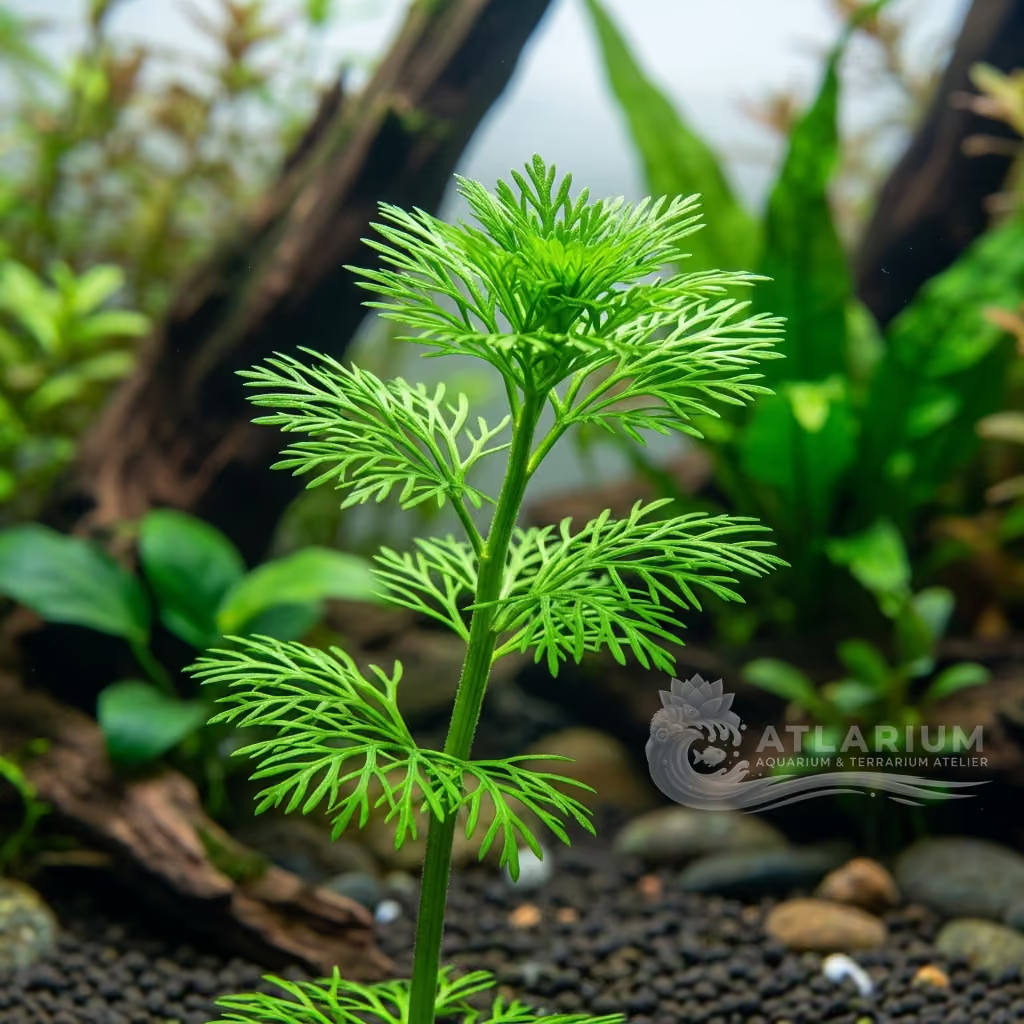
The classic 'Water Wisteria' from India. Under intense light, its submerged leaves become wonderfully feathery and deeply jagged, creating stunning visual textures.
Temperatura da água
22 - 28 °C
Valor de pH
6 - 8
Tipo de água
Água doce
Luz
Média
CO2
Baixa
Altura esperada
40 cm
Largura esperada
20 cm
GH
4 - 20 dGH
KH
2 - 21 dKH

Descrição da espécie
Geographical Origin and Habitat: Hygrophila difformis, universally known as "Water Wisteria," is a marsh plant native to the subtropical and tropical regions of the Indian subcontinent (India, Bangladesh, Bhutan). In its natural biotope, it populates shallow waters, silty riverbanks, and seasonal swamps, facing massive changes in water level. It is accustomed to living both completely submerged and with leaves exposed to the air under the scorching Asian sun.
Taxonomy & Genetics: It belongs to the Acanthaceae family. Its specific epithet *difformis* ("of two forms" or "deformed") refers to the incredible heterophylly that characterizes its genetic expression. The leaf blades radically change morphology depending on environmental conditions, transitioning from simple, rounded leaves (in the emersed form) to deeply jagged, pinnatifid, almost feather-like leaves in the submerged form.
Physical Structure: It possesses fragile, pale, and succulent caulescent stems that grow rapidly upward, or creeping if horizontal living space allows. It roots powerfully both in the substrate and by emitting thick tufts of white adventitious roots at every intermediate node. The modified (submerged) leaves are exquisitely carved and pinnate, giving the plant a feathery, vaporous appearance faintly reminiscent of ferns or Ceratopteris.
Color & Texture: The color is a very bright, lively lime green or pea green, which stands out sharply against the dark greens of ferns and Anubias. The texture of the submerged leaves is impalpable, thin, and jagged. If the leaves touch the surface, they lose their serrations, becoming rough, oval, serrated on the edges, and producing fragrant light blue flowers.

Cuidado, criação e companheiros de tanque
Lighting & CO2: The more light it receives, the more the leaves will divide and become jagged, turning wonderfully "feathery." Under weak or medium light, the submerged leaves will remain relatively un-jagged, broad, and widely spaced, losing much of their aesthetic value. CO2 administration is not essential, but a carbon supply will push the growth rate to impressive levels, requiring continuous scissor work.
Nutrition & Substrate: It is the archetype of the fast-growing "starter" plant. It acts as a natural biological filter: it consumes nitrates and phosphates from the water column at a staggering rate to support its massive foliar development. It prefers a fertilized gravel or sand bottom, but will also grow gloriously by absorbing everything through the long adventitious roots hanging free in the water.
Water Chemistry: Unbeatable in terms of resilience. It thrives in a temperature range from 22 to 28°C (withstanding peaks up to 30°C). pH from 6.5 to 7.5. It is indifferent to water hardness, growing with the same rigor in very soft water as in very hard tap water. It merely requires frequent water changes so as not to exhaust the microelements in solution.
Space Management & Placement: Extremely voluminous, it is not suited for tiny tanks. Its ideal location is in the background or corners, where it can form huge lime-green bushes 40-50 cm high and just as wide. Interestingly, given the fragility of its stems, if planted horizontally on the bottom it will begin to develop new vertical stems from every single node, creating a very dense vegetative wall.
Pruning: Maintenance is its weak point: it grows so fast as to become a weedy plant. To contain it and form aesthetically pleasing bushes, topping (cleanly cutting the upper portion) is necessary. Replanting the broad apical cuttings (10-15 cm) ensures you always have the most beautiful, feathery tips in view, while discarding or giving away the bare lower stems.
Risks & Diseases: It inevitably tends to overshadow all surrounding plants due to the massive spread of its pinnate leaves. Furthermore, if the aquarium runs out of macronutrients (nitrogen or potassium), Hygrophila difformis will instantly sacrifice the older leaves at the base, which will first become transparent or yellow, then develop holes, and finally rot, polluting the water.

Origem e distribuição geográfica
Hygrophila difformis, universally known as "Water Wisteria," is a marsh plant native to the subtropical and tropical regions of the Indian subcontinent (India, Bangladesh, Bhutan). In its natural biotope, it populates shallow waters, silty riverbanks, and seasonal swamps, facing massive changes in water level. It is accustomed to living both completely submerged and with leaves exposed to the air under the scorching Asian sun.
Origem
Sul e Sudeste Asiático

Perfil da planta
- Posicionamento
- Fundo
- It is best positioned in the midground or background of the aquarium depending on the tank size. Due to its bushy growth habit, planting several stems together will create a thick, finely textured thicket. It can easily obscure equipment and serves as a fantastic bright green focal point.
- Forma botânica
- Caule
- This stem plant is characterized by its highly variable, deeply pinnatifid (feather-like) leaves, which give it a delicate, lacy appearance. Interestingly, the leaf shape changes dramatically depending on the environment; submerged leaves are deeply lobed, while emersed leaves are more solid and serrated. It generally displays a bright, lively light green color.
- Crescimento
- Rápida
- Water Wisteria is incredibly fast-growing under almost all conditions. With high light and CO2 injection, its growth is explosive and it will require frequent pruning. Even in low-tech setups, it grows vigorously and serves as an excellent beginner plant for rapid tank establishment.
- Substrato
- Baixa
- Hygrophila difformis, commonly known as Water Wisteria, is highly adaptable and will grow easily in basic, inert substrates like sand or standard aquarium gravel. A relatively shallow depth of 3 to 5 centimeters is adequate for its roots to anchor effectively and stabilize the rapid vertical growth. Because it heavily draws nutrients from the water column through its extensive leaves and aerial roots, it does not strictly require an enriched aquasoil to flourish.
- Fertilização de coluna
- Recomendada
- Liquid fertilization is highly effective, as the large surface area of its finely divided leaves readily absorbs nutrients from the water. Regular additions of a comprehensive fertilizer, particularly rich in nitrogen and trace elements, will sustain its rapid growth. It responds quickly to nutrient fluctuations.
- Fertilização radicular
- Nenhuma
- While it draws heavily from the water column, it develops a surprisingly extensive root system. A nutrient-rich substrate or root tabs will significantly enhance its growth rate and overall robustness. Good rooting prevents the fast-growing stems from floating away.
- Corte
- Regular
- Frequent and sometimes aggressive pruning is required to prevent it from outcompeting other plants for light and space. You can top the stems and replant them, or prune lateral branches to maintain a specific shape. The plant recovers rapidly from trimming and will soon sprout new shoots from cut nodes.
- Propagação
- Estacas
- Propagation is remarkably simple; any cut piece of stem with a few leaves can be replanted and will quickly root. It also frequently produces side shoots that can be snipped and planted elsewhere. Leaves that break off and float will sometimes even develop roots of their own.
- Sensibilidade
- Moderada
- Hygrophila difformis is exceptionally hardy and adaptable, tolerating wide ranges of pH, hardness, and temperature. It is, however, sensitive to very low macronutrient levels, which will cause its lower leaves to melt or detach. Sudden changes from emersed to submerged states will cause old leaves to drop as new, feathery ones grow.
- Função de layout
- Fundo
- Its bright green, finely cut foliage makes it a superb contrasting element against solid-leaved plants or dark hardscape. It serves well as a large background bush or a midground accent in very large tanks. Its rapid growth makes it an ideal pioneer plant for cycling new aquariums.

Galeria de imagens
Imagens licenciadas vinculadas à espécie ou, quando marcadas, ao táxon representativo mais próximo.

Espécies relacionadas
Recomendações agrupadas por parentes próximos, escolhas de acompanhantes e cuidados semelhantes.