Hygrophila corymbosa ''Angustifolia''
Hygrophila corymbosa
Highly accommodating variant with long leaves, native to Southeast Asia. Survives easily in low light but forms much faster, compact bushes under intense illumination.
Temperatura da água
20 - 28 °C
Valor de pH
6 - 8
Tipo de água
Água doce
Luz
Média
CO2
Baixa
Altura esperada
50 cm
Largura esperada
15 cm
GH
4 - 20 dGH
KH
2 - 18 dKH

Descrição da espécie
Geographical Origin and Habitat: *Hygrophila corymbosa* var. 'Angustifolia' (formerly known in some forms as *Nomaphila stricta*) is an amphibious plant native to Southeast Asia, particularly Thailand, Malaysia, and Indonesia. In its natural habitat, it thrives along the banks of slow-moving rivers, shaded streams, and swamps, often emerging partially or completely during the dry season and then being completely submerged during the monsoons.
Taxonomy & Genetics: It is a dicotyledon in the Acanthaceae family. The epithet 'Angustifolia' (from Latin *angustus* = narrow and *folium* = leaf) describes its characteristic varietal mutation: leaves that are significantly longer and more lanceolate than the nominal form (*Hygrophila corymbosa*), which instead has much wider and oval leaf blades.
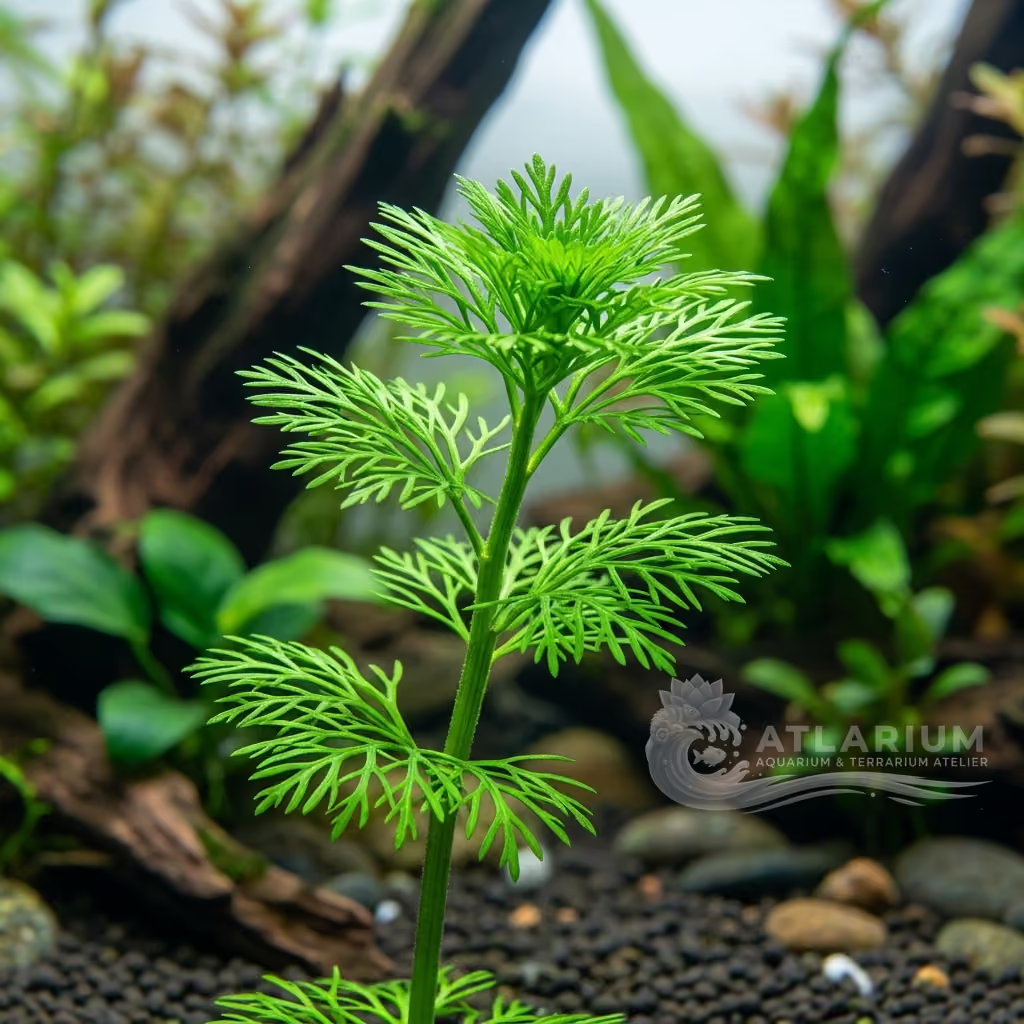
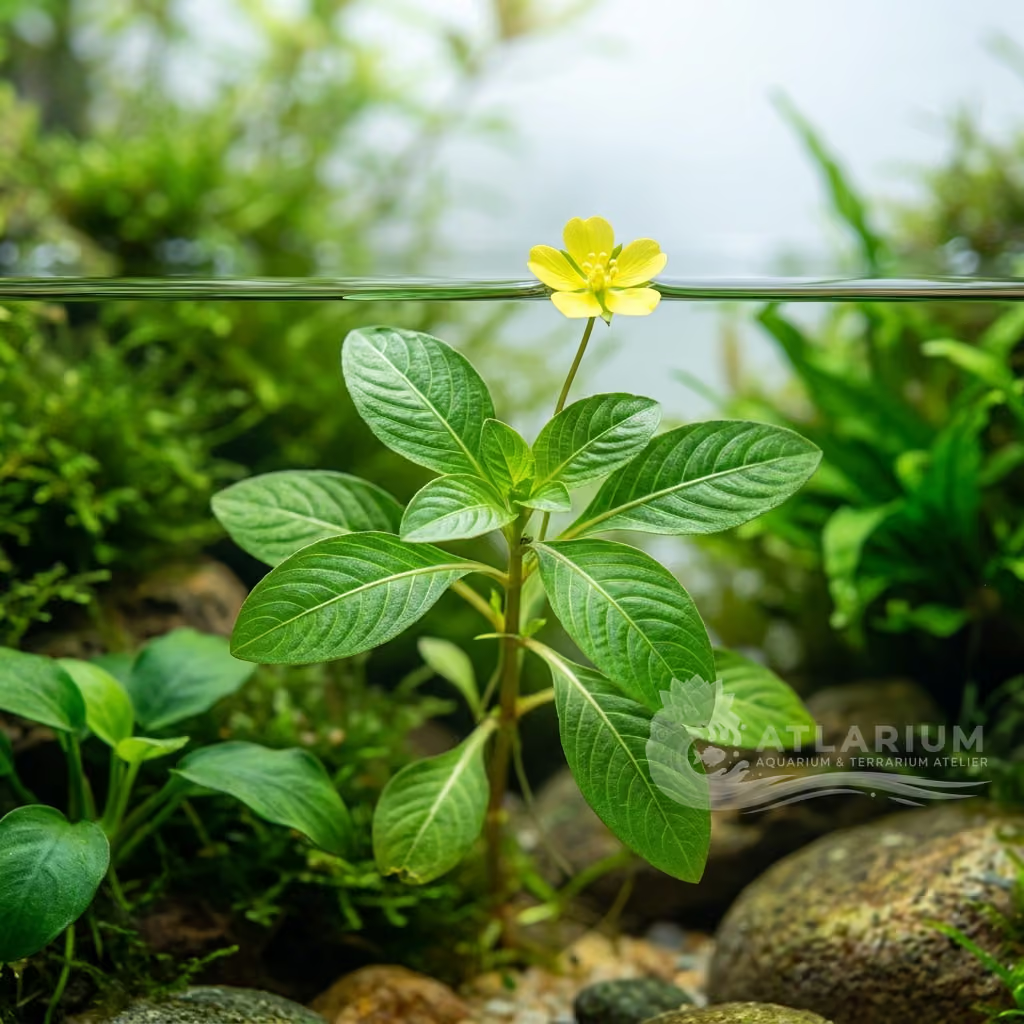
Physical Structure: It is a classic stem plant (caulescent). Its stems are robust, thick, rigid, and fleshy, capable of supporting themselves even out of the water. Adventitious roots often sprout from the nodes along the stem to anchor or draw extra nutrients. The leaves develop in opposite decussate pairs (rotated 90 degrees from the previous node) and are noticeably elongated (up to 15-20 cm) and narrow, resembling willow or oleander leaves.
Color & Texture: The coloration ranges from apple green to intense dark green. In the presence of very strong light, the central vein and upper surface may take on faint bronze or rust hues. The submerged leaf texture is smooth, while if grown emersed (paludarium), the leaves become leathery, covered with dense, fine fuzz (trichomes), and produce beautiful lilac or purple tubular flowers at the leaf axils.

Cuidado, criação e companheiros de tanque
Lighting & CO2: An extremely rustic and accommodating plant. It survives without problems under weak or medium lighting, but in these conditions it will tend to lose its lower leaves (which remain in the shade) and greatly elongate its internodes. With intense light, growth becomes very rapid and compact. It absolutely does not require carbon dioxide (CO2) supplementation to survive, although its addition increases growth rates tenfold.
Nutrition & Substrate: It feeds a rather deep and developed root network, therefore preferring a rich substrate (allophane soil or fertile bottom). However, the countless adventitious roots on the stem demonstrate its formidable ability to extract nutrients (especially nitrates and potassium) directly from the water column. It is an excellent consumer of pollutants, ideal for stabilizing newly established tanks.
Water Chemistry: One of the most tolerant aquarium plants ever. It adapts to acidic pH (6.0) as well as distinctly alkaline (8.0). It withstands very hard water (GH up to 20) and soft water, at temperatures between 20 and 28°C. It is highly indicated for community aquariums with livebearers or African Cichlids that are not too aggressive with vegetation.
Space Management & Placement: Its imposing size (it can easily exceed 50 cm in height) and long, drooping leaves make it perfect for the background or as a focal plant at the sides of the aquarium to hide filter pipes. Given the width of its canopy, the stems should be planted at least 4-5 cm apart to prevent the lower leaves from rotting due to lack of light.
Pruning: It grows incessantly towards the surface. When the stems bend on the water surface or emerge, pruning (topping) is mandatory. The stem is cut just above a healthy node. The rooted lower stump will quickly throw out two or more lateral shoots (making the bush thicker), while the removed upper part (apical cutting) can be buried to form an independent new plant.
Risks & Diseases: It is a very strong plant, but it has a chemical "Achilles' heel": it is extremely sensitive to Potassium (K) deficiency. If this macronutrient is scarce, older leaves will develop scattered small holes and the edges will quickly yellow due to necrosis (classic "pin-hole" symptoms). It is crucial to supplement with potassium-based liquid fertilizers to keep the leaves intact and lush.

Origem e distribuição geográfica
*Hygrophila corymbosa* var. 'Angustifolia' (formerly known in some forms as *Nomaphila stricta*) is an amphibious plant native to Southeast Asia, particularly Thailand, Malaysia, and Indonesia. In its natural habitat, it thrives along the banks of slow-moving rivers, shaded streams, and swamps, often emerging partially or completely during the dry season and then being completely submerged during the monsoons.
Origem
Sul e Sudeste Asiático

Perfil da planta
- Posicionamento
- Fundo
- With its long, flowing, narrow leaves and tall growth habit, it is an ideal background plant. It looks best when planted in dense clusters, where its willow-like foliage can sway gracefully in the water current. It should be placed where it will not shade shorter foreground plants. Its unique texture contrasts beautifully with broad-leaved or red aquatic plants.
- Forma botânica
- Caule
- Compared to the standard H. corymbosa, the 'Angustifolia' variant features significantly longer, narrower, and more pointed leaves, giving it a much finer, willow-like texture. The stems remain thick and sturdy, supporting the long, sweeping green foliage. Under intense lighting, the leaves may develop a subtle brownish or bronze tint. It maintains a very graceful and flowing appearance despite its large size.
- Crescimento
- Rápida
- This plant grows extremely fast, frequently requiring weekly pruning to prevent it from escaping the open top of the aquarium. It will readily grow emersed if allowed to breach the surface. Aggressive trimming encourages the plant to bush out with numerous side shoots. Its rapid metabolism makes it perfect for quickly filling empty spaces in a new aquascape.
- Substrato
- Alta
- It develops a vast and powerful root network that thrives in deep, nutrient-rich active soils. It can also be grown easily in plain gravel or sand, provided that root tabs are added to sustain its rapid growth. A robust substrate prevents the large stems from becoming uprooted easily. The thicker the substrate layer, the better it can establish its massive base.
- Fertilização de coluna
- Recomendada
- Liquid dosing is highly effective, as the long leaves absorb nutrients efficiently directly from the water column. A potassium-rich liquid fertilizer is strongly recommended to keep the foliage pristine and free of pinholes. It responds well to daily dosing of trace elements and macronutrients. Neglecting column fertilization in a lean substrate will quickly lead to stunted growth and dropped lower leaves.
- Fertilização radicular
- Recomendada
- Root feeding yields excellent results, ensuring the thick stems have a constant energy reserve. Pushing root tabs deep into an inert substrate will significantly boost growth speed and leaf size. In an active soil environment, it will quickly exhaust local nutrients, requiring eventual root tab replenishment. Strong roots help the plant recover swiftly from severe top-trimming.
- Corte
- Regular
- Trimming is done by simply cutting the stem at the desired height with sharp scissors. The base will soon produce multiple side shoots, turning the plant into a dense bush. The severed tops can be immediately replanted into the substrate.
- Propagação
- Estacas
- Propagation is exceptionally simple via stem cuttings. Snipping the top of a stem and replanting it will result in rapid root formation within days. The remaining bottom portion will aggressively sprout new lateral branches, creating a denser thicket. It is one of the easiest stem plants to propagate and share with other hobbyists.
- Sensibilidade
- Moderada
- It is a very hardy plant, forgiving of a wide range of water conditions and temperatures. However, severe potassium deficiency will manifest rapidly as pinholes in the long leaves. It is generally unbothered by most algae types.
- Função de layout
- Plano intermediário, Fundo
- It provides an excellent vertical contrast against broad-leaved or carpeting plants. Its flowing, willow-like appearance brings a natural, unkempt beauty to the background. It is a staple in creating lush, jungle-style aquatic landscapes.

Galeria de imagens
Imagens licenciadas vinculadas à espécie ou, quando marcadas, ao táxon representativo mais próximo.

Espécies relacionadas
Recomendações agrupadas por parentes próximos, escolhas de acompanhantes e cuidados semelhantes.