Mole cowry
Talparia talpa
A magnificent marine cowry showcasing a gorgeously banded gold-brown dorsal surface, heavily contrasted by a distinctive, glossy jet-black base.
Temperatura da água
22 - 27 °C
Valor de pH
8.1 - 8.4
Tipo de água
Marinho
Tipo invertebrado
Marine snail
Tamanho adulto
8 cm
Grupo mínimo
>= 1
KH
8 - 12 dKH
Papel ecológico
Herbivore
Sensibilidade ao cobre
High

Descrição da espécie
Geographical Origin and Habitat: This species is widely distributed in the tropical waters of the Indo-Pacific, extending from the coasts of East Africa and the Red Sea to the Hawaiian Islands, French Polynesia, and southern Japan. It inhabits coral reefs, protected lagoons, and outer reef slopes at depths ranging from 2 to 30 meters. During the day, it lives hidden under large coral blocks or deep crevices, emerging at night.
Taxonomy: Cypraea talpa (also known as Talparia talpa) belongs to the class Gastropoda, family Cypraeidae (cowries). It is a marine gastropod mollusk characterized by an exceptionally smooth and glossy shell, highly valued by collectors. The mantle of the living animal covers almost the entire shell when active, protecting it from settling encrusting organisms.
Social Behavior: It is a primarily solitary and nocturnal invertebrate. During daylight hours, it remains motionless in dark rocky shelters away from intense light. At night, it moves slowly over the rocky substrate and corals to feed. It does not exhibit territorial or aggressive behaviors toward other organisms, except for its potential predation on certain sessile invertebrates.
Coloration and Sexual Dimorphism: The shell features a golden-brown or light brown dorsal coloration with 3 to 4 distinct dark brown and cream bands, while the base and lateral margins are a highly characteristic deep, glossy black. The mantle of the living animal is black or dark brown, covered with small, branched gray and white papillae that aid in camouflage. There is no distinguishable external sexual dimorphism.

Cuidado, criação e companheiros de tanque
Tank Setup: Requires a mature marine aquarium of at least 200-300 liters, with a large amount of live rock arranged to form spacious caves and dark crevices for daytime shelter. The presence of a coral sand substrate is beneficial. Lighting should include a lunar phase or low-light period to allow observation of the mollusk when it extends its mantle and is active.
Diet and Feeding: It is an omnivorous species with carnivorous and herbivorous tendencies. In nature, it grazes on marine sponges, tunicates, small coral polyps, and encrusting algae. In an aquarium, although it consumes algae and detritus from rocks, its diet should be supplemented with pieces of frozen food (mysis, krill, chopped shrimp) placed near the mollusk during its night hours.
Water Quality: It demands stable and high-quality reef parameters: temperature between 23°C and 26°C, pH between 8.1 and 8.4, and salinity/specific gravity of 1.023-1.025. To support the growth and maintenance of its calcified shell, it is essential to maintain constant levels of calcium (400-440 mg/L), magnesium (1300-1350 mg/L), and KH (8-10). Avoid copper.
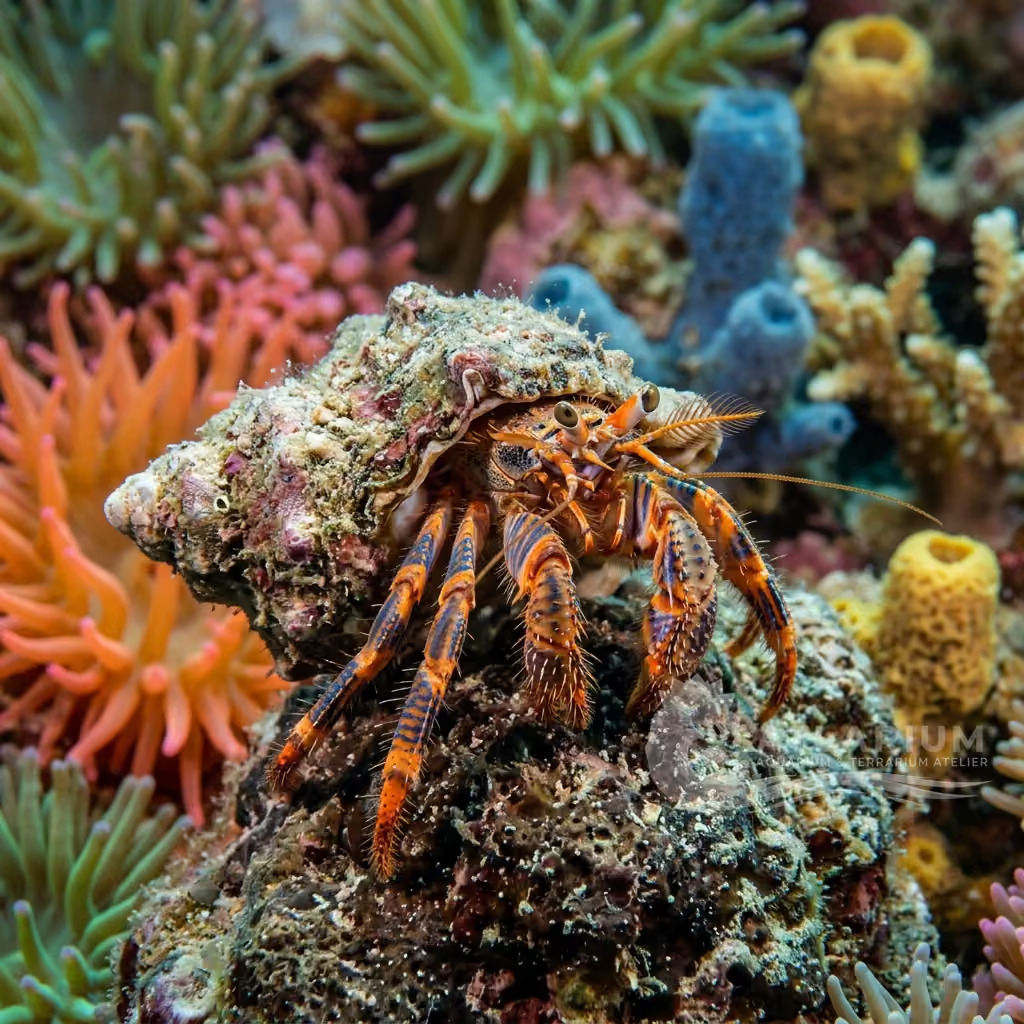
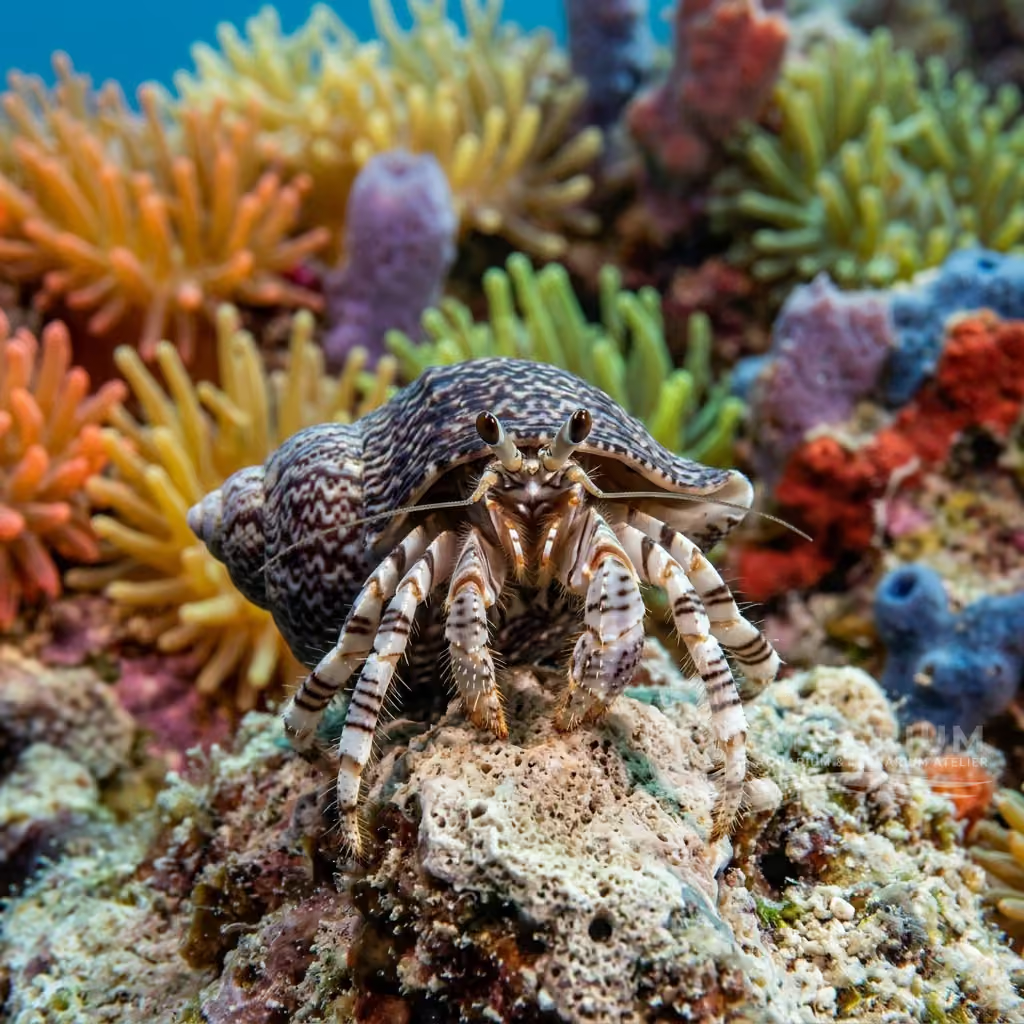
Compatibility and Tankmates: It is not considered fully reef-safe because, as it grows, it may feed on sponges, soft corals, and small polyps of stony corals. It coexists well with peaceful reef fish. Avoid keeping it with large mollusk predators like puffers, triggerfish, groupers, and large hermit crabs that could break its shell or damage its fleshy mantle.
Aquarium Breeding: Breeding in home aquariums is extremely difficult, and there are no documented cases of long-term success. They have separate sexes. The female lays adhesive egg capsules under rocks and sits on top of them to protect them until they hatch. The released larvae (veliger) have a very long and delicate planktonic phase requiring specific microscopic food.
Risks and Diseases: The main risks stem from a lack of adequate food (especially sponges and organic matter), which can lead to slow starvation and death. It is highly sensitive to the presence of copper and heavy metals, as well as sudden changes in salinity and temperature. Slow drip acclimation is mandatory to prevent osmotic shock.

Origem e distribuição geográfica
This species is widely distributed in the tropical waters of the Indo-Pacific, extending from the coasts of East Africa and the Red Sea to the Hawaiian Islands, French Polynesia, and southern Japan. It inhabits coral reefs, protected lagoons, and outer reef slopes at depths ranging from 2 to 30 meters. During the day, it lives hidden under large coral blocks or deep crevices, emerging at night.
Origem
Oceanos tropicais e recifesÁfrica e MadagascarLeste Asiático

Perfil de invertebrados
- Dieta
- Omnivore
- Primarily herbivorous, feeding on microalgae and diatoms. It may also scavenge on detritus.
- Papel ecológico
- Herbivore
- Helps control algae growth on live rock and tank glass, serving as part of the clean-up crew.
- Tamanho adulto
- 8 cm
- Risco de salto
- Yes
- Does not jump, but can slowly crawl above the waterline. Ensure the tank has a secure lid.
- Sensibilidade ao choque
- High
- Requires slow acclimation to prevent osmotic shock. Stable parameters are essential.
- Cálcio e minerais
- High
- Needs high calcium, magnesium, and proper alkalinity for continuous shell growth and maintenance.
- Muda
- Shell growth
- Does not molt like crustaceans; instead, it continuously secretes calcium carbonate to expand and thicken its shell.
- Reprodução
- Oviparous
- Reproduction in captivity is not commonly achieved. Usually involves a complex planktonic larval phase.
- Compatibilidade e companheiros de tanque
- Reef safe
- Peaceful towards other tank inhabitants. Keep away from predatory crabs, large wrasses, and puffers that can crush shells.

Espécies relacionadas
Recomendações agrupadas por parentes próximos, escolhas de acompanhantes e cuidados semelhantes.