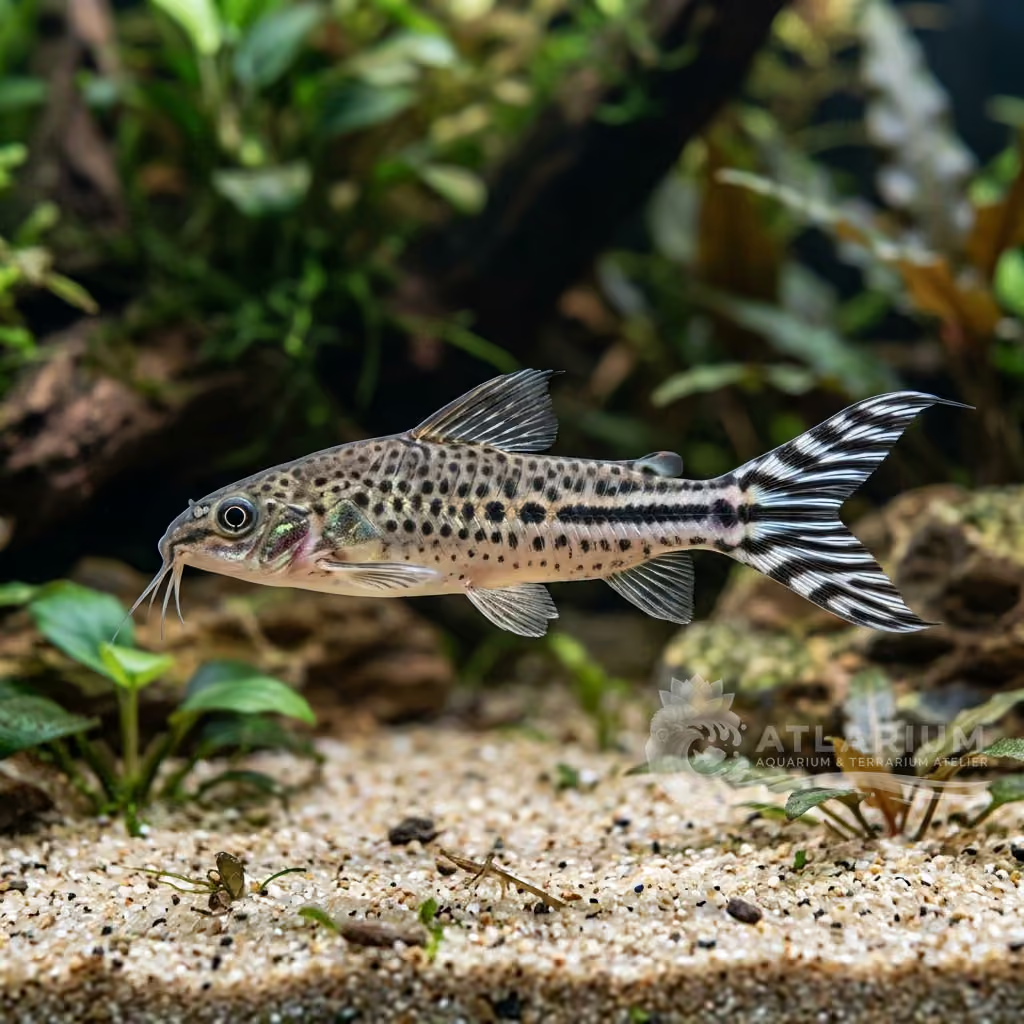
Giant Danio
Devario malabaricus
The king of Danios. A powerful schooling fish reaching 11-12 cm (4.5 inches), characterized by explosive swimming speed and steel-blue flanks traversed by golden stripes.
Température de l’eau
20 - 25 °C
Valeur du pH
6.5 - 7.5
Type d'eau
Eau douce
Niveau dans le bac
Surface et milieu
Taille adulte
12 cm
Volume minimal du bac
>= 100 L
Groupe minimal
>= 1
GH
5 - 15 dGH
KH
2 - 7 dKH
TDS
95 - 295 ppm
Conductivité
148 - 461 uS/cm

Description de l'espèce
Geographical Origin and Habitat: West coast of India (Malabar) and Sri Lanka. Inhabits mountain water basins, well-oxygenated hill streams and waterfalls surrounded by lush forests.
Taxonomy and Morphology: Malabar Danio (Devario malabaricus). Often confused in shops with D. aequipinnatus (Giant Danio). Slightly smaller in size, slender but extremely strong body, apt to defy rapids.
Social Behavior: Indomitable swimmer. Totally schooling, it will dart around the aquarium all day. Creates strong hierarchies where the alpha male assumes the brightest colors. Must live in groups of 8-10 or more.
Coloration and Sexual Dimorphism: Bright turquoise-steel flanks decorated with 3 or 4 yellow horizontal stripes that break behind the gills. Golden spot before the dorsal. Females are swollen and pastel colored, males shiny and thin.

Soins, reproduction et cohabitation
Aquarium Setup: Length is everything for it: min. 120 cm (48 inches). River layout: smooth river rocks on the bottom, resistant wood and, strictly, extra filters or pumps to guarantee a real aquatic stream.
Diet and Feeding: Primary instinct is to strike at the surface (insects). Accepts any food: from mysis to frozen bloodworms, flakes, live insects (crickets, waxworms) and quality granules. Has a very accelerated metabolism.
Water Quality: Requires strict maintenance; if nitrates or temperature (above 26-27°C / 79-81°F) rise, it wastes away quickly and gasps. Appreciates robust weekly changes with fresh water.
Compatibility and Cohabitation: Ideal with medium-large sized fish but with a solid temperament: Crossocheilus, large Barbs, Puntius denisonii (Red Lined Torpedo) and Loricariidae. Will stress small shy Characins or Cyprinids to death.
Aquarium Breeding: Spectacular spawning at dawn. Males push females among the pebbles, fertilizing hundreds of free transparent eggs. Protect the bottom with marbles or grids if you intend to raise the young.
Risks and Diseases: Worst enemy is the open tank: it is a phenomenal jumper. Sensitive, like many cyprinids, to Columnaris in case of wounds or sudden drops in water quality.

Origine et répartition géographiques
West coast of India (Malabar) and Sri Lanka. Inhabits mountain water basins, well-oxygenated hill streams and waterfalls surrounded by lush forests.
Origine
Asie du Sud et du Sud-Est

Profil de poisson
- Tempérament
- Semi-aggressive
- Their temperament is exuberant, fast-paced, and generally peaceful towards other species that can tolerate their activity level. They are inherently gregarious and rely on a strict schooling structure for a sense of security and well-being. Keeping them solitary or in too small a group will lead to abnormal behavior, shyness, and a shortened lifespan. When kept correctly, they provide constant, flashing movement and bring a dynamic energy to the aquarium.
- Régime alimentaire
- Omnivore
- This species is a non-picky omnivore that will readily accept most commercially available aquarium foods. A base diet of high-quality flakes or micro-pellets ensures they receive essential vitamins and minerals. Providing occasional treats of live or frozen bloodworms, daphnia, and brine shrimp will significantly enhance their coloration and vitality. They are vigorous eaters that will competitively feed in the upper portions of the water column.
- Espérance de vie
- 5-7 years
- Taille adulte
- 12 cm
- Ratio des sexes
- School
- In a display tank, maintaining a ratio of at least two females per male is advisable to distribute the male's persistent courtship efforts. A skewed ratio with too many males can result in severe stress and exhaustion for the females. When kept in a sufficiently large school, this ratio is easier to maintain and aggressive pursuits are generally diffused. Purchasing them as a group when young often yields a naturally balanced mix of sexes.
- Fréquence d'alimentation
- Twice daily
- Due to their highly active nature, Malabar Danios burn energy quickly and should be fed two to three small meals a day. Ensure that the food offered is consumed entirely within a few minutes to prevent excess debris from fouling the water. While they will always appear hungry, resisting the urge to overfeed is important for long-term health and water quality. Skipping a day of feeding once a week can also aid in healthy digestion.
- Charge biologique
- Low to Medium
- The Malabar Danio is a highly energetic schooling fish that produces a notable bioload relative to its size. Their active metabolism demands a well-established nitrogen cycle to handle the continuous waste output from a necessary group of six or more. To maintain water clarity and safe parameter levels, a robust canister or power filter is highly recommended. Consistent weekly water changes are crucial to prevent the buildup of nitrates, which they can be sensitive to over time.
- Courant
- Stagnant
- Originating from flowing rivers and streams, they have a strong preference for well-oxygenated water with a moderate to strong current. They can often be observed swimming directly against the flow of filter outflows or powerheads for exercise. Replicating a riverine environment with directional flow will encourage their natural behaviors and keep them physically fit. Ensure the tank length is sufficient to allow them to fully utilize the current.
- Risque de saut
- Yes
- Like their close relatives, Malabar Danios are extremely proficient jumpers and pose a significant flight risk. A tight, secure lid covering the entire surface of the aquarium is absolutely essential to prevent fatal accidents. Jumping is often a response to being startled, sudden darkness, or poor water conditions. Adding floating plants can help diffuse light and provide a physical barrier that discourages jumping attempts.
- Reproduction
- Oviparous
- They are prolific egg scatterers that offer no parental care and are known to consume their own eggs enthusiastically. Breeding requires a separate spawning tank conditioned with slightly cooler water and fine-leaved plants or a spawning mop. The spawning process is typically vigorous, with males intensely driving females into the vegetation to release eggs. After spawning, all adult fish must be immediately removed to allow the eggs a chance to hatch.
- Compatibilité et compagnons
- With caution
- They are a peaceful community fish, but their rapid darting and constant motion can easily intimidate slower, more delicate species. Ideal tank mates include other active schooling fish like barbs, larger rasboras, and resilient bottom dwellers such as Corydoras or loaches. Avoid housing them with fish that have long, trailing fins, as they may become targets of opportunistic nipping. They should be kept in a sufficiently large group to diffuse any intra-species bickering and keep them focused on each other.
- Niveau dans le bac
- Top/Middle
- Malabar Danios are predominantly surface and mid-water swimmers, occupying the upper stratum of the aquarium. They require expansive, unobstructed lateral swimming space to thrive and display their natural schooling dynamics. Decorations and planting should be focused on the perimeter and bottom, leaving the central and upper areas completely open. They rarely interact with the substrate unless investigating fallen food.

Modèles et paramètres scientifiques
FishBase
Fenêtre sur les données scientifiques officielles de l’espèce
FishBase v25.04Données synchronisées le : 15/06/2026
- Niveau trophique
- 3,2 ± 0,2 se
- Résilience
- Élevée (moins de 15 mois)
- Singularité phylogénétique (PD50)
- 0.5
- Relation bayésienne longueur-poids
- a = 0.00977, b = 3.04
- VulnérabilitéVulnérabilité faible (10 / 100)

Espèces associées
Recommandations regroupées par proches parents, compagnons et soins similaires.