Elongate glassy perchlet
Chanda nama
The Elongate Glassfish is a stunning, highly transparent schooling fish from South Asia. It thrives in well-planted fresh or brackish aquariums when fed a varied micro-predator diet.
Température de l’eau
20 - 28 °C
Valeur du pH
7 - 8.5
Type d'eau
Eau douce / Eau saumâtre
Niveau dans le bac
Milieu
Taille adulte
10 cm
Volume minimal du bac
>= 100 L
Groupe minimal
>= 6
GH
8 - 15 dGH
KH
4 - 7 dKH
TDS
160 - 295 ppm
Conductivité
250 - 461 uS/cm

Description de l'espèce
Geographical Origin and Habitat: Chanda nama is native to South Asia, widely distributed across India, Pakistan, Nepal, Bangladesh, and Myanmar. It inhabits a broad range of freshwater and brackish habitats, including slow-flowing rivers, streams, ponds, canals, and flooded rice paddies. It prefers areas with dense submerged vegetation that provide shelter from predators and currents.
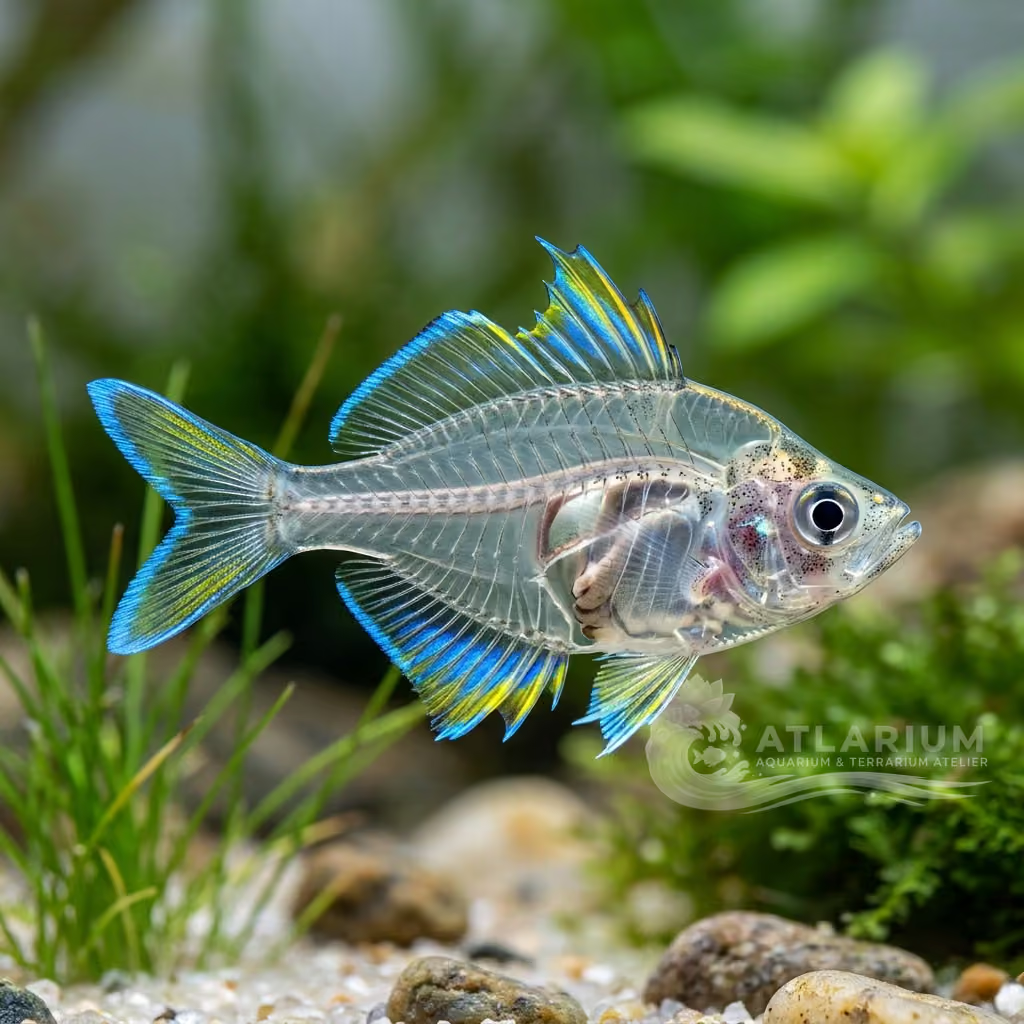
Taxonomy and Morphology: Belongs to the family Ambassidae (glassfishes) and the genus Chanda. It features a highly laterally compressed, slender, and almost completely transparent body, making the backbone, ribs, and silvery internal organ sac clearly visible. It reaches a maximum adult size of approximately 8 to 10 centimeters.
Social Behavior: A gregarious, active species that must be kept in schools of at least 6 to 8 individuals to prevent stress and shyness. It swims actively in the mid-water layers of the tank. While peaceful, it can occasionally exhibit fin-nipping behavior toward slow-moving or long-finned tankmates.
Coloration and Sexual Dimorphism: The body is glass-like and transparent, showing silvery and gold iridescence under direct light. The dorsal and anal fins may feature subtle dark or yellowish edges. Sexual dimorphism is visible primarily during spawning: males develop stronger yellowish-gold body hues and more prominent blue-black borders on their fins.

Soins, reproduction et cohabitation
Aquarium Setup: Requires an aquarium of at least 80 to 100 liters to house a proper school. The setup should include densely planted zones along the back and sides of the tank to offer refuge, while leaving a large open area in the center for swimming. A dark substrate is recommended to enhance the visibility of their transparent bodies.
Diet and Feeding: Primarily a carnivore feeding on microfauna. In captivity, it can be a picky feeder and may initially reject dry foods. It should be fed regularly with live or frozen foods such as daphnia, brine shrimp, copepods, and small mosquito larvae. Over time, it can be conditioned to accept fine dry flakes.
Water Quality: Demands clean, stable water conditions: water temperature between 22 and 28 °C, pH levels from 6.5 to 7.8, and a general hardness of 8 to 15 dGH. While it can tolerate slightly brackish conditions, it thrives in hard freshwater. Efficient filtration is essential to keep ammonia and nitrites at zero.
Compatibility and Cohabitation: Suitable for community aquariums with active, peaceful species such as rasboras, danios, small barbs, and Corydoras. Avoid housing it with slow-moving, long-finned fish (like angelfish or show guppies) that might be nipped, or large predatory species that would prey on it.
Aquarium Breeding: Breeding in captivity is possible. They are egg scatterers, depositing adhesive eggs among fine-leaved plants (such as Java Moss). The parents do not tend to the eggs and will readily eat them, so a separate breeding tank is required to successfully raise the fry.
Risks and Diseases: Highly sensitive to sudden changes in water parameters, ammonia, and nitrite spikes. It is susceptible to Ich (white spot disease) and fungal infections if stressed or placed in an un-cycled aquarium. Exercise caution when catching them, as their sharp fin spines can easily entangle in standard nets.

Origine et répartition géographiques
Chanda nama is native to South Asia, widely distributed across India, Pakistan, Nepal, Bangladesh, and Myanmar. It inhabits a broad range of freshwater and brackish habitats, including slow-flowing rivers, streams, ponds, canals, and flooded rice paddies. It prefers areas with dense submerged vegetation that provide shelter from predators and currents.
Origine
Europe, Méditerranée et Asie occidentaleAsie du Sud et du Sud-Est

Profil de poisson
- Tempérament
- Peaceful
- They are peaceful, slightly timid fish that rely entirely on the safety of the school. If kept alone or in too small a group, they will become stressed, pale, and prone to disease. When kept properly, they are active, fascinating fish to observe.
- Régime alimentaire
- Carnivore
- They are micro-predators by nature, feeding on small insects, worms, and crustaceans. In the aquarium, they readily accept crushed high-quality flakes and micro-pellets. Their diet should be supplemented regularly with small live or frozen foods like daphnia, baby brine shrimp, and bloodworms.
- Espérance de vie
- 2-4 years
- Taille adulte
- 10 cm
- Ratio des sexes
- School
- Females are generally slightly larger and noticeably plumper when carrying eggs, while males may show slightly more intense coloration. They must be kept in a school of at least six individuals, preferably more. A larger group reduces stress and brings out their best schooling behavior.
- Fréquence d'alimentation
- Twice daily
- Being highly active, they benefit from being fed small amounts two times a day. This ensures the entire school receives adequate nutrition and prevents aggressive competition. Overfeeding should be avoided to maintain optimal water quality.
- Charge biologique
- Low to Medium
- The Elongate glass-perchlet produces a moderate bioload typical of small, active schooling fish. While individually they produce little waste, they must be kept in groups, which cumulatively adds to the bioload. Good filtration and standard regular water changes are required.
- Courant
- Strong
- Chanda nama prefers a moderate to brisk water flow, resembling their natural riverine habitats in South Asia. Good circulation is necessary to ensure high dissolved oxygen levels, which keeps them energetic. Utilizing a powerhead or strong filter outflow is recommended.
- Risque de saut
- No
- Reproduction
- Oviparous
- They are egg-scatterers that provide no parental care to their eggs or fry. Breeding requires a separate spawning tank conditioned with fine-leaved plants or spawning mops where the eggs can be deposited. The adults must be removed immediately after spawning to prevent them from eating the eggs.
- Compatibilité et compagnons
- Peaceful
- They are peaceful, schooling community fish that do well with other similarly sized, non-aggressive species. Suitable tank mates include small rasboras, peaceful tetras, and small bottom-dwellers like Corydoras. Large or aggressive fish should be avoided as they will easily prey upon or terrorize them.
- Niveau dans le bac
- Middle
- These glass-perchlets primarily occupy the middle and upper levels of the water column. They are constantly swimming in the open spaces but appreciate the presence of tall plants to retreat into if frightened. Sufficient swimming room is crucial for their well-being.

Modèles et paramètres scientifiques
FishBase
Fenêtre sur les données scientifiques officielles de l’espèce
FishBase v25.04Données synchronisées le : 15/06/2026
- Niveau trophique
- 3,6 ± 0,54 se
- Résilience
- Élevée (moins de 15 mois)
- Singularité phylogénétique (PD50)
- 1
- Relation bayésienne longueur-poids
- a = 0.01072, b = 2.97
- VulnérabilitéVulnérabilité faible (10 / 100)

Espèces associées
Recommandations regroupées par proches parents, compagnons et soins similaires.