

ppm
TDS

What is it
TDS (Total Dissolved Solids) measures the total quantity of dissolved particles in water, including salts, minerals (GH and KH), metals, and organic compounds. It is expressed in ppm (parts per million).
It is not a specific measurement—it does not tell you WHAT is dissolved, only HOW MUCH—but it is a very fast, useful indicator of water purity and the total load the aquarium is handling.
For comparison, pure reverse-osmosis (RO) water has a TDS of 0-5 ppm. Tap water can range from 50 ppm to 800+ ppm depending on geography and plumbing.
Why it matters
TDS is crucial for osmoregulation. Soft-water fish such as Discus and cardinals evolved in very low-TDS water (10-50 ppm) and struggle to expel excess minerals when kept at 400+ ppm. African-lake fish need high TDS.
In shrimp keeping, TDS is considered the number-one parameter to monitor. Delicate species such as Taiwan Bee (Caridina cantonensis) need a very narrow range (120-150 ppm) and suffer fatal osmotic shock when the value fluctuates quickly.
Tracking TDS over time also reveals whether the aquarium is accumulating pollution: if TDS is 150 after a water change and 250 at the end of the week, nutrients, fertilizers, or organic material are accumulating substantially.
Ideal ranges
Interactions with other parameters
TDS is a global indicator. Measuring incoming water, whether tap or prepared RO water, and outgoing aquarium water gives an exact snapshot of accumulated pollutants and fertilizers in the system.
| Tank type | Min | Max | Unit |
|---|---|---|---|
| Tropical community | 150 | 350 | ppm |
| Planted high-tech | 150 | 300 | ppm |
| Planted low-tech | 150 | 400 | ppm |
| Shrimp tank | 120 | 200 | ppm |
Out of range: what happens
TDS that is too high for the species causes chronic osmotic stress, reduced immune defenses, failed moults or arrested growth in invertebrates, and eggs that do not hatch because their membrane becomes excessively hard.
TDS that is too low for hard-water species causes lethargic fish, demineralized whitish snail shells that crumble, and shrimp unable to rebuild their post-moult exoskeleton.
Rapid fluctuations, such as water changes made too quickly with different TDS, cause immediate osmotic shock. In shrimp, water rapidly enters or leaves cells and can cause lethal stress; substantial water changes should be drip-acclimated to equalize TDS slowly.
Common Myths
- TDS zero is perfect for an aquarium; lifeless water without minerals kills through osmotic shock.
- A TDS of 300 is good; it depends on WHAT makes up that 300: 300 ppm of calcium can be fine, while 300 ppm of nitrates is not.
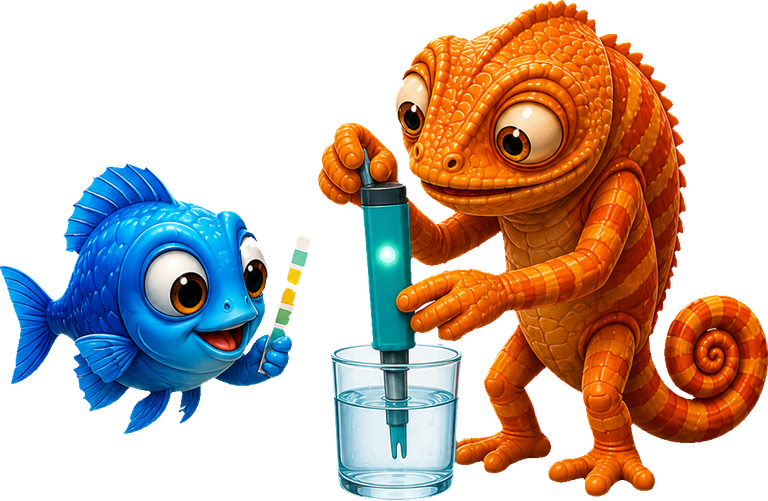
Measurement and adjustment
How to measure
A TDS pen is an essential, inexpensive, instant electronic tool. It measures electrical conductivity and applies a mathematical conversion factor, usually 0.5, to estimate ppm.
A TDS meter is vital when using pure RO water and remineralizing with salts, because it lets you prepare change water at exactly the same value as the tank.
Rinse the TDS meter regularly in pure RO water and calibrate it periodically with the appropriate fluid standards at known ppm.
How to adjust
To lower TDS, make water changes with near-zero-TDS RO water. Never lower total TDS by more than 10-15% in a single day, to avoid shocking fish.
To raise TDS, add remineralizing salts, such as Salty Shrimp GH/KH+ for Neocaridina or GH+ for Caridina, to change water before it enters the tank; never pour salts directly into the aquarium.
Fertilizer management: liquid plant fertilizers, especially NPK macros, inevitably raise TDS. A weekly rise in high-tech tanks is normal; reset it with a 50% weekly water change, the basic Estimative Index principle.
Pro Tips
- Use a TDS meter to decide when to make water changes. If it reads 150 ppm after a change and 220 ppm at week end, organic load is accumulating and you need larger change volumes.
- Taiwan Bee shrimp need TDS strictly between 120 and 150, obtained from RO water (TDS 0) remineralized only with GH+ salts.