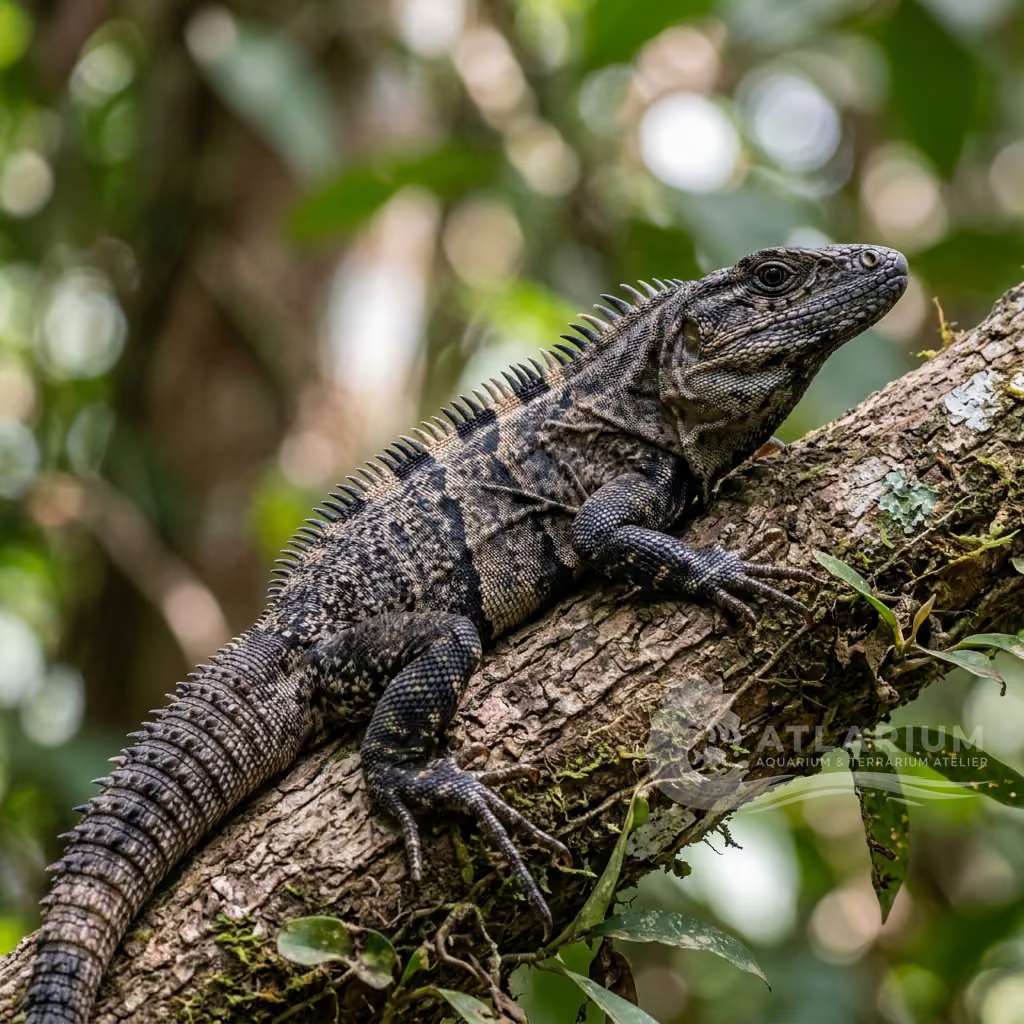
Standing's Day Gecko
Phelsuma standingi
The arid giant among day geckos. Unlike most Phelsuma, this massive and robust species inhabits the hot, dry spiny forests of southwestern Madagascar. Notable for its striated pastel colors and the rare habit of forming stable monogamous pairs.
Environment
Terrestrial
Humidity
50 - 70 %
Day temperature
28 - 32 °C
Night temperature
20 - 24 °C
Adult size
25 cm
UVB
Ferguson 3
UVI
1 - 2.6 UVI

Species description
Geographical Origin and Habitat: Endemic to a very restricted area in southwestern Madagascar. Unlike other Phelsuma that live in rainforests, this species lives in the unforgiving "spiny forests," characterized by a very hot, arid, and dry climate for most of the year, taking refuge on giant Baobab trees.
Taxonomy and Genetics: Standing's day gecko (Phelsuma standingi) belongs to the family Gekkonidae. Named after physician and paleontologist Herbert F. Standing, it is one of the largest species in its genus. Genetically, it displays stable traits with no recognized subspecies.
Behavior and Habits: Extraordinarily intelligent and territorial. They are among the rare reptiles to show prolonged pair bonding: males and females form monogamous pairs that actively defend their tree and their nests from intruders.
Morphology: Among the largest existing day geckos (can exceed 10-11 inches / 25-28 cm) and extremely robust. The livery is peculiar: instead of typical neon greens, it features pastel shades of gray, bluish, and apple green, with a fine reticulation of purplish and gray spots. Juveniles are born with a distinct and beautiful light green and fiery red zebra pattern that fades with maturity.

Care, breeding and tankmates
Terrarium Setup: Large vertical glass or screen enclosures (e.g. 24x18x36 inches for a pair). Decor does not require humid plants, but rather thick rough dry branches, cork bark logs, and large horizontal and vertical bamboo poles simulating the robustness of Malagasy Baobabs.
Lighting and Heating: Diurnal heliotherms from extreme climates. They need extremely strong UVB radiation (at least 10% T5 or metal halide lamps) to prevent severe metabolic bone disease (MBD). They require very high temperatures: the basking spot must reach 95-100°F (35-38°C), with a cool zone at 79-82°F (26-28°C).
Humidity and Hydration: Dry climate (40-60% humidity). Should not be heavily misted like other Phelsuma, except very lightly in the early morning to provide drinking droplets. A small water dish on the floor can be provided.
Feeding and Supplementation: Exceptional predators that require more substantial prey (adult crickets, large lateral roaches, locusts, occasional waxworms), heavily dusted with calcium/D3. They love nectar and will greedily accept specific powdered diets for frugivorous geckos (Repashy/Pangea) mixed thickly.
Compatibility: They are territorial and should be kept individually or in established monogamous male-female pairs. Never house multiple males together. In large enclosures, they can sometimes cohabit with other non-aggressive reptiles, but single-pair housing is recommended.
Health and Common Diseases: Highly susceptible to metabolic bone disease (MBD) if intense UVB and calcium/D3 supplements are lacking. Prone to skin injuries during shedding if the enclosure is kept too humid. Monitor for parasites in wild-caught specimens.

Geographic origin and distribution
Endemic to a very restricted area in southwestern Madagascar. Unlike other Phelsuma that live in rainforests, this species lives in the unforgiving "spiny forests," characterized by a very hot, arid, and dry climate for most of the year, taking refuge on giant Baobab trees.
Origin
Africa and Madagascar

Reptile profile
- Diet
- Omnivore
- Standing's Day Gecko (Phelsuma standingi) thrives on an omnivorous diet characterized by significant frugivorous and nectarivorous tendencies. In its native dry scrubland of Madagascar, this highly active arboreal species forages widely for sweet fruit juices, floral nectar, tree sap, and a vast array of diurnal insects. In captive husbandry, their nutritional requirements are best met using specialized, high-quality commercial gecko diets designed for frugivores, meticulously supplemented with crickets, flies, and roaches to provide essential protein and fulfill their natural hunting instincts.
- Adult size
- 25 cm
- Lifestyle/Microhabitat
- Arboreal
- Arboreal, but adapted to arid scrubland trees and thick branches rather than the lush rainforests typical of other day geckos.
- Activity cycle
- Diurnal
- Diurnal, spending most of the day basking openly under strong UV rays in the drier, spiny forests of southwestern Madagascar.
- Sociality
- Solitary
- This robust species is renowned for its highly territorial and aggressive nature, particularly toward conspecifics of the same sex. In the wild, they are known to form long-term, monogamous pair bonds, actively defending their chosen tree or territory from intruders with intense vocalizations and physical confrontation. For this reason, terrarium keepers must never house two males or two females together; instead, they should be maintained as a bonded male-female pair within a spacious, densely planted enclosure to prevent severe injuries and fatal stress.
- Reproduction
- Oviparous
- As an oviparous reptile, Phelsuma standingi has a fascinating reproductive cycle, with females characteristically gluing their egg clutches—almost always in pairs—to the interior walls of hollow branches or tight crevices. Unlike many other day geckos, female Standing's geckos invest substantial calcium reserves into developing thick-shelled eggs, underscoring the critical need for calcium supplementation prior to the breeding season. The eggs typically incubate for 55 to 70 days depending on the temperature, yielding remarkably robust and distinctly patterned hatchlings.
- Handling tolerance
- Display only
- Display animal. Like other day geckos, their skin is delicate and easily damaged, so they should not be handled.
- Brumation
- Not required
- A cooler winter period is highly beneficial for this species to stimulate breeding, as they come from a region with distinct dry/cool seasons.
- Molting
- Regular
- They require somewhat lower ambient humidity than rainforest Phelsuma, but a localized humid microclimate is still necessary for clean shedding.

Related species
Recommendations grouped by close relatives, companion choices, and similar care.