Brown Turbo Snail
Turbo bruneus
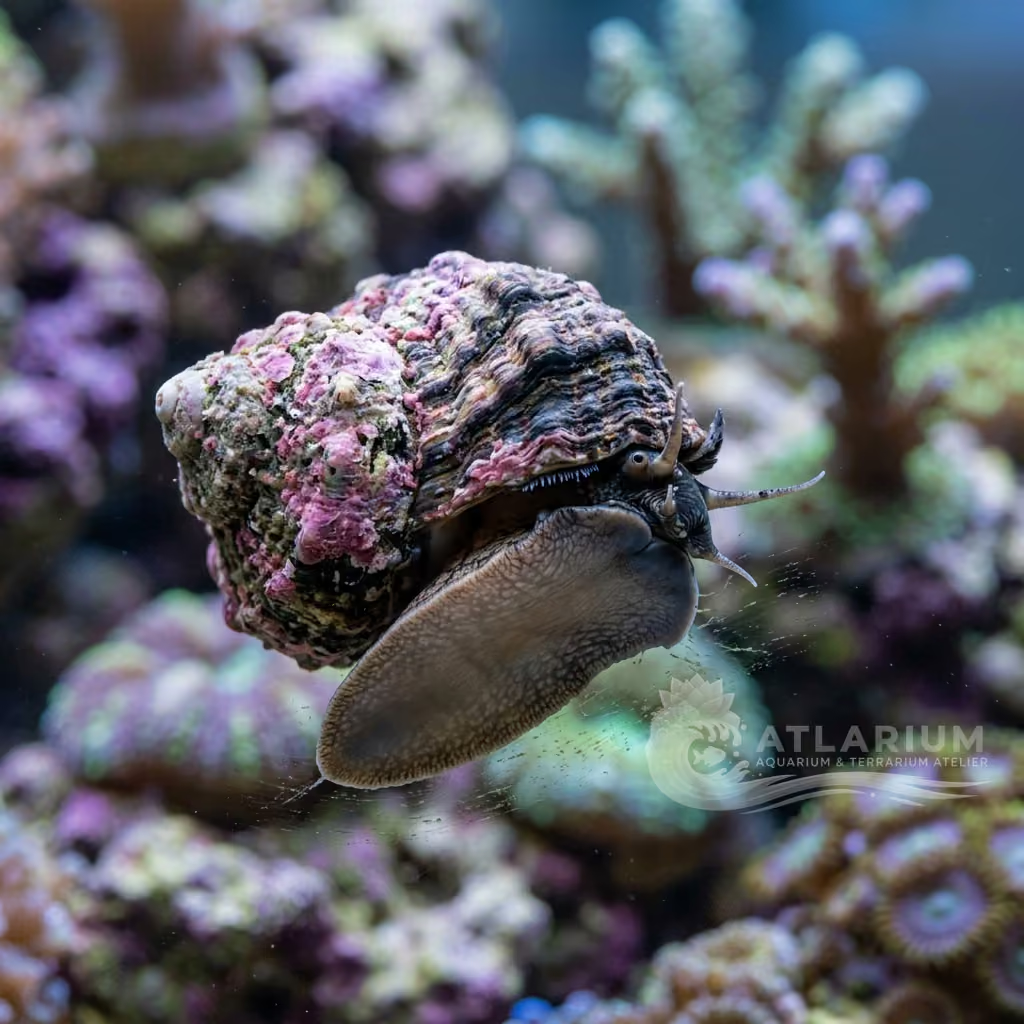
A hardy herbivorous marine turbo snail with a mottled brown shell. It is outstanding at scraping nuisance algae and diatoms from live rock and glass.
Wassertemperatur
22 - 28 °C
pH-Wert
8.1 - 8.4
Wassertyp
Meerwasser
Wirbelloser Typ
Freshwater snail
Erwachsenengröße
4 cm
Mindestgruppe
>= 1
KH
8 - 12 dKH
Ökologische Rolle
Herbivore
Kupferempfindlichkeit
High

Artbeschreibung
Geographical Origin and Habitat: Widely distributed across the tropical Indo-Pacific region, from the coast of East Africa and the Red Sea to Australia, Japan, the Philippines, and various islands of the central Pacific. It inhabits shallow marine waters, rocky reefs, tide pools, and seagrass beds.
Taxonomy: Belongs to the class Gastropoda, family Turbinidae, and genus Turbo. The officially accepted scientific name is Turbo bruneus (Röding, 1798), though the misspelling 'Turbo brunneus' is common in the hobby. It is characterized by its heavy, calcified shell and operculum.
Social Behavior: Completely peaceful and harmless. It is a slow-moving grazer that spends its time crawling over substrate, rocks, and glass. Mostly active at night, though it will forage during the day if algae is abundant. It does not bother other tank inhabitants.
Coloration and Sexual Dimorphism: The shell is thick and conical, showing a mottled brown color with cream, grey, or dark greenish markings. The operculum (trapdoor) is thick, calcified, and round, often white and green (known as a cat's eye). There is no visible sexual dimorphism.

Pflege, Zucht und Mitbewohner
Tank Setup: Best suited for established marine aquariums of at least 50 liters (12 gallons). Requires sturdy live rock structures that can support the snail's weight without collapsing. Small corals should be glued down, as these snails can easily bulldoze loose items.
Diet and Feeding: A strict herbivore. It feeds on film algae, diatoms, hair algae, and cyanobacteria. In clean tanks with low algae growth, they must be supplemented with dried seaweed (nori) attached to a veggie clip to prevent starvation.
Water Quality: Marine parameters must remain stable: density 1.021-1.025, temperature 22-26°C (71-79°F), and pH 8.1-8.4. High calcium levels (400-450 ppm) and adequate alkalinity are required to allow shell growth and prevent shell erosion.
Compatibility and Tankmates: 100% reef-safe. Compatible with peaceful fish, corals, and other invertebrates. Avoid keeping with aggressive hermit crabs that may kill the snail to steal its heavy shell for a home.
Aquarium Breeding: Broadcast spawners. They release eggs and sperm into the water column. The larval stage is pelagic and rarely survives home filtration, but occasional self-population can occur in large, established tanks.
Risks and Diseases: Very sensitive to copper treatments and high levels of nitrate. A major risk is falling upside down on flat sand; they often cannot turn themselves over and will die of exhaustion or predator attacks if not assisted.

Geografische Herkunft und Verbreitung
Widely distributed across the tropical Indo-Pacific region, from the coast of East Africa and the Red Sea to Australia, Japan, the Philippines, and various islands of the central Pacific. It inhabits shallow marine waters, rocky reefs, tide pools, and seagrass beds.
Ursprung
Tropische Ozeane und RiffeAfrika und MadagaskarSüd- und SüdostasienAustralien, Neuguinea und Ozeanien

Wirbelloses Profil
- Diät
- Algae eater
- Strictly herbivorous. Focuses on turf algae.
- Ökologische Rolle
- Herbivore
- Keeps the aquarium clean through continuous grazing.
- Erwachsenengröße
- 4 cm
- Sprungrisiko
- Yes
- Does not jump.
- Stoßempfindlichkeit
- High
- Needs a stable environment. Acclimate slowly.
- Kalzium und Mineralien
- High
- Requires typical reef tank calcium levels.
- Häutung
- Shell growth
- They do not molt. They continually calcify and add solid calcium carbonate to their thick, protective shells as they consume algae and grow larger throughout their lives.
- Reproduktion
- Oviparous
- This species reproduces as a broadcast spawner, releasing sperm and eggs into the water current. Captive breeding in typical home aquariums is exceedingly rare due to their complex larval requirements.
- Kompatibilität & Tankkameraden
- With caution
- They are 100% reef safe but notorious for acting like tiny bulldozers. Because of their size and strength, they will easily knock over any unsecured coral frags or lightweight rockwork.

Wissenschaftliche Modelle & Parameter
SeaLifeBase
Zugang zu den offiziellen wissenschaftlichen Daten der Art
SeaLifeBase v26.04Daten synchronisiert am: 15.06.2026
- Belastbarkeit
- Hoch (weniger als 15 Monate)

Verwandte Arten
Empfehlungen gruppiert nach nahen Verwandten, Auswahl von Begleitern und ähnlicher Betreuung.