Toadstool leather coral
Sarcophyton glaucum
Toadstool leather coral: marine corallo molle in the family Alcyoniidae, included for reef role, behavior, or aquarium utility. Geographical Origin and Habitat: The Toadstool Leather Coral...
Wassertemperatur
24 - 28 °C
pH-Wert
8.1 - 8.4
Wassertyp
Meerwasser
Wirbelloser Typ
Soft coral
Erwachsenengröße
40 cm
Mindestgruppe
>= 1
Ökologische Rolle
Symbiont
Kupferempfindlichkeit
High

Artbeschreibung
Geographical Origin and Habitat: The Toadstool Leather Coral (*Sarcophyton glaucum*) is an iconic, highly resilient soft coral natively endemic to the warm, sun-drenched, shallow reef flats and lagoons of the Indo-Pacific Ocean, the Red Sea, and the Great Barrier Reef. Their natural biotope is defined by expansive, high-energy environments where they dominate large sections of the reef alongside other soft corals, thriving in areas with intense, direct sunlight and strong, sweeping tidal currents.
Taxonomy: Scientifically classified within the Alcyoniidae (Leather Corals) family, they are octocorals entirely lacking a rigid calcium carbonate skeleton. Instead, their structure is supported by tiny, internal calcareous spicules (sclerites) embedded within their fleshy tissue. Morphologically, they perfectly resemble a large mushroom or toadstool. They feature a thick, fleshy stalk (capitulum) topped by a broad, slightly undulating, flattened disc (crown) from which hundreds of long, delicate polyps emerge.
Social Behavior: As sessile invertebrates, they do not exhibit traditional social behavior, but they are highly biologically active and fiercely competitive for space.
Fascinating Biological Process: They periodically undergo a process called "sloughing." The coral will completely retract all its polyps, shrink slightly, and its surface will develop a shiny, waxy film. Over several days, it sheds this film into the water current to physically remove built-up detritus, algae, and parasites.
Coloration and Sexual Dimorphism: Because they are clonal organisms, sexual dimorphism is not visually applicable. Their coloration is generally muted but highly attractive, relying on subtle pastels rather than the blinding neon of SPS corals. The thick stalk and the base of the crown are typically a pale, fleshy beige, tan, or muted olive green. The massively extended polyps are usually the visual highlight, presenting in a stunning pale green, mint green, or slightly glowing yellow-green hue under actinic blue lighting.

Pflege, Zucht und Mitbewohner
Tank Setup: The aquarium architecture must accommodate their potential for massive, rapid growth. A minimum 110-liter (30-gallon) marine aquarium is required.
CRITICAL REQUIREMENT: They MUST be securely glued or epoxied to a solid piece of live rock. Provide ample open space around them; a healthy Toadstool can rapidly expand its crown to over 12 inches (30 cm) in diameter, physically overshadowing and blocking light from any neighboring corals beneath it.
Diet and Feeding: They are largely autotrophic, deriving the vast majority of their nutritional requirements (up to 90%) from the photosynthesis performed by the symbiotic zooxanthellae algae housed within their fleshy tissues. Therefore, intense lighting is their primary "food." However, they also actively filter-feed from the water column. While target feeding is completely unnecessary, they will absorb dissolved organic nutrients and passively capture microscopic phytoplankton and zooplankton.
Water Quality: They are universally regarded as one of the most indestructible, "bulletproof" corals in the marine hobby, making them ideal for beginners. They demand stable tropical heat (24-27°C / 75-81°F) and a specific gravity between 1.023 and 1.025. Unlike delicate SPS corals, Leather Corals actually prefer slightly "dirty" water and thrive in systems with low-to-moderate Nitrate (5-15 ppm) and Phosphate levels. However, pristine Calcium and Alkalinity remain important for overall health.
Compatibility and Tankmates: Compatibility requires careful strategic placement. They are generally peaceful but employ invisible
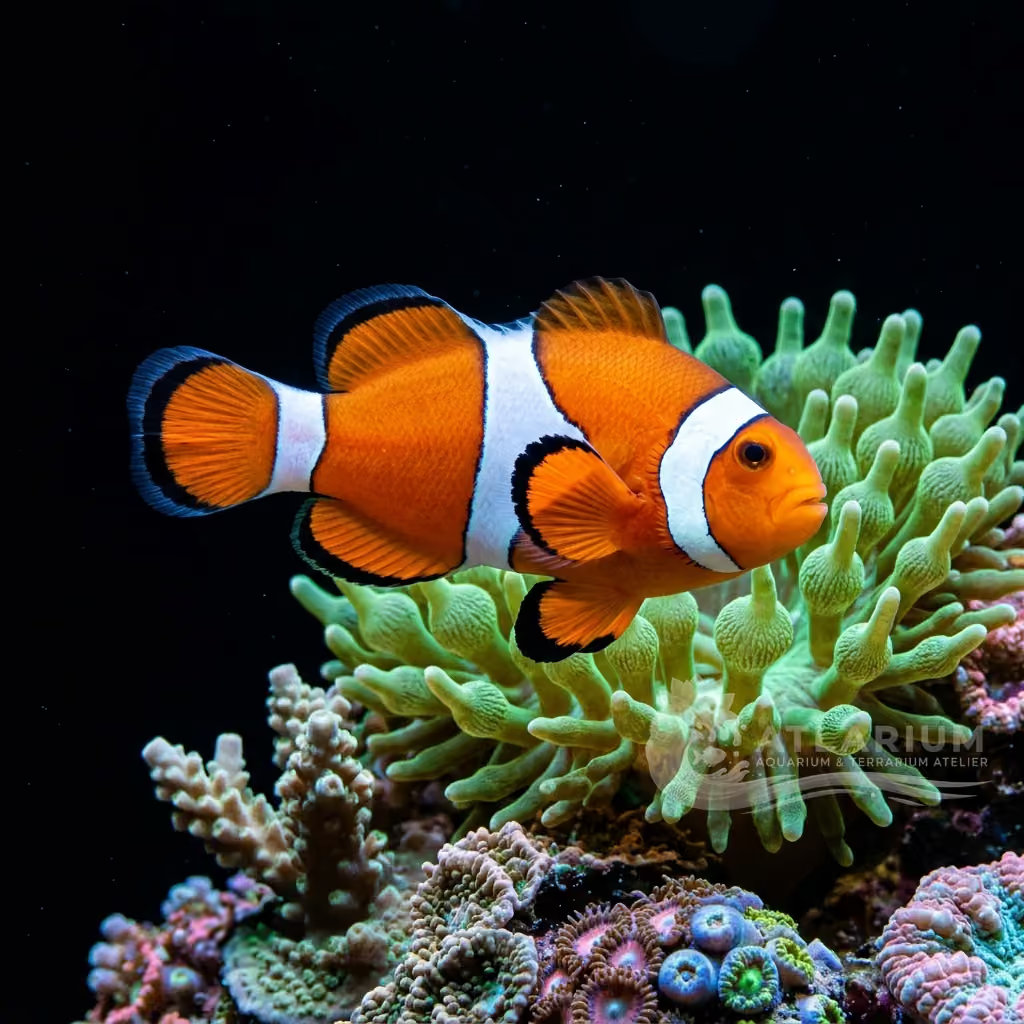
CHEMICAL WARFARE (Allelopathy): Toadstool Leathers constantly release potent chemical toxins (terpenes) into the water to stunt the growth of neighboring stony corals (LPS and SPS). Running activated carbon is highly recommended in mixed reef tanks to absorb these toxins. They frequently host Clownfish in the absence of a true anemone, providing a safe, surrogate home.
Aquarium Breeding: Propagating (fragging) the Toadstool Leather Coral is incredibly simple and highly successful. Aquarists simply use a razor blade or sharp scissors to cleanly slice a piece (like a slice of pizza) directly out of the crown, or even decapitate the entire crown. The cut piece is loosely attached to a frag plug using a rubber band or bridal veil (never superglue, as they produce too much slime) until it naturally attaches. The mother colony will rapidly heal the wound and regrow.
Risks and Diseases: The primary risk to Leather Corals is poor water flow; if the flow is too weak, they cannot successfully shed their waxy film during sloughing, leading to bacterial infections, tissue necrosis (rot), and death. The second risk is predatory pests; specific species of Nudibranchs and predatory flatworms are biologically adapted to eat Leather Corals. Always carefully dip and inspect new Leather Corals before introducing them to the display tank.

Geografische Herkunft und Verbreitung
The Toadstool Leather Coral (*Sarcophyton glaucum*) is an iconic, highly resilient soft coral natively endemic to the warm, sun-drenched, shallow reef flats and lagoons of the Indo-Pacific Ocean, the Red Sea, and the Great Barrier Reef. Their natural biotope is defined by expansive, high-energy environments where they dominate large sections of the reef alongside other soft corals, thriving in areas with intense, direct sunlight and strong, sweeping tidal currents.
Ursprung
Tropische Ozeane und RiffeAfrika und MadagaskarOstasien

Wirbelloses Profil
- Diät
- Photosynthetic
- Toadstool leathers rely predominantly on their symbiotic zooxanthellae to generate essential nutrients through photosynthesis under moderate to high lighting. While they do not require direct feeding like large-polyp stony corals, they passively absorb dissolved organic compounds from the water column. Supplemental additions of marine snow, phytoplankton, and amino acids can stimulate faster growth and promote robust polyp extension.
- Ökologische Rolle
- Symbiont
- In their natural Indo-Pacific habitats, they form massive colonies that offer shelter and microhabitats for a variety of reef-dwelling organisms. In captivity, they provide essential shade for lower-light corals and serve as a beautiful, swaying host for some clownfish species if an anemone is absent. They are active biological filters, assimilating dissolved organics and contributing significantly to the nutrient balance of the aquarium.
- Erwachsenengröße
- 40 cm
- Sprungrisiko
- No
- Stoßempfindlichkeit
- High
- Sarcophyton glaucum is remarkably tough but can still react negatively to sudden, extreme shifts in salinity, alkalinity, or temperature. When stressed or adjusting to new lighting parameters, they will entirely retract their polyps and may remain closed for several days. A steady acclimation process and placing them in areas of moderate, indirect flow helps them adjust without triggering a defensive shutdown.
- Kalzium und Mineralien
- High
- As a soft coral, the toadstool leather does not build a rigid calcium carbonate skeleton, thus its direct calcium consumption is minimal compared to SPS or LPS corals. However, it requires a stable, balanced chemistry including appropriate levels of calcium, magnesium, and alkalinity for internal structural support via sclerites. Routine water changes using high-quality reef salt are generally sufficient to maintain these vital parameters.
- Häutung
- Periodic
- This coral exhibits a fascinating, wax-like shedding process that is often mistaken by beginners for a sign of disease or death. Periodically, the coral will retract its polyps, shrink slightly, and form a shiny, translucent mucus film over its entire crown. After a few days, strong water currents will peel away this film, effectively shedding accumulated algae, detritus, and giving way to a larger, cleaner coral.
- Reproduktion
- Oviparous
- Toadstool leathers reproduce effectively in the aquarium through natural asexual budding or dropping small fragments from the edges of their crown. Aquarists frequently and easily propagate them through a process called 'fragging,' which involves cleanly slicing the crown into smaller pieces with a sharp blade. These fragmented pieces will quickly heal, attach to new rubble, and grow into entirely new, independent colonies.
- Kompatibilität & Tankkameraden
- Verify
- This coral is generally peaceful but utilizes potent chemical defenses (terpenes) to deter other corals from encroaching on its growing space. Heavy carbon filtration and protein skimming are highly recommended to prevent these chemical compounds from stunting the growth of sensitive neighboring stony corals. They should be positioned with ample room to grow, as they can quickly overshadow and shade out adjacent, lower-growing species.

Bildergalerie
Lizenzierte Bilder, die mit der Art oder, wenn markiert, mit dem nächstgelegenen repräsentativen Taxon verknüpft sind.

Verwandte Arten
Empfehlungen gruppiert nach nahen Verwandten, Auswahl von Begleitern und ähnlicher Betreuung.