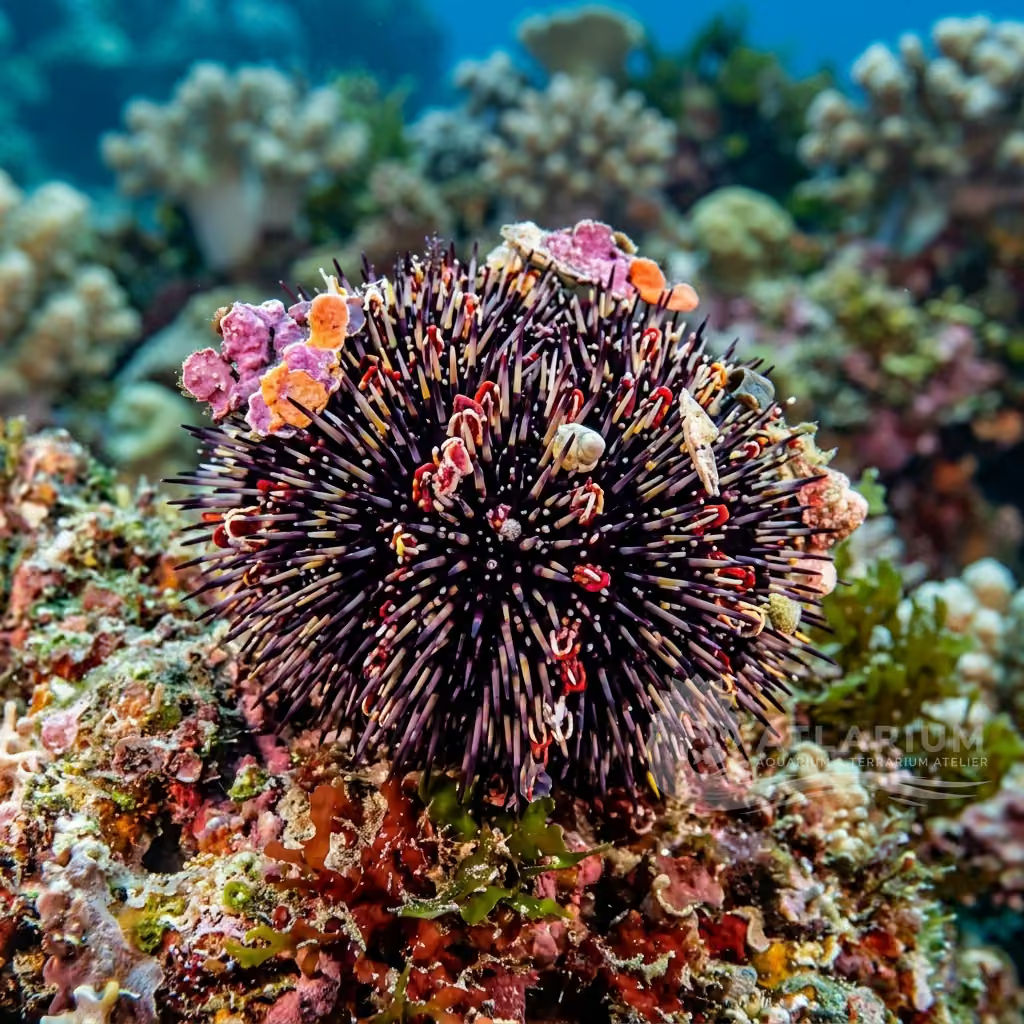
Tiger cowrie
Cypraea tigris
The Tiger Cowry is a large, striking mollusk famous for its beautifully patterned shell. A peaceful nocturnal herbivore, it requires a very large reef tank with securely glued rockwork to graze.
Wassertemperatur
22 - 28 °C
pH-Wert
8.1 - 8.4
Wassertyp
Meerwasser
Wirbelloser Typ
Freshwater snail
Erwachsenengröße
10 cm
Mindestgruppe
>= 1
KH
8 - 12 dKH
Ökologische Rolle
Herbivore
Kupferempfindlichkeit
High

Artbeschreibung
Geographical Origin and Habitat: Cypraea tigris is widely distributed throughout the tropical Indo-Pacific, from the coast of East Africa and the Red Sea to the Hawaiian Islands and French Polynesia. It inhabits outer reef slopes, lagoons, and shallow sandy flats to depths of about 30 meters. During the day, it seeks shelter in dark caves, under large coral plates, or in deep crevices to avoid natural predators.
Taxonomy: Belongs to the class Gastropoda, family Cypraeidae, and genus Cypraea. Described by Linnaeus in 1758, it is the quintessential cowrie species. The shell is heavy, egg-shaped, and has an exceptionally high natural polish because the animal's mantle tissue covers it almost entirely during activity, protecting it from abrasion and epibiont growth.
Social Behavior: A solitary and primarily nocturnal mollusk. During the day, it remains stationary in its hiding spots, but at night it extends its dark, papilla-covered mantle and crawls across the tank in search of food. It is peaceful toward fish and other non-prey invertebrates, but its large size and weight can make it physically destructive to aquascapes.
Coloration and Sexual Dimorphism: The shell features a white, cream, or yellowish background pattern, densely covered with dark brown to black spots of varying sizes, resembling a leopard or tiger print. The mantle is dark grey with black markings. No visible external sexual dimorphism exists; sexes can only be distinguished during reproduction or internal examination.

Pflege, Zucht und Mitbewohner
Tank Setup: Requires a mature and large marine aquarium of at least 300 liters. Since adults can reach a significant size (up to 12-15 cm) and have a heavy shell, they can easily knock over unsecured rockwork or damage loose coral colonies. All aquascape structures must be firmly glued. Provide large caves for daytime shelter.
Diet and Feeding: Unlike strictly herbivorous snails, Cypraea tigris is an opportunistic omnivore. It feeds on benthic algae, detritus, sponges, anemones, and soft coral polyps. In captivity, it must be offered pieces of fresh seafood, thawed shrimp, mussels, and dried nori. If underfed, it will nip at LPS and soft corals.
Water Quality: Demands stable marine water parameters. Temperature between 24°C and 28°C, pH of 8.1 to 8.4, specific gravity of 1.023 to 1.025, and dKH between 8 and 12. As a mollusk, it has zero tolerance for copper or heavy metals. Maintaining calcium (400-440 ppm) and magnesium (1250-1350 ppm) is vital for shell health.
Compatibility and Tankmates: Can be kept with peaceful or medium-sized reef fish. Do not house with mollusk-eating predators like puffers, triggers, or large wrasses that could crush its shell or attack the exposed mantle. It is not reef-safe for tanks containing delicate soft corals, anemones, or sponges.
Aquarium Breeding: Breeding in captivity is extremely rare and difficult. In nature, the female deposits egg capsules on hard surfaces and guards them by sitting on them for about two weeks. The hatched veliger larvae have a prolonged pelagic phase, making survival impossible in standard aquarium setups due to filtration systems.
Risks and Diseases: Starvation in sterile or clean tanks is the most common risk. The shell can erode if pH drops below 8.0 or if calcium levels are inadequate. Extremely sensitive to medications; copper treatments for fish diseases must never be used in a tank housing this cowrie.

Geografische Herkunft und Verbreitung
Cypraea tigris is widely distributed throughout the tropical Indo-Pacific, from the coast of East Africa and the Red Sea to the Hawaiian Islands and French Polynesia. It inhabits outer reef slopes, lagoons, and shallow sandy flats to depths of about 30 meters. During the day, it seeks shelter in dark caves, under large coral plates, or in deep crevices to avoid natural predators.
Ursprung
Tropische Ozeane und RiffeAfrika und Madagaskar

Wirbelloses Profil
- Diät
- Omnivore
- Omnivorous. Grazes on algae, but large adults may eat soft corals.
- Ökologische Rolle
- Herbivore
- A large scavenger that can help clean up a fish-only system.
- Erwachsenengröße
- 10 cm
- Sprungrisiko
- Yes
- Cannot jump. A heavy and slow-moving snail.
- Stoßempfindlichkeit
- High
- Sensitive to salinity changes. Do not expose it to air.
- Kalzium und Mineralien
- High
- Requires high calcium levels to maintain its massive shell.
- Häutung
- Shell growth
- Tiger cowries do not undergo molting. They possess an external shell that grows continually as they age by adding material to the edges. A unique fleshy mantle extends to fully cover the shell, secreting layers that keep the impressive shell completely glossy, polished, and free of algae or marine encrustations.
- Reproduktion
- Oviparous
- In their natural habitat, they are gonochoric broadcast spawners, with the female laying and carefully guarding a gelatinous egg mass. Captive reproduction, however, is exceedingly rare and considered virtually impossible for the average aquarist, as the delicate pelagic larvae require highly specialized care and planktonic diets to survive.
- Kompatibilität & Tankkameraden
- Not reef safe
- Use extreme caution when placing them in reef tanks. Their large, bulky size turns them into bulldozers that easily knock over unsecured rockwork and coral frags. Furthermore, as opportunistic omnivores, they will readily consume sponges, anemones, and expensive soft or LPS corals if their primary food sources run low.

Verwandte Arten
Empfehlungen gruppiert nach nahen Verwandten, Auswahl von Begleitern und ähnlicher Betreuung.