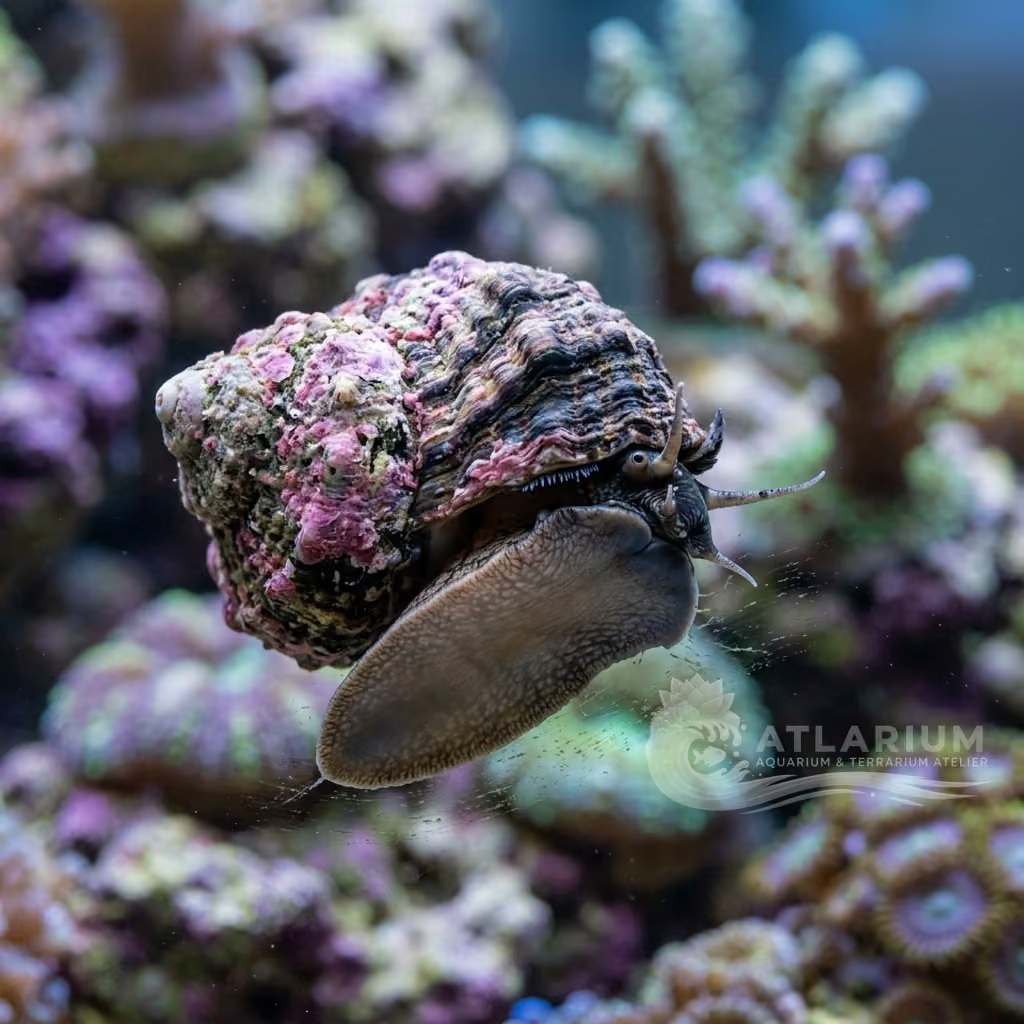
Millepora acropora
Acropora millepora
Acropora millepora, or "Mille," is a premium, fuzzy SPS coral from sunlit reef crests. It absolutely requires flawless water quality, intense flow, and extreme lighting.
Wassertemperatur
24 - 28 °C
pH-Wert
8.1 - 8.4
Wassertyp
Meerwasser
Wirbelloser Typ
SPS Coral
Erwachsenengröße
25 cm
Mindestgruppe
>= 1
Ökologische Rolle
Scavenger
Kupferempfindlichkeit
High

Artbeschreibung
Geographical Origin and Habitat: The Millepora Acropora (*Acropora millepora*), often simply called a "Mille," is an incredibly coveted, premium Small Polyp Stony (SPS) coral natively endemic to the ultra-shallow, brightly sunlit reef crests of the Indo-Pacific Ocean, the Red Sea, and the Great Barrier Reef. Their natural biotope is defined by extreme environments; they thrive in the highly oxygenated, chaotic surf zones directly subjected to the brutal, crashing mechanical force of the ocean waves.
Taxonomy: Scientifically classified within the Acroporidae family, they are the undisputed crown jewels of the SPS world. Morphologically, they possess a massive, dense, heavily calcified branching skeleton that forms tightly clustered, thick, corymbose (cushion-like) colonies.
Defining Feature: Unlike smooth *Acropora*, *A. millepora* possesses uniquely elongated, radial corallites (polyps) that extend far past the skeletal branch. This gives the entire coral a distinctly "hairy" or fuzzy appearance.
Social Behavior: They are entirely sessile and completely peaceful toward other coral species, lacking any long sweeper tentacles. However, they are highly aggressive competitors for environmental dominance. They achieve dominance through rapid, dense skeletal calcification, growing into massive, impenetrable thickets that physically block light and water flow from reaching neighboring, slower-growing corals on the reef crest.
Coloration and Sexual Dimorphism: Sexual dimorphism is non-existent. Their coloration is the primary driver of their legendary status in the hobby; they are capable of displaying some of the most intense, saturated colors of any living organism. The thick branches and extraordinarily long, "hairy" polyps typically present in blinding, solid neon colors: intense Barbie-pink, radioactive highlighter-green, sapphire blue, or deep sunset-orange. Premium color morphs command exceptionally high prices.

Pflege, Zucht und Mitbewohner
Tank Setup: The aquarium architecture MUST be specifically engineered for high-end SPS corals. A minimum 200-liter (55-gallon) mature reef aquarium is strictly required.
CRITICAL REQUIREMENT: They MUST be securely epoxied to the absolute highest peaks of the rockwork. They unconditionally demand
MASSIVE, BRUTAL WATER FLOW: (random, chaotic, and highly turbulent) to penetrate their tight branches, mimic the crashing ocean surf, and stimulate their famous "hairy" polyp extension.
Diet and Feeding: They are heavily autotrophic, relying overwhelmingly on their symbiotic zooxanthellae to convert blazing intense light into energy. However, because they grow so rapidly in such high-flow environments, they are also voracious filter feeders. While direct target feeding is impossible due to the microscopic size of the polyps, they must be passively fed. Broadcasting high-quality "Coral Snow," dissolved amino acids, and live phytoplankton into the high-flow water column is highly recommended.
Water Quality: This is an
EXPERT-LEVEL CORAL.: They demand absolutely pristine, flawless, and surgically stable water chemistry. Tropical heat must be rigidly locked at 25-26°C (77-79°F).
CRITICAL REQUIREMENT: They require blindingly intense lighting (PAR 300-500). Calcium (430-450 ppm), Magnesium (1350-1400 ppm), and specifically Alkalinity (7.5-8.5 dKH) MUST NOT FLUCTUATE. Even a minor swing of 1.0 dKH in 24 hours can trigger catastrophic Rapid Tissue Necrosis (RTN).
Compatibility and Tankmates: Compatibility requires strategic placement in an SPS-dominated system. They are completely peaceful but utterly defenseless against chemical warfare.
CRITICAL WARNING: They MUST NEVER be placed anywhere near aggressive LPS corals (*Euphyllia*, *Galaxea*, *Acanthastrea*). If an LPS sweeper tentacle touches a Millepora branch, it will instantly burn a dead white hole in the tissue. They are highly compatible with other *Acropora* and *Montipora* species.
Aquarium Breeding: Propagating (fragging) *Acropora millepora* is the backbone of the high-end SPS hobby. Aquarists use heavy-duty bone shears to snap off a 1 to 2-inch terminal branch. The severed branch is quickly glued to a ceramic frag plug using cyanoacrylate gel. Because they are fast growers under optimal conditions, the fragment will rapidly encrust the plug and sprout multiple new axial growth tips, forming a miniature colony in months.
Risks and Diseases:
CRITICAL MORTALITY RISK: *Acropora millepora* are the most sensitive corals in the hobby. The primary risk is Rapid Tissue Necrosis (RTN), a stress response to parameter fluctuations (especially Alkalinity) where the flesh literally sloughs off the skeleton overnight, killing the coral in hours. The second massive risk is Acropora Eating Flatworms (AEFW) and Red Bugs—microscopic parasites that specifically hunt and consume *Acropora*. Always dip and quarantine.

Geografische Herkunft und Verbreitung
The Millepora Acropora (*Acropora millepora*), often simply called a "Mille," is an incredibly coveted, premium Small Polyp Stony (SPS) coral natively endemic to the ultra-shallow, brightly sunlit reef crests of the Indo-Pacific Ocean, the Red Sea, and the Great Barrier Reef. Their natural biotope is defined by extreme environments; they thrive in the highly oxygenated, chaotic surf zones directly subjected to the brutal, crashing mechanical force of the ocean waves.
Ursprung
Tropische Ozeane und RiffeAfrika und MadagaskarSüd- und Südostasien

Wirbelloses Profil
- Diät
- Photosynthetic
- The diet of Acropora millepora typically reflects its natural foraging behavior as a marine small polyp stony (SPS) coral. It thrives on a varied diet that can include specialized commercial foods, naturally occurring biofilm, and appropriately sized organic matter. Providing a balanced nutritional profile ensures robust health, strong coloration, and proper energy levels. Supplemental feeding should be adjusted based on the maturity of the tank and the presence of natural food sources.
- Ökologische Rolle
- Scavenger
- In its native habitat and the home aquarium, Acropora millepora plays a vital ecological role. It contributes significantly to the processing of organic waste and the maintenance of a balanced micro-ecosystem. By engaging in natural behaviors like scavenging, grazing, or sifting, it helps prevent the accumulation of detritus. This species is often considered a crucial component of a comprehensive clean-up crew.
- Erwachsenengröße
- 25 cm
- Sprungrisiko
- No
- Stoßempfindlichkeit
- High
- Sudden shifts in water parameters can trigger severe osmotic shock in Acropora millepora. It requires slow, careful acclimation, preferably using the drip method over several hours. Rapid changes in temperature, salinity, or pH can lead to immediate stress, failed molts, or mortality. Maintaining absolute stability in the tank is more important than chasing specific target values.
- Kalzium und Mineralien
- High
- Adequate calcium levels are absolutely essential for the structural integrity and growth of Acropora millepora. For crustaceans and snails, it facilitates proper shell and exoskeleton development, while for corals, it builds the skeletal structure. Aquarists must regularly monitor calcium concentration alongside alkalinity and magnesium. Supplementation through specialized products or mineral-rich foods may be necessary in depleted systems.
- Häutung
- No
- If applicable to this species, the molting process is a highly vulnerable period for Acropora millepora. During this time, the animal will hide while its new exoskeleton hardens, requiring peace and stable water chemistry. The discarded molt should generally be left in the tank, as it provides a valuable source of recycled minerals. A lack of iodine or calcium can lead to fatal molting issues, often referred to as the 'white ring of death'.
- Reproduktion
- Oviparous
- The reproductive strategy of Acropora millepora can range from simple cloning and fragmentation to complex larval stages requiring varying water conditions. Successful captive breeding often signifies excellent water quality and a well-balanced environment. While some species will readily multiply and populate the tank, others may require specialized rearing setups for the offspring to survive. Researching their specific larval development phase is critical for aquarists aiming to breed them.
- Kompatibilität & Tankkameraden
- Verify
- When selecting tank mates for Acropora millepora, cautious planning is imperative to avoid predation or aggressive competition. Small or peaceful invertebrates should not be housed with aggressive fish, loaches, or large crabs that might view them as food. Conversely, some specialized invertebrates form symbiotic relationships that can be highlighted in a community setup. A heavily planted or intricately rock-scaped tank often provides necessary refuges.

Bildergalerie
Lizenzierte Bilder, die mit der Art oder, wenn markiert, mit dem nächstgelegenen repräsentativen Taxon verknüpft sind.

Verwandte Arten
Empfehlungen gruppiert nach nahen Verwandten, Auswahl von Begleitern und ähnlicher Betreuung.