Java Barb
Systomus rubripinnis
Often sold in shops without warning that it is a freshwater giant. This majestic silvery barb devours aquatic plants and demands massive aquariums to house its restless school.
Wassertemperatur
20 - 26 °C
pH-Wert
6 - 8
Wassertyp
Süßwasser
Tankfüllstand
Unten und in der Mitte
Erwachsenengröße
25 cm
Mindesttankvolumen
>= 300 L
Mindestgruppe
>= 1
GH
2 - 20 dGH
KH
1 - 10 dKH
TDS
40 - 400 ppm
Leitfähigkeit
63 - 625 uS/cm

Artbeschreibung
Geographical Origin and Habitat: Widely distributed throughout Indochina, the Mekong basin, and the island of Java. Adapts to almost all fluvial habitats: large clear rivers with strong currents, turbid agricultural irrigation canals, and plains flooded during monsoons. It is a crucial human food resource in the area.
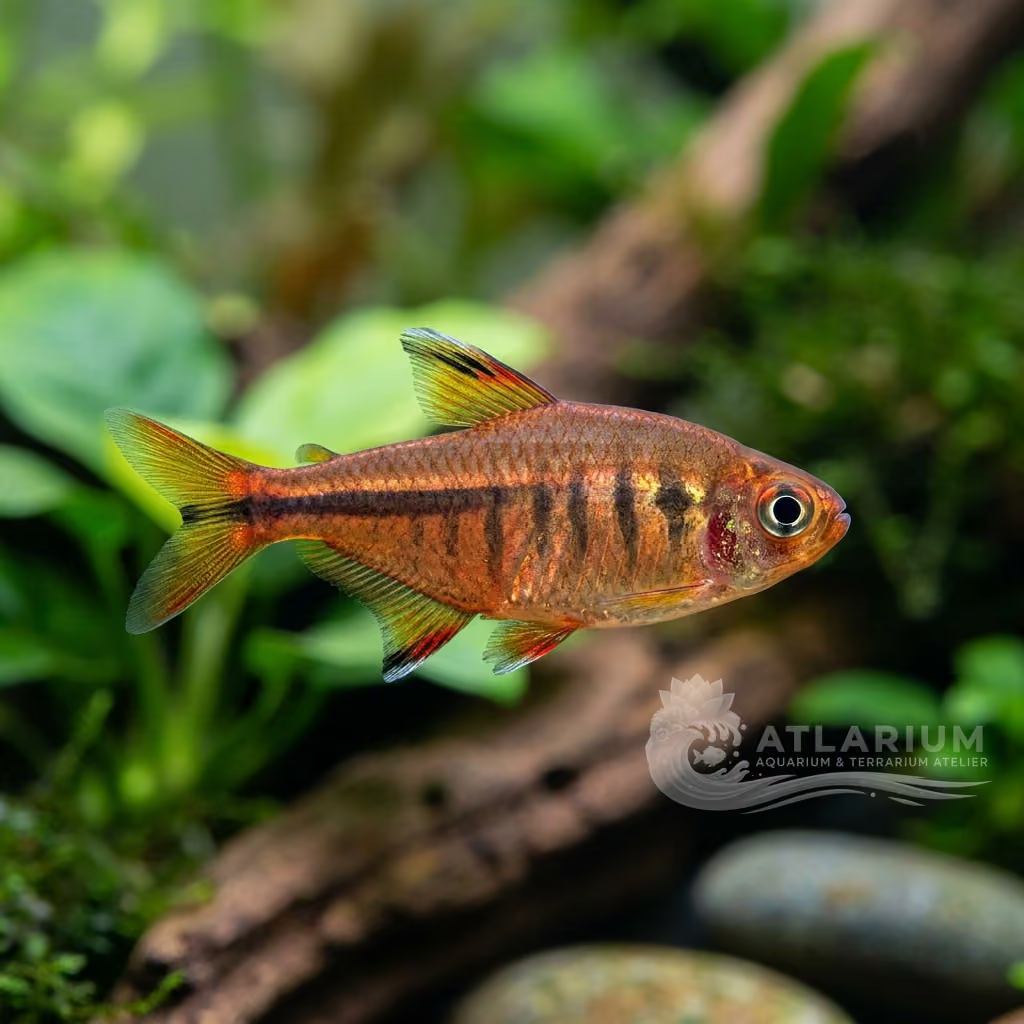
Taxonomy and Morphology: Cyprinidae. This fish has undergone numerous name changes, known in the past as Puntius orphoides or Puntioplites. It presents the classic deep, very tall diamond/lozenge-shaped body, covered in large, rigid scales. Reaches the impressive size of 25 cm (10 inches), the size of a dinner plate.
Social Behavior: Formidable schooling swimmer. Despite its 'freshwater monster' size, it is very peaceful, but infinitely exuberant and hyperactive. It frantically swims back and forth across the tank, digging in the substrate. MUST live in groups (at least 5-6 specimens), otherwise a solitary specimen will develop psychosis, becoming apathetic and refusing food.
Coloration and Sexual Dimorphism: The entire massive body is a brilliant silver leaf or reflective metallic aluminum, sometimes with coppery shadows on the back. A blood-red spot stands out on the gills. The breathtaking touch of color is provided by the pelvic, anal, and caudal fins: painted an intense coral red or fire red with black tips. Females are true, egg-laden colossuses; males are slimmer with more intense reds.

Pflege, Zucht und Mitbewohner
Aquarium Setup: Demands public aquarium-style or 'monster tanks'. Minimum footprint 150-180 cm (5-6 feet) long. Do not furnish the aquarium with delicate plants: they will eat them or uproot them by ramming them. Opt for large smooth river stones, enormous smooth driftwood, and, if vegetation is desired, use only mastodontic Anubias tied to high branches. Extreme mechanical filtration is needed to handle their monstrous bioload (feces).
Diet and Feeding: Omnivores with a very strong herbivorous ('lawnmower') tendency. They literally devour anything: huge sinking cichlid pellets, flakes, thawed shrimp. Crucial to provide a large vegetable base every day (sinking spirulina wafers, blanched zucchini, romaine lettuce) otherwise they will suffer lethal intestinal blockages.
Water Quality: Totally bulletproof. These are fish that naturally tolerate polluted rivers. They accept any pH (6.0 - 8.0) and soft or calcareous water up to GH 20. Appreciate slightly cool water (20-26°C / 68-79°F).
Compatibility and Cohabitation: The perfect dither fish for aquariums with giant American Cichlids (Oscars, Geophagus) or large catfish (Pimelodus, Plecostomus). They are too large and massive to be eaten by almost anything. Forbidden to add them to tanks with small fish under 4 cm (1.5 inches), as they will eventually try to swallow them.
Aquarium Breeding: Only happens in miles-long tanks, scattering thousands of eggs among roots or debris piles. Very difficult to replicate at home due to the enormous size of the breeders.
Risks and Diseases: Stunting or irremediable illness if kept in classic 1-meter (3-foot) tanks for normal hobbyists. They will literally smash thin glass lids or fracture their jaws if they hit obstacles during a panic sprint.

Geografische Herkunft und Verbreitung
Widely distributed throughout Indochina, the Mekong basin, and the island of Java. Adapts to almost all fluvial habitats: large clear rivers with strong currents, turbid agricultural irrigation canals, and plains flooded during monsoons. It is a crucial human food resource in the area.
Ursprung
Kosmopolitisch oder eingeführtSüd- und SüdostasienOstasienTropische Ozeane und Riffe

Fischprofil
- Temperament
- Semi-aggressive
- The Redfin Barb is a peaceful but highly active and sometimes boisterous fish. Their constant, rapid movement is their most defining behavioral trait. When kept in proper numbers, they direct their energy towards each other in harmless displays. They are excellent dither fish that can encourage shy species to come out of hiding.
- Diät
- Omnivore
- In the wild, they are opportunistic omnivores feeding on insects, plant matter, and small invertebrates. In the aquarium, they are voracious eaters that will accept almost any high-quality flake or granular food. Their diet should be varied with live or frozen foods like bloodworms and daphnia, as well as blanched vegetables. Providing a balanced diet enhances their red fin coloration and overall vitality.
- Lebenserwartung
- 5-10 years
- Erwachsenengröße
- 25 cm
- Geschlechterverhältnis
- School
- As a schooling fish, they must be kept in groups of at least six, though ten or more is highly preferable. In larger groups, a mix of males and females diffuses any minor squabbling and encourages the males to display their best colors. Keeping them in too small a group can lead to stress and fin-nipping behaviors directed at other tankmates. Males are generally slimmer and more intensely colored than females.
- Fütterungsfrequenz
- Twice daily
- Feed them small amounts two or three times a day. They are enthusiastic eaters that consume food greedily at all levels of the water column. Ensure that food is spread out so that less aggressive fish also have a chance to eat. Fasting them for one day a week can aid digestion and mimic natural food scarcity.
- Bioload
- High
- The Redfin Barb produces a moderate bioload due to its active nature and healthy appetite. They are fast swimmers that constantly forage, requiring a highly efficient biological filtration system. Regular water changes are necessary to keep nitrate levels in check, as they are sensitive to declining water quality. A mature tank with excellent filtration is key to their long-term health.
- Fluss
- Stagnant
- They originate from flowing rivers and streams in Southeast Asia and thrive in moderate to high water flow. Strong currents provide the oxygenation and physical exercise these energetic swimmers require. A powerhead or a strong filter return will encourage their natural schooling behavior against the current. However, there should always be resting spots provided by dense vegetation or driftwood.
- Sprungrisiko
- Yes
- Due to their active, fast-paced swimming style, they pose a moderate to high jump risk. They can easily launch themselves out of the water if startled or during frantic feeding sessions. A tight-fitting lid is absolutely essential to keep this species safely contained. Open-top aquariums are highly discouraged for these energetic barbs.
- Reproduktion
- Oviparous
- They are egg-scatterers that exhibit no parental care and will eagerly consume their own eggs. Breeding requires a separate tank with a mesh floor or dense spawning mops where the eggs can fall out of reach. Spawning is triggered by large, cool water changes and feeding live foods. The fry are tiny and require infusoria followed by newly hatched brine shrimp as they grow.
- Kompatibilität & Tankkameraden
- With caution
- They are generally peaceful schooling fish but their fast, active swimming can intimidate shy or slow-moving species. They make great companions for other robust cyprinids, large tetras, and peaceful bottom dwellers like Corydoras or loaches. Long-finned or slow fish like Angelfish may occasionally be nipped if the barbs are kept in too small a group. Keep them with fish of similar size and energy levels.
- Tankfüllstand
- Middle/Bottom
- They are primarily mid-water to upper-level swimmers that utilize open spaces to shoal. They are constantly on the move, darting back and forth across the length of the aquarium. They appreciate tanks with a long footprint to accommodate their active lifestyle. While they need open swimming space, they also appreciate heavily planted areas along the margins to retreat into.

Wissenschaftliche Modelle & Parameter
FishBase
Zugang zu den offiziellen wissenschaftlichen Daten der Art
FishBase v25.04Daten synchronisiert am: 15.06.2026
- Trophäenniveau
- 2,9 ± 0,34 se
- Belastbarkeit
- Mittel (1,4 - 4,4 Jahre)
- Phylogenetische Einzigartigkeit (PD50)
- 0.5
- Bayessche Längen-Gewichts-Beziehung
- a = 0.01072, b = 3.02
- AnfälligkeitGeringe Anfälligkeit (21 / 100)

Verwandte Arten
Empfehlungen gruppiert nach nahen Verwandten, Auswahl von Begleitern und ähnlicher Betreuung.