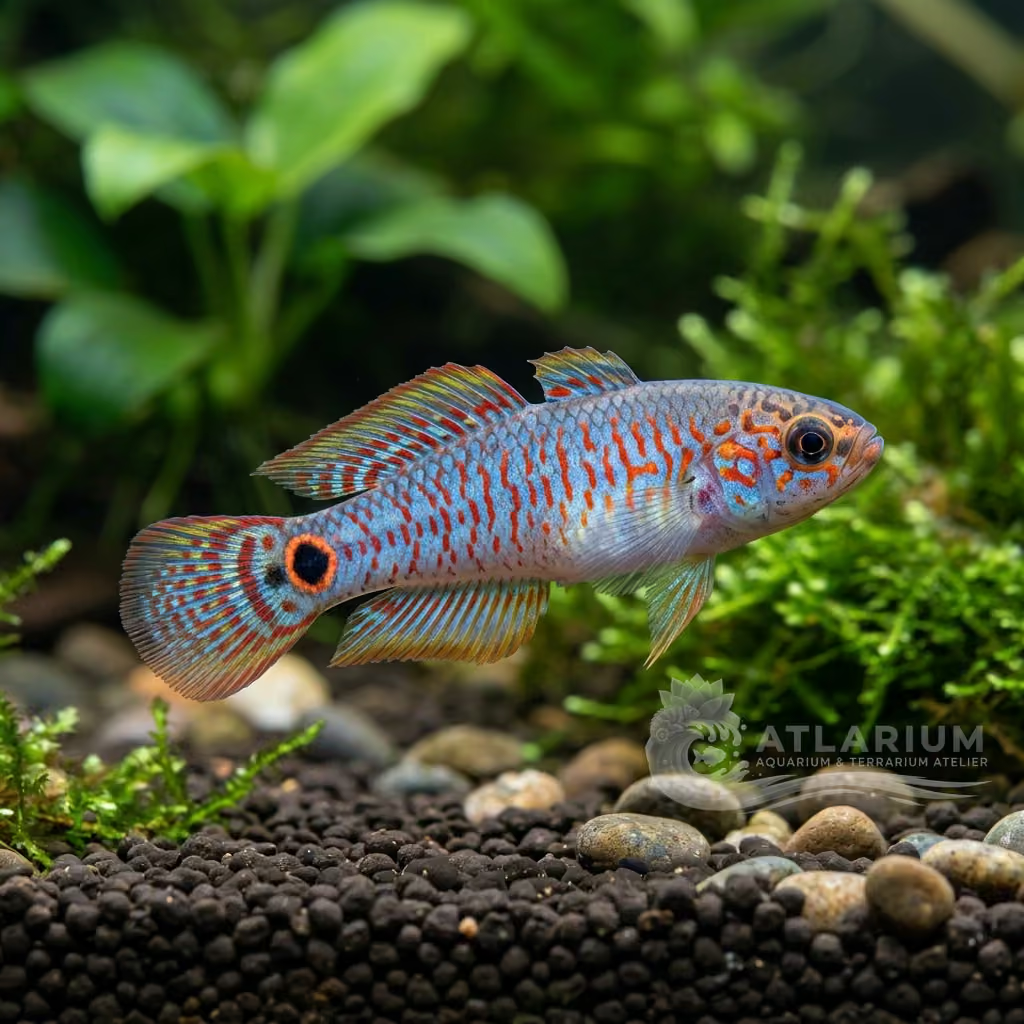
Vietnamese White Cloud
Tanichthys micagemmae
The miniature cousin of the classic White Cloud. A hyper-hardy subtropical cyprinid that thrives at cool temperatures, decorated with a bright white-neon lateral stripe that catches the light.
Wassertemperatur
18 - 23 °C
pH-Wert
6.5 - 7.5
Wassertyp
Süßwasser
Tankfüllstand
Oberfläche und Mitte
Erwachsenengröße
3 cm
Mindesttankvolumen
>= 30 L
Mindestgruppe
>= 1
GH
5 - 15 dGH
KH
2 - 7 dKH
TDS
95 - 295 ppm
Leitfähigkeit
148 - 461 uS/cm

Artbeschreibung
Geographical Origin and Habitat: Endemic to the small rocky tributaries and mountain streams in the Ben Hai river basin, central Vietnam. Inhabits shallow sandy bottoms, with clear waters, fast-moving currents, and high oxygenation.
Taxonomy and Morphology: Cyprinidae. Discovered only in 2001. It is noticeably slimmer and shorter than the classic Tanichthys albonubes (White Cloud Mountain Minnow). The body shape is a tiny torpedo, barely reaching 2.5-3 centimeters (1-1.2 inches).
Social Behavior: Extremely lively, peaceful, and totally gregarious. To be kept in schools of at least 10-15 specimens. Males engage in spectacular sparring matches, swimming parallel and arching their bodies and fins to maximum extension, but without ever hurting each other.
Coloration and Sexual Dimorphism: Semi-transparent silvery-gray base body. The main feature is the vivid, sharp milk-white stripe (with blue neon flashes) bordered below by a thin black line, running all along the flank. All male fins (dorsal, anal) are tinted coral red or bright ruby, broad and sail-shaped. Females are egg-laden with much shorter, almost colorless fins.

Pflege, Zucht und Mitbewohner
Aquarium Setup: Being so small, a 60 cm (24 inch) aquarium is a real castle. Create a 'mountain stream' layout: an abundance of smooth round stones, fine gravel and sand, clean driftwood, and a few tufts of moss. They literally love swimming against the current, so a powerful filter or an additional powerhead is strongly recommended.
Diet and Feeding: Very agile micro-omnivores. They will pick food at every level of the aquarium. Powdered flakes and nano granules are fine, but for the color explosion on the males' fins, it is vital to feed baby brine shrimp, small live/frozen daphnia, and cyclops.
Water Quality: SUBTROPICAL FISH. A HEATER IS NOT NEEDED (in most homes). They thrive incredibly well between 18 and 22°C (64-72°F) (maximum 23-24°C / 75°F in summer tolerated well if the water is hyper-oxygenated). They tolerate moderate tap water hardness well (GH 5-15) and neutral/alkaline pH (6.5 - 7.5).
Compatibility and Cohabitation: The undisputed queen species of river nano-aquariums. Perfect paired in fast waters with small loaches (Sewellia, Gastromyzon, Kuhlis) or Hillstream Loaches, all lovers of flowing oxygenated waters. Also excellent with dwarf shrimp (Cherry Shrimp) since their mouths are too small to decimate the adult shrimp colony.
Aquarium Breeding: Continuous and messy. They lay one egg at a time among fine leaves (e.g. moss). Unlike most cyprinids, they are NOT ruthless cannibals of their own eggs: in a dense aquarium, dozens of fry will grow up undisturbed among the adults.
Risks and Diseases: 1. Killed slowly by heat and premature aging if forced to live in stable tropical aquariums at 27-28°C (82°F) alongside Discus or Rams. 2. Genetic weakness from inbreeding if purchased from poor stock.

Geografische Herkunft und Verbreitung
Endemic to the small rocky tributaries and mountain streams in the Ben Hai river basin, central Vietnam. Inhabits shallow sandy bottoms, with clear waters, fast-moving currents, and high oxygenation.
Ursprung
Tropische Ozeane und RiffeSüd- und Südostasien

Fischprofil
- Temperament
- Semi-aggressive
- They are incredibly peaceful, energetic, and completely non-aggressive. Males spend a significant amount of time displaying to one another, spreading their fins to show off their colors. These displays are entirely harmless and highly entertaining to watch. They are a joyful addition that brings constant motion to a nano setup.
- Diät
- Omnivore
- They are tiny omnivores that require appropriately sized micro-foods. High-quality crushed flakes, micro-pellets, and powdered fry foods are excellent staples. They thrive when offered frequent live or frozen foods like daphnia, newly hatched brine shrimp, and cyclops. A varied diet brings out the stunning sparkling stripe along their sides.
- Lebenserwartung
- 3-5 years
- Erwachsenengröße
- 3 cm
- Geschlechterverhältnis
- School
- They are a schooling species that feels most secure in groups of 8 to 10 or more. A mixed group allows for natural social dynamics and beautiful sparring displays between competing males. Males are generally more colorful with longer fins, while females are noticeably plumper. A ratio of equal males to females works perfectly.
- Fütterungsfrequenz
- Twice daily
- Feed them very small amounts once or twice daily. Because their mouths are incredibly small, they need time to pick at micro-foods suspended in the water column. They are eager eaters but cannot consume large pieces. Ensure that food remains suspended long enough for them to eat before it sinks into the substrate.
- Bioload
- Low
- The Vietnamese White Cloud produces an exceptionally low bioload, similar to its more common cousin. They are perfect for nano tanks, generating very minimal waste. A gentle sponge filter is usually adequate to maintain water quality and provide necessary biological filtration. Weekly small water changes ensure their environment remains spotless and oxygen-rich.
- Fluss
- Stagnant
- They originate from shallow, clear streams and appreciate gentle to moderate flow. Strong, turbulent currents will exhaust them, so filter outputs should be baffled or gently diffused. A steady, gentle current provides them with exercise and mimics their natural habitat. They also appreciate dense vegetation to rest out of the flow.
- Sprungrisiko
- Yes
- Like many small, active top-dwellers, they pose a moderate jump risk. They can be easily startled by sudden movements outside the tank or aggressive feeding behavior. A tight-fitting lid or a thick layer of floating plants is strongly recommended. Cover any large gaps around the filter to prevent escapes.
- Reproduktion
- Oviparous
- They breed similarly to the standard White Cloud, acting as continuous egg-scatterers. In a well-planted setup with lots of Java Moss, fry will often survive alongside the adults. The parents are not aggressive egg-eaters if well-fed, making colony breeding quite simple. The microscopic fry require infusoria for the first week before graduating to larger foods.
- Kompatibilität & Tankkameraden
- Peaceful
- They are remarkably peaceful and ideal for nano community aquariums. Excellent tankmates include dwarf shrimp, micro-rasboras, and small Corydoras species. They should absolutely never be kept with larger, boisterous, or aggressive fish that could easily swallow them. They are completely harmless to plants and all peaceful invertebrates.
- Tankfüllstand
- Top/Middle
- They are highly active in the top and middle levels of the aquarium. They enjoy swimming in open spaces but always stay close to the safety of tall plants. They often patrol just below the surface waiting for food to drop. They do not interact with the bottom substrate.

Wissenschaftliche Modelle & Parameter
FishBase
Zugang zu den offiziellen wissenschaftlichen Daten der Art
FishBase v25.04Daten synchronisiert am: 15.06.2026
- Trophäenniveau
- 3 ± 0,2 se
- Phylogenetische Einzigartigkeit (PD50)
- 0.5312
- Bayessche Längen-Gewichts-Beziehung
- a = 0.00389, b = 3.12
- AnfälligkeitGeringe Anfälligkeit (10 / 100)

Verwandte Arten
Empfehlungen gruppiert nach nahen Verwandten, Auswahl von Begleitern und ähnlicher Betreuung.