Spotted Congo Puffer
Tetraodon schoutedeni
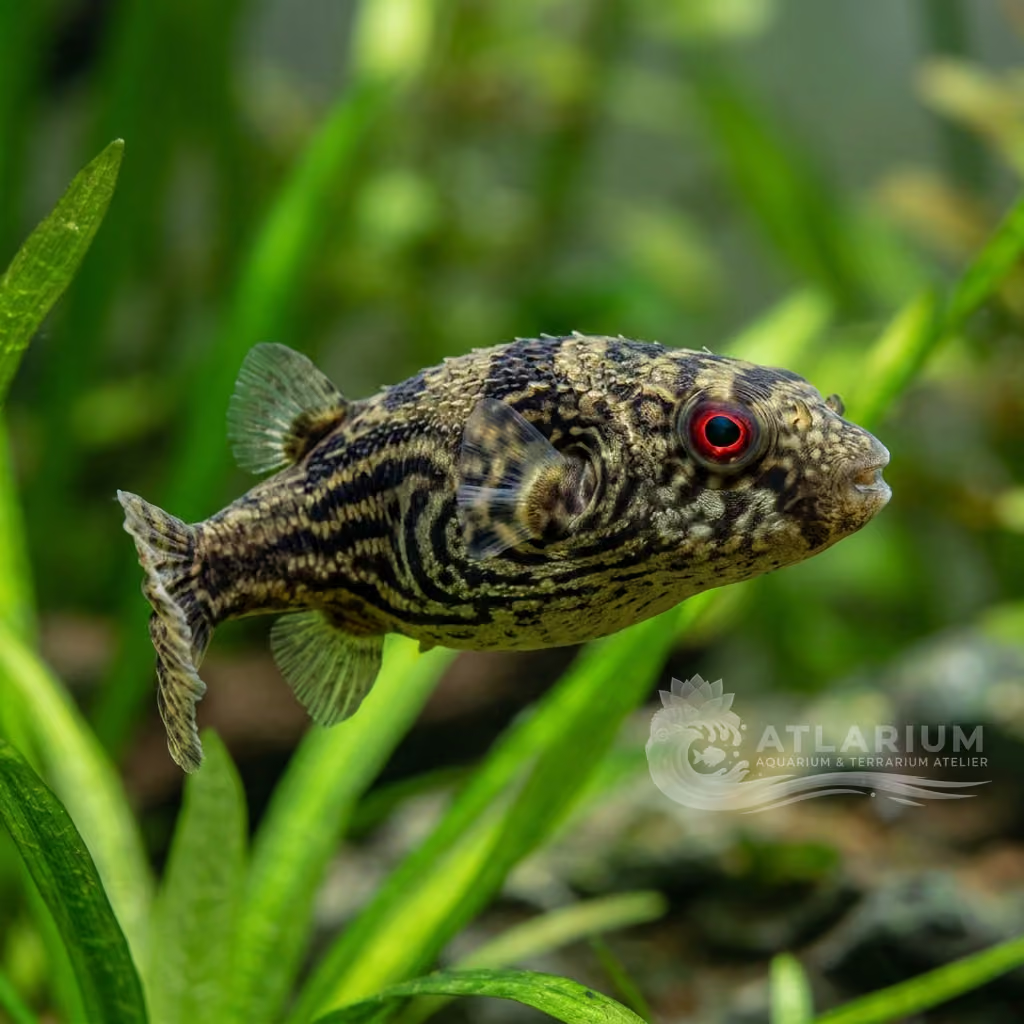
The 'Puppy Dog' Puffer (3.5-4 inches / 10 cm). The Schoutedeni Puffer was missing from the hobby for 30 years and is now the Holy Grail of true freshwater puffers. It has a beautiful leopard-spotted blimp-like body and highly intelligent, independently moving chameleon eyes. Unlike the famously hyper-aggressive and homicidal Fahaka or Mbu puffers, the Congo Puffer is miraculously peaceful, clumsy, and interactive, literally begging for food like a water-puppy.
Wassertemperatur
24 - 28 °C
pH-Wert
6.5 - 7.5
Wassertyp
Süßwasser
Tankfüllstand
Mitte
Erwachsenengröße
10 cm
Mindesttankvolumen
>= 100 L
Mindestgruppe
>= 1
GH
5 - 15 dGH
KH
2 - 7 dKH
TDS
95 - 295 ppm
Leitfähigkeit
148 - 461 uS/cm

Artbeschreibung
Geographical Origin and Habitat: Endemic to the Congo River basin in Central Africa (Pool Malebo). Strictly and perennially a freshwater pufferfish (no salt). Inhabits slow-flowing river stretches with muddy bottoms thickly covered with aquatic vegetation and decaying wood.
Taxonomy and Morphology: Known as the Spotted Congo Puffer. It is one of the few medium-sized pufferfish (up to 10 cm / 4 inches in adulthood) that has a reasonably mild disposition. Like all Tetraodontidae, it is scaleless, has a strong dental beak, and can inflate with water to deter predators.
Social Behavior: Highly famous in the aquarium hobby because it is the only medium-sized African pufferfish that is generally tolerant and community-friendly. Forms small, curious, and extremely intelligent groups in which they gently chase each other to establish hierarchy, swimming like clumsy little submarines.
Coloration and Sexual Dimorphism: Pale yellow-green back and flanks, densely decorated with well-defined round spots (polka dots) and black and brown vermiculated streaks. The belly is ivory white. There is no clear visual sexual dimorphism, except for the more pronounced abdominal roundness in females during breeding periods.

Pflege, Zucht und Mitbewohner
Aquarium Setup: Minimum aquarium of 100-120 liters (30 gallons). It imperatively needs heavily planted tanks, thick with Anubias, Java ferns, twisted driftwood, and caves that offer countless blind spots to tease its endless investigative curiosity. Fine sandy bottom where they love to rest or blow to unearth prey.
Diet and Feeding: Molluscivorous and insectivorous. Refuses dry processed feeds. Must consume huge quantities of hard-shelled snails (Malaysian Trumpet Snails, Ramshorns) for their dental health. Readily accept giant bloodworms, clam pieces, live earthworms (chopped), and frozen shrimp dusted with vitamin complexes.
Water Quality: Scaleless, requiring perfect parameters. Stable pH between 6.5 and 7.5. Temperature between 24.0 and 28.0 °C (75-82 °F). GH hardness from 5.0 to 15.0. Totally sensitive to ammonia and nitrite spikes, which cause immediate intoxication manifested by extreme inactivity and dull coloration.
Compatibility and Cohabitation: The only averagely "community" pufferfish. If raised well-fed and in ample spaces, it can coexist excellently with large Rainbowfish (Melanotaenia), large Corydoras, Congo Tetras, and Synodontis. Avoid pairing with static fish and those with flowing fins that sooner or later might be tasted out of curiosity.
Aquarium Breeding: Very difficult but achieved and documented by rare European experts. Often triggered by substantial and cool water changes. After a clumsy belly-to-belly courtship, the pair scatters free eggs on thick moss. Fry are born vulnerable and preyed upon even by parents, demanding constant microscopic infusoria.
Risks and Diseases: Crazy purchase price: up to 100-150 USD/EUR per specimen, making mortality dramatic. They fear high nitrates. Keeping them without almost daily administration of live snails leads to lethal dental overgrowth. Avoid mesh nets in which the fish would get stuck with micro-spines if it inflates into a ball.

Geografische Herkunft und Verbreitung
Endemic to the Congo River basin in Central Africa (Pool Malebo). Strictly and perennially a freshwater pufferfish (no salt). Inhabits slow-flowing river stretches with muddy bottoms thickly covered with aquatic vegetation and decaying wood.
Ursprung
Afrika und Madagaskar

Fischprofil
- Temperament
- Semi-aggressive
- They are inquisitive, relatively peaceful, and highly interactive fish. They lack the extreme aggression typical of most pufferfish, making them highly sought after in the hobby. Their charming personality and manageable size make them an ideal, albeit rare, pet fish.
- Diät
- Omnivore
- A diet rich in hard-shelled foods is critical to keep their teeth properly ground down. Pest snails, such as ramshorn and bladder snails, should make up a large portion of their diet. Without sufficient hard foods, their teeth will require stressful manual trimming.
- Lebenserwartung
- 8-12 years
- Erwachsenengröße
- 10 cm
- Geschlechterverhältnis
- Harem
- Sexing is difficult, but mature females are often rounder and slightly larger than males. They are one of the few puffers that can usually be kept in groups without severe aggression. A ratio of one male to multiple females is ideal to minimize any potential territorial squabbles.
- Fütterungsfrequenz
- Twice daily
- They should be fed small meals once or twice daily to keep them active and healthy. It is important not to overfeed, as they will readily consume more than they need. A slight rounding of the belly is a good indicator that they have had enough to eat.
- Bioload
- Low to Medium
- The Schoutedeni puffer has a moderate bioload compared to larger puffer species. Because they are scaleless, they are highly sensitive to water quality, meaning strong filtration and regular water changes are mandatory. Their messy eating habits contribute to rapid waste buildup if not maintained.
- Fluss
- Stagnant
- They originate from rivers in the Congo basin and appreciate a moderate water flow. The flow should be strong enough to ensure good oxygenation but not so strong that they are constantly fighting it. Providing densely planted areas will give them places to rest out of the main flow.
- Sprungrisiko
- Yes
- Like many puffers, they present a moderate jump risk, especially when first introduced to a new environment. A secure lid is highly recommended to prevent accidental escapes. Their curious nature may sometimes lead them to investigate the surface a little too closely.
- Reproduktion
- Oviparous
- Breeding is rare but has been successfully accomplished by dedicated aquarists in captivity. They are egg scatterers that typically spawn among fine-leaved plants or mosses. The parents will often eat the eggs, so the spawning mop must be removed to a separate rearing tank.
- Kompatibilität & Tankkameraden
- Semi-aggressive
- They are generally considered one of the most peaceful freshwater puffers and can often be kept in community tanks. They typically ignore fast-moving, peaceful schooling fish like tetras and rasboras. However, snails and small shrimp will definitely be viewed as food and consumed.
- Tankfüllstand
- Middle
- They are active explorers that utilize all levels of the aquarium. They spend their time carefully inspecting plants, driftwood, and the substrate for potential food. They have a hovering, helicopter-like swimming style that allows them to maneuver precisely through complex environments.

Wissenschaftliche Modelle & Parameter
FishBase
Zugang zu den offiziellen wissenschaftlichen Daten der Art
FishBase v25.04Daten synchronisiert am: 15.06.2026
- Trophäenniveau
- 3,2 ± 0,45 se
- Belastbarkeit
- Hoch (weniger als 15 Monate)
- Phylogenetische Einzigartigkeit (PD50)
- 0.502
- Bayessche Längen-Gewichts-Beziehung
- a = 0.0263, b = 2.88
- AnfälligkeitGeringe Anfälligkeit (10 / 100)

Verwandte Arten
Empfehlungen gruppiert nach nahen Verwandten, Auswahl von Begleitern und ähnlicher Betreuung.