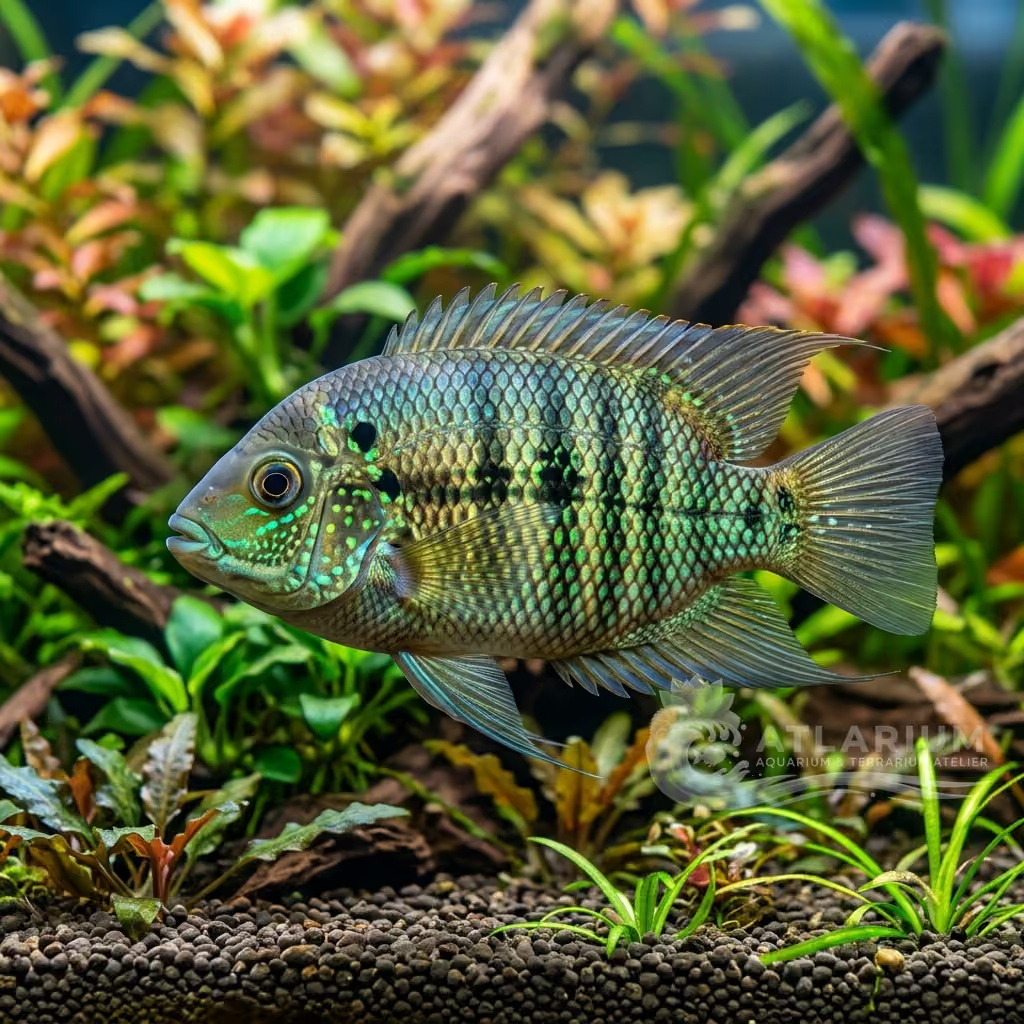
White Mullet
Mugil curema
The White mullet is an active, schooling silvery fish found in brackish and marine waters. Known to be powerful jumpers, they need a large 350L tank, strong flow, secure cover, and an omnivorous diet.
Wassertemperatur
18 - 28 °C
pH-Wert
7.5 - 8.5
Wassertyp
Brackwasser / Meerwasser
Tankfüllstand
Alle Ebenen
Erwachsenengröße
35 cm
Mindesttankvolumen
>= 350 L
Mindestgruppe
>= 5

Artbeschreibung
Geographical Origin and Habitat:
Mugil curema is widely distributed in the Atlantic Ocean from Canada to Brazil, and in the Pacific Ocean from Mexico to Chile. It primarily inhabits shallow coastal waters, estuaries, bays, and brackish mangrove swamps, adapting to varying salinities.
Taxonomy and Morphology:
Member of the family Mugilidae. It features an elongated, robust, and fusiform body, reaching up to 35 cm in aquarium conditions. It has two widely separated dorsal fins, a small mouth without distinct teeth, and large, smooth scales.
Social Behavior:
A peaceful, active, and schooling fish that must be kept in groups of 3 to 5 individuals. It swims constantly in the open water column. Its fast, continuous swimming can stress slow-moving or shy fish, though it is non-aggressive.
Coloration and Sexual Dimorphism:
Body is bright silver, shading to olive-green or bluish on the back and white on the belly. It often features a small dark spot at the base of the pectoral fins and a golden tint on the gill covers. No visible sexual dimorphism exists.

Pflege, Zucht und Mitbewohner
Aquarium Setup:
Requires a large aquarium of at least 350 liters to accommodate a school. The tank must feature ample open swimming space and moderate to strong water flow. A secure, heavy cover is mandatory, as they are powerful jumpers when startled.
Diet and Feeding:
Omnivorous and detritivorous, feeding on algae, detritus, and small invertebrates. In captivity, feed high-quality flake and pellet food with a high vegetable content, algae sheets (nori), and frozen brine shrimp or mysis. Feed multiple times daily.
Water Quality:
Highly adaptable but thrives best in stable brackish or marine water. Keep temperature at 18-28°C, pH at 7.5-8.5, and salinity between SG 1.005 and 1.025. Strong filtration and regular water changes are required to manage high organic load.
Compatibility and Cohabitation:
Peaceful with similarly sized brackish or marine fish. Good tankmates include archerfish, monos, scats, and large gobies. Not suitable for delicate reef tanks or with tiny, slow-moving fish that may be easily intimidated.
Aquarium Breeding:
Breeding in captivity is not recorded. In nature, they are catadromous or marine broadcast spawners that migrate offshore to release pelagic eggs, which float in ocean currents—conditions that cannot be replicated in home aquariums.
Risks and Diseases:
The main threat is jumping out of the tank. They are generally hardy but can contract skin infections or marine parasites like velvet (Amyloodinium) if water quality is neglected. High dissolved oxygen levels are required.

Geografische Herkunft und Verbreitung
Mugil curema is widely distributed in the Atlantic Ocean from Canada to Brazil, and in the Pacific Ocean from Mexico to Chile. It primarily inhabits shallow coastal waters, estuaries, bays, and brackish mangrove swamps, adapting to varying salinities.
Ursprung
Tropische Ozeane und RiffeExtra-Amazonas-SüdamerikaMittelamerika und KaribikNordamerika

Fischprofil
- Temperament
- Peaceful
- They are peaceful, highly gregarious, but exceptionally skittish fish. They panic easily at sudden shadows, vibrations, or aggressive tank mates, which triggers their instinct to flee or jump. They require a calm environment and a massive footprint to exhibit natural, relaxed behavior.
- Diät
- Omnivore
- They are benthic grazers that survive by extracting algae, diatoms, and organic detritus from mud and sand. In an artificial environment, they must be fed sinking algae wafers, spirulina, and plant-based flakes. It is vital to provide them with a fine sandy substrate that they can safely sift through their gills.
- Lebenserwartung
- 10 years
- Erwachsenengröße
- 35 cm
- Geschlechterverhältnis
- Solitary
- Males and females appear identical to the naked eye. They are obligate schooling fish that rely on the group for safety and behavioral cues. A school of at least six is necessary, and keeping them solitary is considered cruel and will lead to their rapid demise.
- Fütterungsfrequenz
- 2-3 times daily
- As their food sources are low in protein, they spend their entire day foraging and eating. They require several feedings a day of plant-based foods to meet their caloric needs. A heavily illuminated tank that promotes natural algae growth provides essential grazing opportunities between meals.
- Bioload
- Extreme
- The White mullet, while slightly smaller than its cousin, still produces an extremely high bioload. They possess voracious appetites for detritus and vegetation, leading to heavy waste output. Powerful mechanical filtration is required to clear the water of the substrate particles they constantly stir up.
- Fluss
- Strong
- They thrive in environments with heavy water movement and high levels of dissolved oxygen. Strong powerheads or wavemakers are highly beneficial to replicate the strong coastal tides they are accustomed to. Sluggish water will lead to lethargy and rapid health decline.
- Sprungrisiko
- Yes
- Like all mullets, the White mullet is an extraordinary jumper that uses leaping as a defense mechanism against predators. Any aquarium or pond housing them must be completely and securely covered. They will easily clear the sides of an open tank if they become spooked.
- Reproduktion
- Oviparous
- Reproduction in captivity is not feasible for the home aquarist. They are catadromous, living in brackish estuaries but migrating to the open sea to spawn in large aggregations. The tiny larvae undergo complex developmental stages in the ocean before returning to coastal waters.
- Kompatibilität & Tankkameraden
- Verify
- They are non-aggressive and generally ignore other fish, making them safe for peaceful community settings. However, their high-speed swimming and large size restrict tank mates to other active, robust brackish or marine species. Slow-moving or nervous fish will be highly stressed by their constant activity.
- Tankfüllstand
- All levels
- They are predominantly bottom and mid-water swimmers. They constantly patrol the substrate, pitching nose-down to vacuum up mouthfuls of sand. They require vast, unobstructed lengths of aquarium to accommodate their schooling and swimming behaviors.

Wissenschaftliche Modelle & Parameter
FishBase
Zugang zu den offiziellen wissenschaftlichen Daten der Art
Daten synchronisiert am: 15.06.2026
- Trophäenniveau
- 2 ± 0 se
- Belastbarkeit
- Mittel (1,4 - 4,4 Jahre)
- Phylogenetische Einzigartigkeit (PD50)
- 0.5
- Bayessche Längen-Gewichts-Beziehung
- a = 0.01175, b = 2.95
- AnfälligkeitHohe Anfälligkeit (56 / 100)

Verwandte Arten
Empfehlungen gruppiert nach nahen Verwandten, Auswahl von Begleitern und ähnlicher Betreuung.