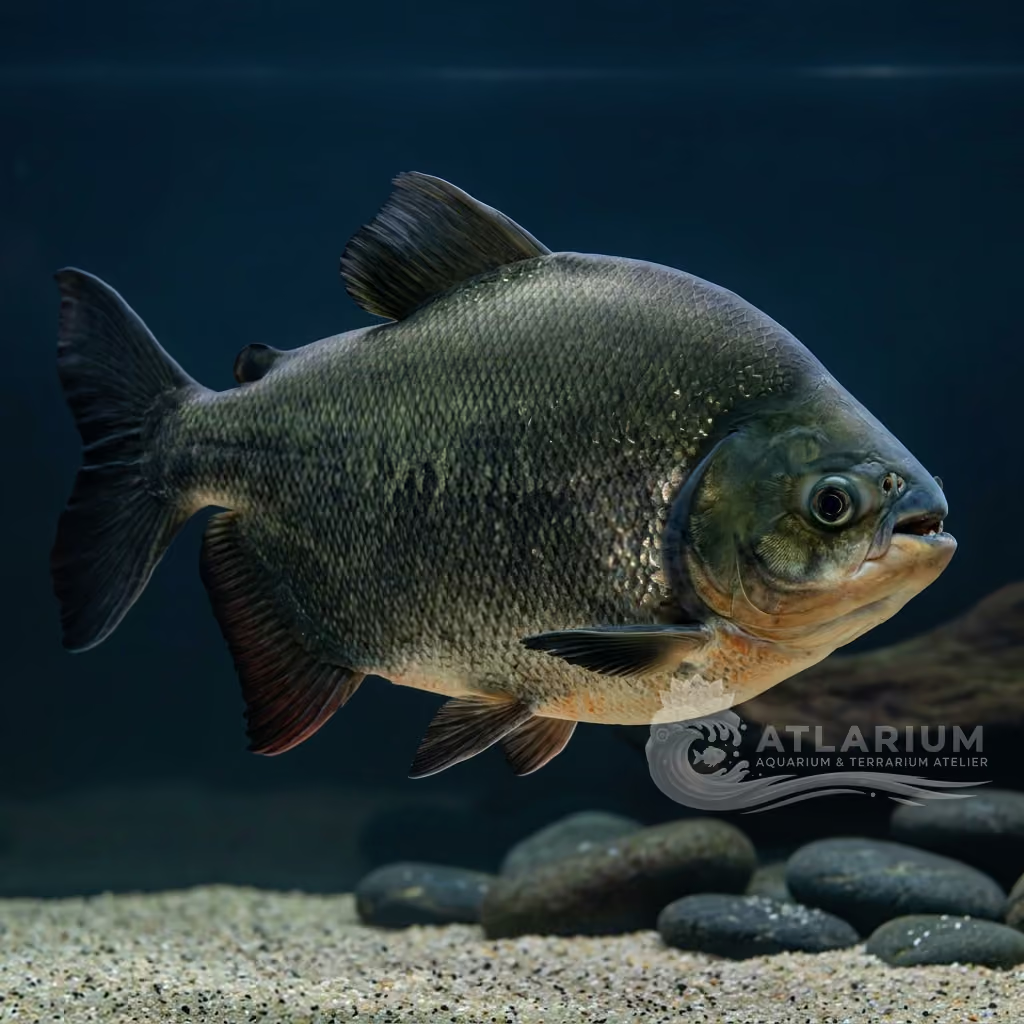
Bleher's rainbowfish
Chilatherina bleheri
A rainbowfish endemic to Lake Holmes (Danau Bira), a complex of three interconnected lakes in West Papua's Mamberamo basin at 430 meters altitude. Males develop a distinctive yellow forehead stripe during courtship — a unique trait in the genus. The body shows orange, turquoise and olive-green reflections that vary with mood and light. An active, social swimmer that needs spacious tanks with wide open swimming lanes and lateral vegetation. Breeding is relatively easy if water quality is maintained high.
25 - 30 °C
7 - 8
Eau douce
Milieu
12 cm
>= 120 L
>= 6
8 - 15 dGH
4 - 7 dKH
160 - 295 ppm
250 - 461 uS/cm

Description de l'espèce

Soins, reproduction et cohabitation

Origine et répartition géographiques
Origine

Profil de poisson
- Tempérament
- Peaceful
- They exhibit a very peaceful and playful temperament suitable for most community setups. Males may display harmless sparring behaviors to establish hierarchy and impress females. They are schooling fish that require a group of at least six individuals to feel confident and exhibit natural behavior.
- Régime alimentaire
- Omnivore
- Bleher's rainbowfish are omnivores that readily accept a wide variety of foods. They should be offered high-quality flakes or pellets as a staple diet. Supplementing with live or frozen foods like daphnia, bloodworms, and brine shrimp will enhance their stunning colors.
- Espérance de vie
- 5-8 years
- Taille adulte
- 12 cm
- Ratio des sexes
- School
- A ratio of one male to two or three females is ideal to reduce harassment. Having multiple females allows the male to distribute his breeding attention evenly. If keeping a large school, an equal or female-heavy ratio ensures a harmonious environment.
- Fréquence d'alimentation
- Twice daily
- It is best to feed these energetic fish two to three times a day. Only offer an amount they can completely consume within two minutes to prevent water fouling. Regular, small meals help maintain their high energy levels and vibrant appearance.
- Charge biologique
- Medium
- Chilatherina bleheri contributes a moderate bioload to the aquarium ecosystem. They are active swimmers that require clean water conditions and regular water changes. Maintaining excellent filtration is essential to support a group of these rainbowfish.
- Courant
- Strong
- Coming from moderately flowing streams, they appreciate a decent water current in the aquarium. A steady, moderate flow simulates their natural riverine habitat and encourages natural swimming behaviors. You can achieve this using powerheads or a strong filter return.
- Risque de saut
- Yes
- There is a significant risk of jumping when keeping this species, especially when startled. Rainbowfish are prone to leaping out of the water during feeding or playful chasing. A tight-fitting lid or cover glass is absolutely mandatory for their enclosure.
- Reproduction
- Oviparous
- Breeding involves the daily scattering of eggs among fine-leaved plants or spawning mops. The parents exhibit no parental care and will likely consume the eggs if not separated. Hatching typically occurs after a week, and fry require infusoria as their initial food source.
- Compatibilité et compagnons
- With caution
- This species is highly peaceful and thrives in a vibrant community aquarium. They do best when kept with other similarly sized, peaceful, and active fish. Avoid housing them with slow-moving or long-finned species that might be intimidated by their fast swimming.
- Niveau dans le bac
- Middle
- Chilatherina bleheri primarily occupies the middle to upper levels of the water column. They are constantly on the move, exploring the open swimming spaces near the surface. Providing floating plants can make them feel more secure while inhabiting these higher zones.

Modèles et paramètres scientifiques
Fenêtre sur les données scientifiques officielles de l’espèce
- Niveau trophique
- 2,8 ± 0,3 se
- Résilience
- Moyenne (1,4 - 4,4 ans)
- Singularité phylogénétique (PD50)
- 0.5005
- Relation bayésienne longueur-poids
- a = 0.01122, b = 3.04
- VulnérabilitéVulnérabilité faible (10 / 100)

Espèces associées
Recommandations regroupées par proches parents, compagnons et soins similaires.