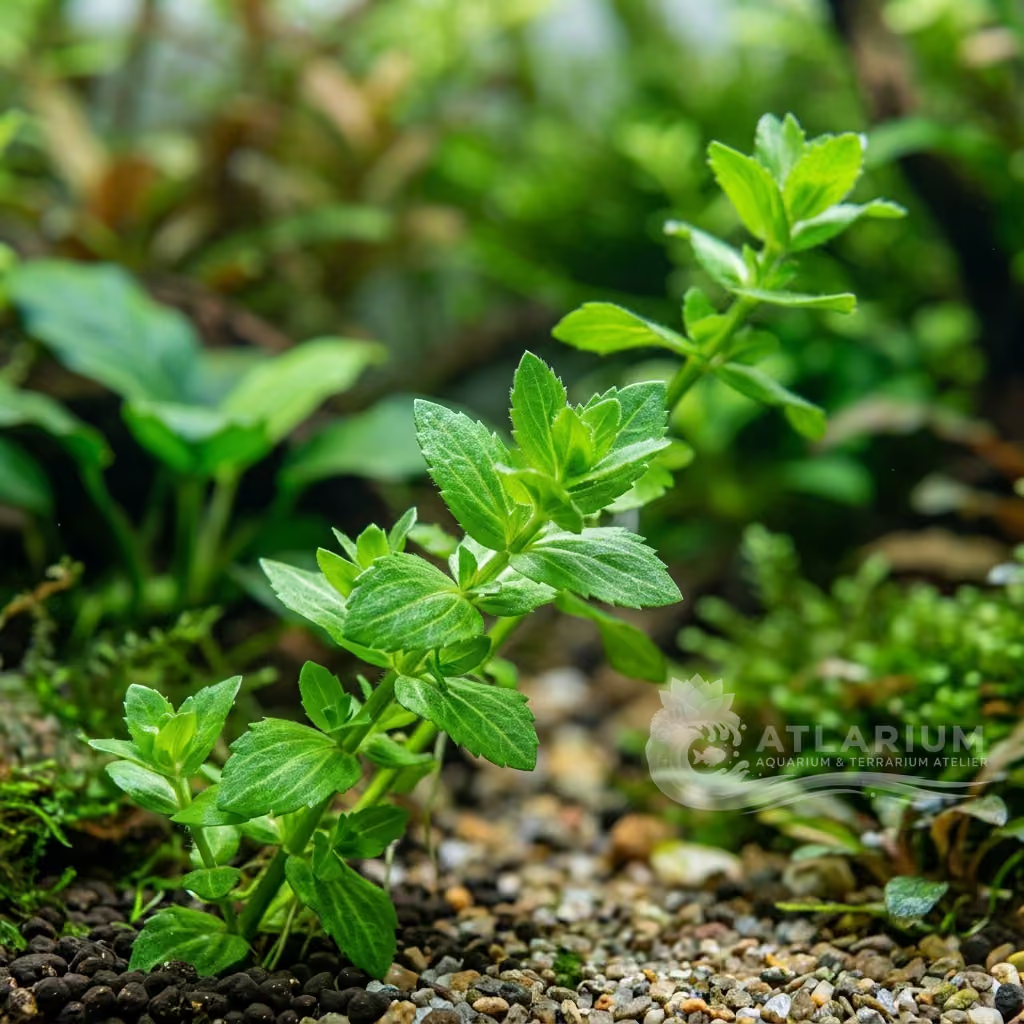
Alternanthera reineckii "Kleines Papageienblatt"
Alternanthera reineckii "Kleines Papageienblatt"
Dwarf cultivar displaying striking red to fuchsia colors. Requires high lighting and CO2 to maintain dense, creeping growth and intense pigmentation.
Wassertemperatur
4 - 30 °C
pH-Wert
5 - 7
Wassertyp
Süßwasser
Licht
Mittel - Hoch
CO2
Niedrig - Hoch
Erwartete Höhe
30 cm
Erwartete Breite
4 cm
KH
0 - 14 dKH

Artbeschreibung
Geographical Origin and Habitat: Alternanthera reineckii "Kleines Papageienblatt" (German for "Little Parrot Leaf") is a dwarf cultivar selected in Europe from strains native to subtropical South America, particularly along the Paraná River basin in Brazil and Paraguay. In its native habitats, the species grows in dense, low colonies on muddy and marshy soils exposed to the sun, adapting to months of partial or total submersion. The selection of this specific dwarf variety emphasized the plant's tendency to remain compact and creeping on the substrate.
Taxonomy & Genetics: Taxonomically, it belongs to the Amaranthaceae family, genus Alternanthera. This cultivar is genetically related to the widespread 'Mini' variety, sharing the mutation that causes extremely short internodes and compact growth. The genetic expression of this plant is highly responsive to lighting conditions: under intense light and stable nutrients, the plant maximizes anthocyanin synthesis, showing uniform red
Color & Texture: ation and inhibiting vertical stem elongation.
Physical Structure: It features an erect but very compact stem structure, with a height in the aquarium that rarely exceeds 20-30 cm and a single stem width of about 4 cm. The leaves are arranged in opposite, decussate pairs, very close to each other due to the short internodes. The leaf blade has a lanceolate-ovate shape, smaller than other cultivars of the same species, with a slightly wavy surface that catches light from different angles.
Color & Texture: The foliage has a spectacular coloration ranging from ruby red to brilliant carmine pink. The upper side of the leaf can show bronze-olive shades under moderate light but assumes a uniform bright red under intense light, while the underside consistently shines with a very bright fuchsia pink. The leaf texture is soft and delicate, with thin but visible main veins standing out on the leaf surface.

Pflege, Zucht und Mitbewohner
Lighting & CO2: It requires medium to high lighting (at least 30-40 lumens/liter or good quality LEDs) to maintain its compact growth and prevent internodes from stretching in search of light. Stable CO2 injection at levels of 15-25 mg/L is strongly recommended to support growth, preventing lower leaf loss and ensuring the development of healthy new leaves.
Nutrition & Substrate: A fertile substrate rich in clay and iron, such as active aquasoil, is ideal to support its dense root system. Liquid column fertilization must be regular and complete, focused on the constant supply of chelated iron and potassium to prevent chlorosis and necrosis of older leaves.
Water Chemistry: Tolerant of water chemistry: it withstands temperatures from 4°C to 30°C, preferring a range between 22°C and 26°C. It adapts to acidic or neutral pH (5.0-7.0) and carbonate hardness between 0 and 14 dKH. Keeping the water clean with regular changes promotes overall plant health.
Space Management & Placement: Due to its compact height, it is perfect for the foreground or midground of small aquariums (nano tanks). It should be planted in dense groups, spacing individual stems 1-2 cm apart to create a dense, uniform red cushion without shading each other.
Pruning: Pruning is done by trimming the upper tips with sharp scissors. The cut tips can be replanted directly into the substrate to propagate the plant, while the remaining stem will quickly develop two or more lateral shoots, helping to further densify the cushion.
Risks & Diseases: If light is insufficient, the plant tends to stretch, losing its lower leaves and fading. It is susceptible to thread algae or green spot algae if macro-nutrients in the water column are not balanced. Tender leaves are welcomed by pest snails and herbivorous fish if not fed correctly.

Geografische Herkunft und Verbreitung
Alternanthera reineckii "Kleines Papageienblatt" (German for "Little Parrot Leaf") is a dwarf cultivar selected in Europe from strains native to subtropical South America, particularly along the Paraná River basin in Brazil and Paraguay. In its native habitats, the species grows in dense, low colonies on muddy and marshy soils exposed to the sun, adapting to months of partial or total submersion. The selection of this specific dwarf variety emphasized the plant's tendency to remain compact and creeping on the substrate.
Ursprung
Extra-Amazonas-SüdamerikaSelektive Züchtung und Sorten

Pflanzenprofil
- Platzierung
- Vordergrund
- It is best positioned in the midground or foreground of the aquarium, depending on the tank size. Its compact nature allows it to create beautiful, dense bushes that do not overshadow other plants. When planted in groups, it forms a striking focal point that draws the eye. Ensure it is placed in an area that receives unobstructed light for optimal development.
- Botanische Form
- Stängel
- This plant features sturdy, upright stems adorned with decussate leaves that exhibit a striking red to magenta hue on the underside. The leaves are typically lanceolate and somewhat smaller than the standard species, giving it a more compact appearance. Its structure is quite robust, allowing it to withstand moderate water flow. The dense foliage creates a beautifully textured visual element in the aquascape.
- Wachstum
- Mittel
- The growth rate is generally moderate when provided with optimal lighting and CO2 injection. Under lower light conditions, growth slows down significantly and the plant may struggle. Regular fertilization will encourage a steady and manageable upward progression. Overall, it requires less frequent maintenance compared to faster-growing stem plants.
- Substrat
- Hoch
- This species develops a robust root system that benefits significantly from a nutrient-rich aqua soil. The roots anchor deeply into the substrate, demanding a depth of at least 4-5 centimeters to properly support the plant's upright growth. A substrate infused with iron and macronutrients is highly recommended to promote vigorous root development and enhance the vibrant red coloration of the foliage.
- Säulendüngung
- Empfohlen
- Liquid column fertilization is highly recommended to supply readily available nutrients to the leaves. A comprehensive liquid fertilizer containing both macro and micronutrients should be dosed regularly. Iron supplements are particularly beneficial to enhance the red pigmentation. Consistent dosing schedules help prevent deficiencies and promote vigorous foliage development.
- Wurzeldüngung
- Keine
- While it can absorb nutrients from the water column, it benefits significantly from a nutrient-rich substrate. Root tabs placed near the base can provide a steady supply of essential elements, promoting stronger root development. A fertile soil base encourages thicker stems and more robust overall growth. This dual feeding approach maximizes the plant's health and coloration.
- Trimmen
- Gelegentlich
- Trimming should be done by cutting the stem just above a healthy node using sharp scissors. This encourages the plant to develop side shoots, resulting in a bushier appearance over time. The replanted tops will quickly root and form new plants, allowing for easy expansion. Regular pruning is necessary to maintain its compact shape and prevent lower leaves from being shaded out.
- Ausbreitung
- Stecklinge
- Propagation is straightforward and is achieved primarily through stem cuttings. Simply cut a healthy top portion of the stem and plant it directly into the substrate. Ensure the cutting has at least a few leaves and a healthy node to promote rapid root growth. With optimal conditions, the new cuttings will establish themselves within a few days.
- Empfindlichkeit
- Mäßig
- This species is somewhat sensitive to sudden fluctuations in water parameters, particularly pH and temperature. It does not tolerate prolonged periods of shading, which will cause it to quickly drop its lower leaves. Algae growth on its leaves can be a problem if nutrients and light are not properly balanced. Extreme care should be taken when using chemical treatments, as it can be delicate.
- Layoutrolle
- Nano, Mittelgrund, Vordergrund, group
- It plays an excellent role as a colorful midground accent, adding depth and contrast to green aquatic landscapes. Its smaller leaf size makes it suitable for both large and small aquariums without overwhelming the layout. It pairs beautifully with light green foreground carpets or dark hardscape materials. Its striking coloration draws attention and serves as a natural focal point.

Verwandte Arten
Empfehlungen gruppiert nach nahen Verwandten, Auswahl von Begleitern und ähnlicher Betreuung.