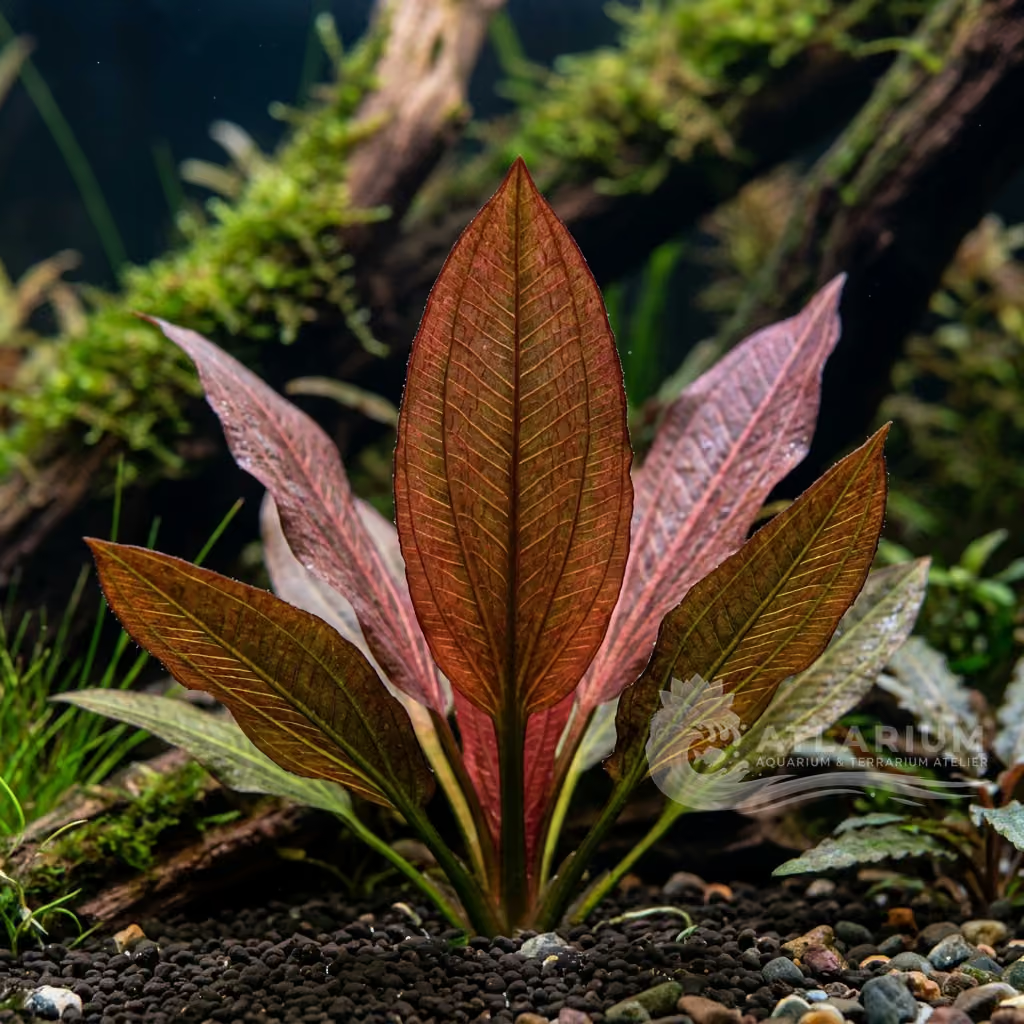
Ceratopteris pteridoides
Ceratopteris pteridoides
An American floating water fern forming large rosettes with broad, spongy, lobed leaves. It hangs an extensive dark root system in the water to efficiently absorb excess nutrients under moderate light.
Wassertemperatur
18 - 30 °C
pH-Wert
5 - 8
Wassertyp
Süßwasser
Licht
Medium to High
CO2
Niedrig - Hoch
Erwartete Höhe
10 cm
Erwartete Breite
30 cm
KH
0 - 21 dKH

Artbeschreibung
Geographical Origin and Habitat: This species is widely distributed in the tropical and subtropical regions of the Americas, from the southern United States down to Argentina. It colonizes stagnant water bodies, shallow ponds, canals, and calm lake shores, growing primarily as a free-floating plant in well-lit areas rich in organic matter.
Taxonomy & Genetics: Belongs to the Pteridaceae family and the genus Ceratopteris. Commonly known as the American water fern or floating watermarie. Genetically, it shares the capability to produce adventitious daughter plantlets directly on the margins of mature leaves, an evolutionary strategy to rapidly colonize water surfaces.
Physical Structure: Features broad, thick, and fleshy leaves arranged in a flat, floating rosette. The floating fronds have wide, rounded lobes, whereas if forced submerged, the leaves become more dissected. It produces a highly branched, dark brown or black floating root system that hangs down into the water.
Color & Texture: Bright emerald green or light olive green, highly glossy on the upper side of the floating leaves. The texture is fleshy and spongy (due to internal aerenchyma tissue that aids buoyancy), and relatively fragile to the touch.

Pflege, Zucht und Mitbewohner
Lighting & CO2: Requires moderate to intense lighting. Floating on the surface, it benefits from direct light and atmospheric CO2. It does not require CO2 injection in the
Water Chemistry: but in closed aquariums, it suffers if too much heat accumulates between the water surface and the lid.
Nutrition & Substrate: Nutrition is entirely column-dependent. The hanging roots absorb nitrates, phosphates, and heavy metals from the water with extreme efficiency, acting as a natural water purifier. No substrate is required.
Water Chemistry: Very tolerant, living in water with pH from 5.0 to 8.0 and hardness from very soft to very hard (KH 0-21). The optimal temperature range is 18 to 30°C. Avoid strong surface currents that can flip or submerge the rosettes.
Space Management & Placement: Should be kept exclusively as a floating plant on the surface. It provides excellent shading for shade-loving species and an ideal refuge for shy fish or fry. It must be culled regularly to prevent it from blocking all light.
Pruning: Pruning consists of removing excess rosettes or older, damaged fronds that start to yellow, cutting them close to the base of the rosette.
Risks & Diseases: Tends to suffer if its leaves remain wet from condensation under the lids of closed aquariums. It can turn yellow rapidly in case of iron or potassium deficiencies in the water.

Geografische Herkunft und Verbreitung
This species is widely distributed in the tropical and subtropical regions of the Americas, from the southern United States down to Argentina. It colonizes stagnant water bodies, shallow ponds, canals, and calm lake shores, growing primarily as a free-floating plant in well-lit areas rich in organic matter.
Ursprung
NordamerikaExtra-Amazonas-SüdamerikaMittelamerika und Karibik

Pflanzenprofil
- Platzierung
- Mittelgrund
- This species is strictly a floating plant and should not be buried in the substrate. It develops an extensive, trailing root system that hangs down into the water column.
- Botanische Form
- Rosette
- It has a unique, almost cabbage-like floating rosette with broad, fleshy, buoyant fronds. The dense, trailing roots provide an intricate, naturalistic network beneath the surface.
- Wachstum
- VERY_FAST
- The growth rate is remarkably fast, and a single plant can quickly cover a significant portion of the water surface. Constant removal of older growth is required to ensure light reaches the plants below.
- Substrat
- Keiner
- Ceratopteris pteridoides is predominantly a floating fern, requiring absolutely no substrate for its cultivation. It develops an extensive, dangling root system in the water column that excels at absorbing dissolved nutrients. The plant does not need to be rooted in soil or gravel, as it naturally drifts on the water's surface. Providing a nutrient-rich water column is far more critical for its success than any bottom substrate.
- Säulendüngung
- Empfohlen
- Since it floats, it relies entirely on water column fertilization to sustain its massive growth. It responds very well to regular liquid fertilizer dosing, especially in brightly lit environments.
- Wurzeldüngung
- Keine
- Root tabs and substrate fertilizers are completely inapplicable as the plant remains floating at the surface.
- Trimmen
- Gelegentlich
- Maintenance consists of physically removing entire large plants or older, decaying fronds from the surface. The trailing roots can also be trimmed if they begin to interfere with the hardscape or swimming space.
- Ausbreitung
- Teilung
- It propagates prolifically by producing numerous small plantlets along the margins of its mature fronds. These detach naturally over time, quickly forming a dense floating mat.
- Empfindlichkeit
- Mäßig
- It requires high humidity above the water surface to thrive and prevent its leaves from drying out. The leaves are quite brittle and can easily break if handled roughly or agitated by strong surface currents.
- Layoutrolle
- Schwimmend
- It is an ideal floating plant for open-top aquariums or setups that require significant shading. Its roots are highly prized by breeders as spawning mops and sanctuaries for fry.

Verwandte Arten
Empfehlungen gruppiert nach nahen Verwandten, Auswahl von Begleitern und ähnlicher Betreuung.