Flame Hawkfish
Neocirrhites armatus
The Flame Hawkfish is a brilliant red marine fish celebrated for perching on hard corals. Its comical, alert behavior makes it a charismatic centerpiece for stable reef setups.
Wassertemperatur
24 - 27 °C
pH-Wert
8.1 - 8.4
Wassertyp
Meerwasser
Tankfüllstand
Unten
Erwachsenengröße
9 cm
Mindesttankvolumen
>= 120 L
Mindestgruppe
>= 1
KH
8 - 12 dKH

Artbeschreibung
Geographical Origin and Habitat: Neocirrhites armatus is widely distributed throughout the tropical waters of the Western and Central Indo-Pacific, ranging from the Ryukyu Islands south to the Great Barrier Reef of Australia and east to the islands of Polynesia. It inhabits outer reef slopes and reef crests exposed to strong currents and surge at depths between 10 and 25 meters. It lives in close association with hard coral colonies of Stylophora and Pocillopora.
Taxonomy and Morphology: It belongs to the family Cirrhitidae and the genus Neocirrhites, of which it is the only described member. Morphologically, it features a compact, sturdy, and slightly compressed body, with large, prominent eyes located high on the head that can move independently. Lacking a swim bladder, its swimming is limited to short, rapid darts, followed by perching behaviors on rock or coral branches.
Social Behavior: This species is an alert, territorial, diurnal ambush predator. It spends most of its time perched on hard coral branches to monitor its territory and spot potential prey. It shows strong intraspecific territoriality and may attack conspecifics in smaller tanks. However, it is generally peaceful toward other unrelated fish families, provided they are not large enough to prey on it.
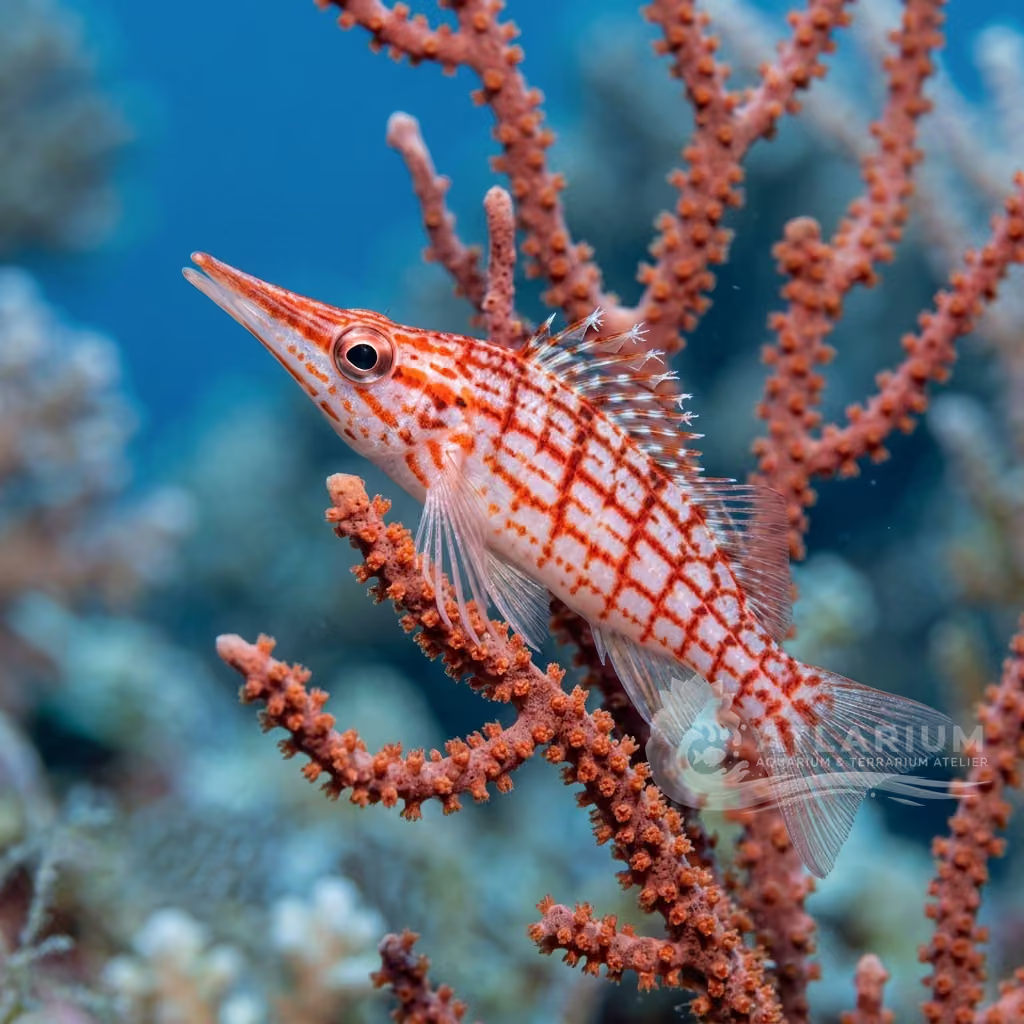
Coloration and Sexual Dimorphism: The coloration is an exceptionally bright, uniform flame red over the entire body and fins, accented only by a dark black band along the base of the dorsal fin and a black mask encircling the eyes. There is no significant external sexual dimorphism; males and females look identical, though males tend to be slightly larger and socially dominant in their natural haremic groups.

Pflege, Zucht und Mitbewohner
Aquarium Setup: Requires an aquarium of at least 100-150 liters with a good amount of live rock. It is essential to include branching hard corals (either live or artificial, like Stylophora or Pocillopora species) to allow the fish to display its natural perching behavior. The aquarium should have moderate to strong water flow and high dissolved oxygen levels to mimic its natural environment.
Diet and Feeding: It is a carnivorous predator. In captivity, it must be fed a varied diet of high-quality frozen foods such as mysis, brine shrimp, krill, and finely chopped shrimp or clam. It also readily accepts dry commercial pellets and flakes. Feed once or twice daily, ensuring that some food reaches the rockwork or the perches where the hawkfish spends most of its time.
Water Quality: Water parameters must remain stable: temperature between 24°C and 27°C, pH between 8.1 and 8.4, and salinity (specific gravity) between 1.020 and 1.025. Nitrites and ammonia must be kept at zero, with nitrates managed at low levels using an efficient protein skimmer and regular water changes to ensure a clean, oxygen-rich environment.
Compatibility and Cohabitation: Compatibility is excellent with corals, which they do not damage in any way. They are compatible with robust community fish such as tangs, damselfish, and clownfish. However, they are not compatible with small ornamental shrimp (such as Thor amboinensis or small Lysmata species) or small crabs, which they will eat. Avoid keeping them with small, slow-moving gobies.
Aquarium Breeding: Aquarium breeding is extremely difficult and has not been recorded in home aquariums. In nature, they are protogynous hermaphrodites and form haremic pairs. Spawning occurs at dusk when the pair swims rapidly toward the surface to release eggs and sperm simultaneously. The fertilized eggs float with ocean currents and undergo a planktonic stage before settling.
Risks and Diseases: This is a hardy species once acclimated. It can contract common parasites like Cryptocaryon or Oodinium under extreme stress. The primary risk is jumping: lacking a swim bladder and being capable of explosive upward leaps to catch prey, the aquarium must be fitted with a secure lid or mesh top to prevent the fish from jumping out, which would be fatal.

Geografische Herkunft und Verbreitung
Neocirrhites armatus is widely distributed throughout the tropical waters of the Western and Central Indo-Pacific, ranging from the Ryukyu Islands south to the Great Barrier Reef of Australia and east to the islands of Polynesia. It inhabits outer reef slopes and reef crests exposed to strong currents and surge at depths between 10 and 25 meters. It lives in close association with hard coral colonies of Stylophora and Pocillopora.
Ursprung
Tropische Ozeane und RiffeSüd- und SüdostasienOstasienAustralien, Neuguinea und Ozeanien

Fischprofil
- Temperament
- Semi-aggressive
- They are highly observant and charismatic fish, constantly watching the room with their independently rotating eyes. While aggressive toward small shrimp and other hawkfish, they mostly ignore other swimming fish. Their bold, inquisitive nature makes them a spectacular pet.
- Diät
- Carnivore
- This species is a predatory carnivore that naturally hunts small crustaceans and invertebrates. In the aquarium, they must be fed a diet rich in meaty foods like frozen mysis shrimp, krill, and chopped seafood. They will also quickly learn to accept high-quality marine carnivore pellets.
- Lebenserwartung
- 5-10 years
- Erwachsenengröße
- 9 cm
- Geschlechterverhältnis
- Solitary
- There are no obvious visual differences between the sexes in this species. Keeping multiple Flame Hawkfish in the same aquarium usually results in violent, sometimes fatal, territorial disputes. They should strictly be kept as a solitary specimen unless a proven mated pair is acquired.
- Fütterungsfrequenz
- 2-3 times daily
- Feeding them once or twice daily is sufficient to maintain their plump, healthy body shape. They are eager eaters that will dart out from their perches to snatch food from the water column. Avoid overfeeding, as they can quickly become obese and suffer liver issues.
- Bioload
- Low to Medium
- The Flame Hawkfish produces a moderate bioload in the marine aquarium. As strict carnivores, their protein-rich waste requires efficient protein skimming and good biological filtration. Provided standard maintenance is followed, their impact on water quality is easily mitigated.
- Fluss
- Strong
- They prefer moderate to strong water flow, typical of the coral heads they inhabit in the wild. Good flow ensures high oxygenation and sweeps food past their preferred perching spots. They use their specialized pectoral fins to anchor themselves against strong currents.
- Sprungrisiko
- Yes
- Like most hawkfish, they are prone to leaping from the tank when startled. A secure, tight-fitting mesh lid is an absolute necessity to prevent a fatal jump. They will often inspect the surface and any open top is a severe risk.
- Reproduktion
- Oviparous
- Flame Hawkfish are pelagic spawners that release eggs into the water column. Captive breeding is incredibly difficult and almost entirely restricted to specialized aquaculture facilities. They are protogynous hermaphrodites, able to change sex from female to male.
- Kompatibilität & Tankkameraden
- Reef safe
- They are generally peaceful with larger fish but are a severe threat to small ornamental shrimp. They are not entirely reef safe because they will hunt and eat small crustaceans. They should be kept with other moderately aggressive or robust peaceful fish.
- Tankfüllstand
- Bottom
- They lack a swim bladder and therefore sink when not actively swimming. They spend their entire lives perching on rocks, corals, or equipment in the lower to middle zones of the tank. Intricate rockwork is essential for providing them with numerous perching vantage points.

Wissenschaftliche Modelle & Parameter
FishBase
Zugang zu den offiziellen wissenschaftlichen Daten der Art
FishBase v25.04Daten synchronisiert am: 15.06.2026
- Trophäenniveau
- 3,5 ± 0,5 se
- Phylogenetische Einzigartigkeit (PD50)
- 1
- Bayessche Längen-Gewichts-Beziehung
- a = 0.01585, b = 3.05
- AnfälligkeitGeringe Anfälligkeit (10 / 100)

Verwandte Arten
Empfehlungen gruppiert nach nahen Verwandten, Auswahl von Begleitern und ähnlicher Betreuung.