SüßwasserEinfach
©AI Generated·Proprietary
Carassius auratus — Comet Goldfish

Comet Goldfish

Carassius auratus

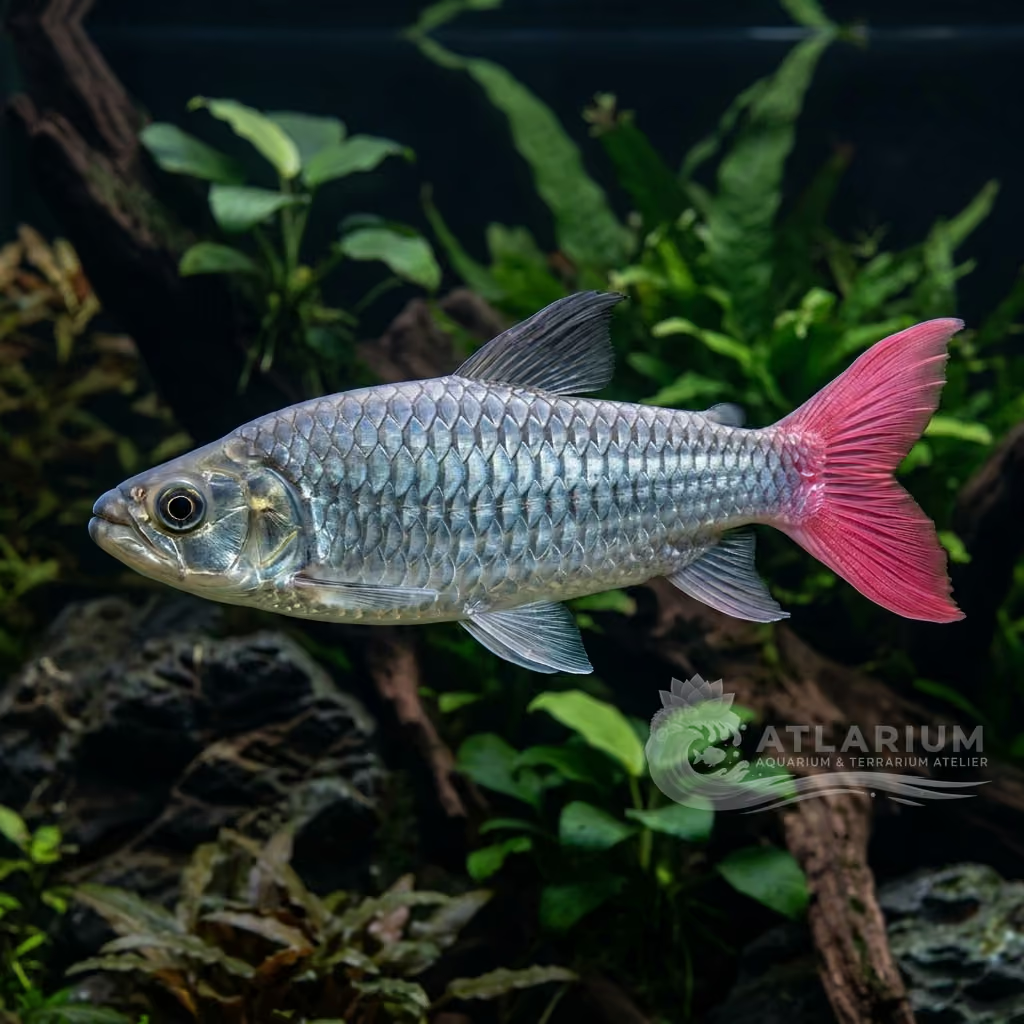
The 'Comet' Goldfish is the aesthetic and dynamic upgrade of the Common Goldfish. This magnificent variety, developed in America, retains the same very robust and massive torpedo body shape of its common cousin, but enhances it with an explosion of immense, veil-like, floating and elegant fins. The caudal fin (tail) is deeply forked and fluffy. It easily reaches 25-30 centimeters (10-12 inches) and swims with an unprecedented fast and snappy grace. It unfortunately shares the same tragic and bitter commercial fate as the common: sold for a few cents and condemned to atrocious asphyxiations in tiny domestic glass bowls. It is a formidable athlete of cold waters and open spaces.

Wassertemperatur

10 - 24 °C

pH-Wert

7 - 8

Wassertyp

Süßwasser

Tankfüllstand

Alle Ebenen

Erwachsenengröße

30 cm

Mindesttankvolumen

>= 200 L

Mindestgruppe

>= 2

GH

8 - 20 dGH

KH

4 - 10 dKH

TDS

160 - 400 ppm

Leitfähigkeit

250 - 625 uS/cm

Artbeschreibung

Geographical Origin and Habitat: Developed and selected in the United States at the end of the 19th century from variants of the common goldfish (Carassius auratus). This morphology was designed specifically to swim freely and quickly in large outdoor ornamental basins and North American cold ponds.
Taxonomy and Morphology: Cyprinid of monumental size. Streamlined torpedo body, identical to the common but equipped with an explosion of immense fins. The caudal fin (tail) is deeply forked and almost as long as the body itself. Easily reaches 30-35 cm (12-14 inches) in total length. Pharyngeal teeth developed for bottom chewing.
Social Behavior: Frantic athlete, lively and an explorer. Unlike lazy carps or deformed Orandas, the Comet is a gentle fury: it spends the whole day in rapid mid-water sprints or scouring the bottom in a school. Although not aggressive, its enormous liveliness intimidates shy or slow fish.
Coloration and Sexual Dimorphism: Classically bright red, metallic orange, vivid yellow, or sarasa (red and white). During the mating season, triggered by spring warming, males show clear white opercular breeding tubercles, while females heavy with eggs take on an asymmetrical and swollen abdominal profile.

Pflege, Zucht und Mitbewohner

Aquarium Setup: Colossal fish requiring, as an absolute minimum, rectangular aquariums 150-200 cm long (over 300 liters / 80 gallons for a few specimens), although their habitat of choice remains the outdoor pond. Minimal decor to leave immense swimming lanes clear: smooth rocks, non-sharp roots, and very fine sand substrate to protect their delicate veil tails.
Diet and Feeding: Insatiable herbivore with omnivorous tendencies. Swallows whatever it finds, including tender aquatic plants. Requires high-quality sinking vegetable pellets and weekly rations of blanched fresh vegetables (primarily zucchini and peas) to keep the very long intestine clear and promote gastric regularity.
Water Quality: Formidable cold-water fish: tolerates from 10.0 to 24.0 °C. Water must be hard (GH 8.0-20.0) and slightly alkaline (pH 7.0-8.0). Mechanical and biological filtration must be industrial: the Comet produces a massive fecal load, and ammonia quickly corrodes and rots its long majestic caudal fins in closed environments.
Compatibility and Cohabitation: Strict. Pair exclusively with other fast goldfish (Common Goldfish, Shubunkin, Koi Carp). Absolute ban on pairing with "Fancy" goldfish (Oranda, Moor) because the Comet is too fast and would steal all their food, condemning them to starvation. Totally incompatible with all tropical fish.
Aquarium Breeding: Very common in outdoor ponds. Between spring and summer, males engage in frantic chases towards females, pinning them against walls or dense marsh plants to induce spawning. They release thousands of transparent, non-sticky eggs. They eat their own offspring with incredible voracity given the chance.
Risks and Diseases: In tanks that are too small, it suffers from "induced stunting", where bone growth stops but internal organs continue to grow, causing an atrocious early death. The massive veil tails are easily prone to tearing (on sharp wood) and bacterial necrosis if nitrates and ammonia are not kept near zero.

Geografische Herkunft und Verbreitung

Developed and selected in the United States at the end of the 19th century from variants of the common goldfish (Carassius auratus). This morphology was designed specifically to swim freely and quickly in large outdoor ornamental basins and North American cold ponds.

Ursprung

Selektive Züchtung und SortenNordamerika

Fischprofil

Temperament
Peaceful
They are completely peaceful and social. They love schooling with other comets. Fast movements are just enthusiastic energy.
Diät
Omnivore
They thrive on varied omnivorous diets. Sinking pellets prevent dangerous surface gulping. Fresh greens support healthy digestion.
Lebenserwartung
10-20 years
Erwachsenengröße
30 cm
Geschlechterverhältnis
Group
Two males per female ensures fertilization. General display tanks need no specific ratio. Avoid keeping only one heavily harassed female.
Fütterungsfrequenz
Continuous
Two small daily meals are optimal. Overfeeding causes fatal ammonia spikes. Remove uneaten food after three minutes.
Bioload
Extreme
Comets produce a substantial biological waste load. Their fast growth demands oversized filtration. Weekly massive water changes are vital.
Fluss
Strong
They appreciate moderate to strong currents. Their streamlined bodies handle flow easily. Circulation keeps their water heavily oxygenated.
Sprungrisiko
No
Reproduktion
Oviparous
Spring temperatures trigger active spawning behavior. Males aggressively chase females until exhaustion. Sticky eggs are scattered and abandoned.
Kompatibilität & Tankkameraden
Species only
They are incredibly fast and boisterous. Slower fish can get easily stressed. Keep them with large pond fish.
Tankfüllstand
All levels
The Comet goldfish is an exceptionally agile and wide-ranging fish that will dynamically utilize every single level of the water column. Similar to common goldfish, they spend a considerable portion of their day scanning the bottom substrate for food particles and algae. However, their sleek, hydrodynamic bodies allow them to effortlessly dart into the middle and upper levels, especially when anticipating food from their caretakers. Providing a spacious, long aquarium is essential to accommodate their continuous movement across all depth zones.

Wissenschaftliche Modelle & Parameter

FishBase

Zugang zu den offiziellen wissenschaftlichen Daten der Art

FishBase v25.04Daten synchronisiert am: 15.06.2026
Trophäenniveau
2 ± 0 se
Belastbarkeit
Mittel (1,4 - 4,4 Jahre)
Generierungszeit
6,7 Jahre
Phylogenetische Einzigartigkeit (PD50)
0.5156
Bayessche Längen-Gewichts-Beziehung
a = 0.01259, b = 3.04
AnfälligkeitMäßige Anfälligkeit (37 / 100)