Bacopa monnieri
Bacopa monnieri
A globally distributed, indestructible amphibious stem plant with creeping habits and thick teardrop leaves. An ideal low-maintenance background addition.
Wassertemperatur
15 - 28 °C
pH-Wert
6 - 8
Wassertyp
Süßwasser
Licht
Mittel
CO2
Niedrig
Erwartete Höhe
30 cm
Erwartete Breite
10 cm
GH
4 - 20 dGH
KH
2 - 30 dKH

Artbeschreibung
Geographical Origin and Habitat: Bacopa monnieri is an incredibly successful, globally distributed amphibious marsh weed. While originally native to the wetlands of India, Asia, and the Americas, its aggressive adaptability has allowed it to colonize marshes, bogs, and shallow river margins across almost every continent. It is a highly specialized creeping marsh plant that evolved to survive completely submerged during monsoon floods, and equally well growing emersed on baking, cracking mud during extreme droughts. Its survival adaptations make it practically indestructible in an aquarium.
Taxonomy & Genetics: Belonging to the Plantaginaceae family, Bacopa monnieri (commonly known in the trade as "Moneywort" or "Water Hyssop") is a highly significant botanical species. Unlike B. caroliniana, it does not possess the genetic markers that produce the distinct crushed-lemon scent. However, it is globally famous outside of the aquarium hobby in Ayurvedic medicine as "Brahmi," heavily cultivated for its neuropharmacological properties. In the aquatic trade, it is the undisputed baseline standard for bulletproof stem plants.
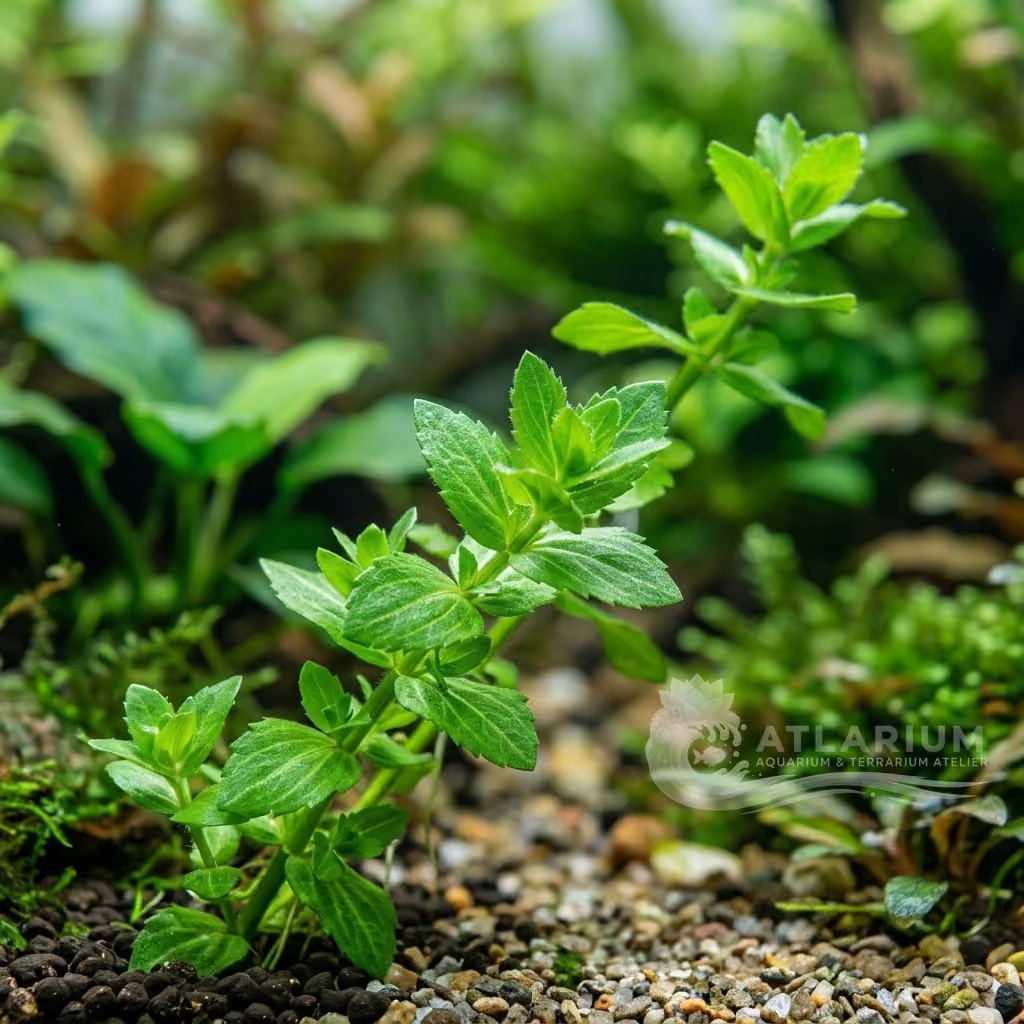
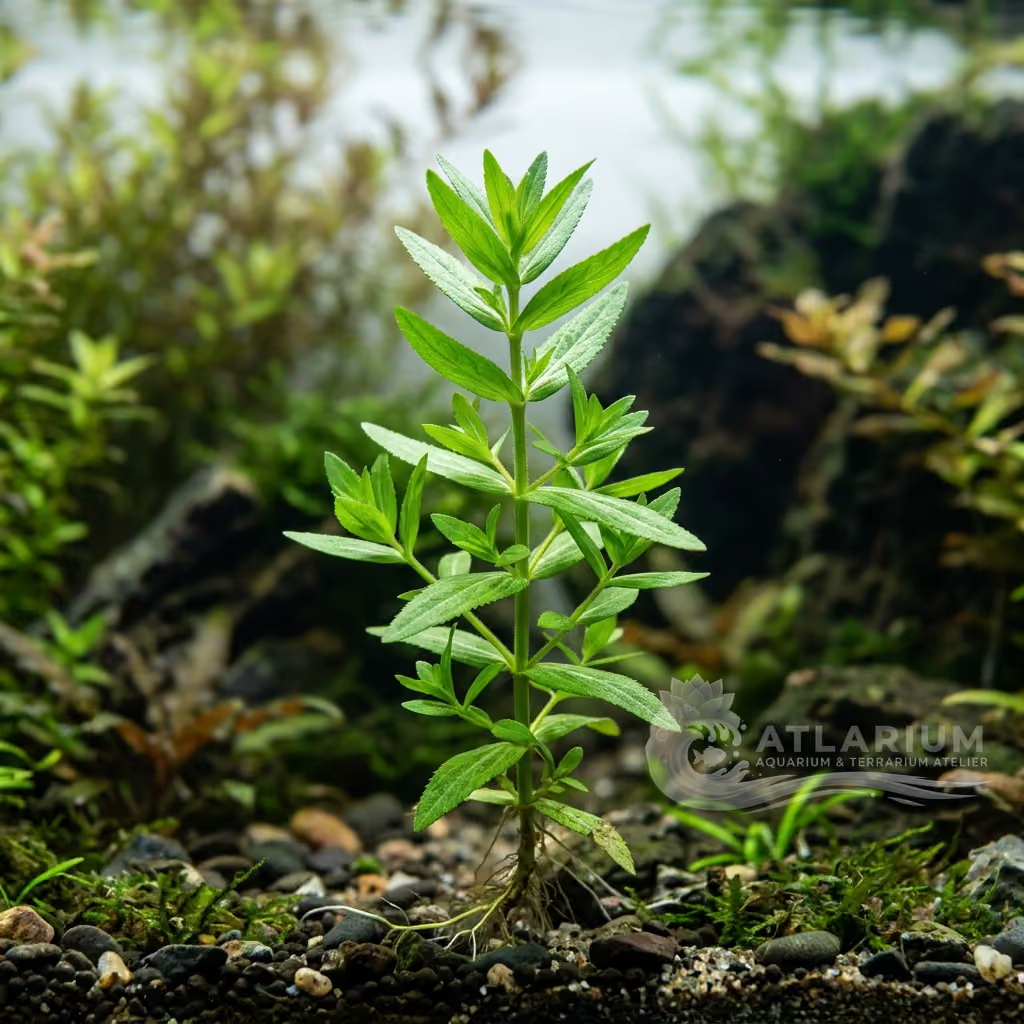
Physical Structure: The architecture of Bacopa monnieri is characterized by highly disciplined, vertical growth when submerged. It produces moderately thick, fleshy stems that shoot stubbornly straight toward the light. The leaves are distinctly small, perfectly teardrop-shaped, fleshy, and emerge in opposite pairs marching uniformly up the stem. The physical structure is very rigid, allowing the plant to easily breach the water surface without collapsing, where it will happily produce tiny, beautiful white or pale purple flowers.
Color & Texture: The entire plant, from stem to teardrop leaf, is colored a completely solid, opaque, vibrant light-green to bright lime. Unlike many other stem plants, B. monnieri completely refuses to change color: regardless of how intense the lighting is, or how heavily it is fertilized with iron, it will stubbornly remain bright green and will never flush red or bronze. The texture is noticeably fleshy and succulent, making it highly resistant to physical damage from clumsy fish or snails.

Pflege, Zucht und Mitbewohner
Lighting & CO2: It is an extremely forgiving, low-tech powerhouse. It will happily survive and grow steadily under very weak, low-intensity lighting. If exposed to intense, high-energy LED lighting, its growth rate will rapidly accelerate, but it will never change its green color. It absolutely does not require CO2 injection to survive. However, injecting pressurized CO2 will force the plant to grow thicker, bushier, and vastly speed up its naturally moderate growth rate.
Nutrition & Substrate: This plant is a master of survival and highly versatile in its feeding habits. While it produces a healthy white root system, it does not require deep, nutrient-rich aquasoil to survive. It can be successfully planted in completely sterile, inert sand or plain gravel, provided the water column is occasionally dosed with a standard liquid fertilizer. It happily absorbs necessary macro and micro nutrients directly through its fleshy teardrop leaves from the surrounding water.
Water Chemistry: Bacopa monnieri is arguably one of the most indestructible aquatic plants on the planet. It thrives effortlessly in standard tropical temperatures (22-28°C) but is completely comfortable in unheated, freezing cold-water aquariums. It completely ignores chaotic, wild fluctuations in pH, severe ammonia spikes, or extreme water hardness. It can even survive in low-end brackish water setups. It is the absolute, undisputed champion plant for beginners and newly cycling aquariums.
Space Management & Placement: Due to its strictly vertical, ladder-like growth habit and moderate height, it is an ideal background or rear-midground plant. It should be planted in tight groupings of 5 to 10 stems in the rear corners of the tank to create a dense, bright green thicket. Because its stems are incredibly rigid and orderly, it provides an excellent structural contrast against wild, messy foreground plants or dark, sprawling driftwood.
Pruning: Pruning is simple and necessary to create a bushier aesthetic. Use sharp scissors to cut the rigid stem exactly in half. The rooted bottom half left in the substrate will quickly sprout two new lateral shoots, doubling the density of the bush. Take the cut top half and stick it directly back into the substrate next to the mother plant; it will grow new roots within days. If the bottom stems become bare due to shading, simply uproot, discard the bottoms, and replant the fresh tops.
Risks & Diseases: It is entirely immune to biological diseases or melting. The only minor risk is "leggy" growth. If planted in a massive, dense clump without space between stems, the top leaves will block light from reaching the bottom. The plant will then intentionally drop all its lower leaves to conserve energy, resulting in ugly, bare green sticks at the bottom of the tank. To prevent this, plant individual stems at least 1-2 cm apart to allow light penetration.

Geografische Herkunft und Verbreitung
Bacopa monnieri is an incredibly successful, globally distributed amphibious marsh weed. While originally native to the wetlands of India, Asia, and the Americas, its aggressive adaptability has allowed it to colonize marshes, bogs, and shallow river margins across almost every continent. It is a highly specialized creeping marsh plant that evolved to survive completely submerged during monsoon floods, and equally well growing emersed on baking, cracking mud during extreme droughts. Its survival adaptations make it practically indestructible in an aquarium.
Ursprung
Süd- und SüdostasienExtra-Amazonas-SüdamerikaMittelamerika und KaribikNordamerikaAustralien, Neuguinea und OzeanienKosmopolitisch oder eingeführt

Pflanzenprofil
- Platzierung
- Mittelgrund
- Plant it in the midground or background, depending on the aquarium's size. Its upright, neat appearance looks best when planted in small, dense clusters. It bridges the gap perfectly between low foreground plants and taller background species.
- Botanische Form
- Stängel
- This species features smooth, rounded, somewhat fleshy light green leaves on a sturdy stem. The leaf pairs grow strictly opposite one another, creating an orderly, ladder-like appearance. It can also be grown emersed, where it produces small, delicate white flowers.
- Wachstum
- Mittel
- It exhibits a steady, moderate growth rate in most conditions. Under high light and CO2, the growth accelerates, but it remains very manageable. It is forgiving and won't rapidly overtake neighboring plants.
- Substrat
- Keiner
- Bacopa monnieri is an exceptionally undemanding plant that does not require a nutrient-rich substrate, thriving even in completely inert materials like plain sand or gravel. Its fine, white roots are highly efficient at drawing nutrients directly from the water column, using the substrate primarily for mechanical anchoring rather than feeding. A shallow layer of 2 to 4 centimeters is perfectly adequate to keep the stems securely positioned at the bottom of the aquarium. Because of its lack of substrate dependence, it is an excellent choice for newly established setups or bare-bottom tanks where it can be grown attached to hardscape or left floating.
- Säulendüngung
- Empfohlen
- It easily absorbs nutrients from the water column through its leaves. Regular additions of a standard liquid fertilizer are sufficient to keep it healthy. Ensure adequate potassium to avoid small holes in the older leaves.
- Wurzeldüngung
- Keine
- A nutrient-rich substrate is beneficial but not strictly necessary for B. monnieri. It will develop a solid root system in plain gravel if the water column is well-fertilized. Root tabs can jump-start the growth of newly planted cuttings.
- Trimmen
- Gelegentlich
- Trimming is very simple: just cut the stems to your preferred height. Replant the tops to expand the thicket, and let the bases sprout new lateral branches. Regular pruning keeps the group looking dense and prevents legginess.
- Ausbreitung
- Stecklinge
- Propagation is as simple as snipping off a piece of stem and burying the end in the substrate. Almost any healthy section with a node will root and grow. Emersed cuttings adapt to submerged conditions relatively quickly.
- Empfindlichkeit
- LOW
- It is one of the hardiest stem plants available, tolerating a vast range of temperatures and water hardness. It easily survives temporary nutrient shortages or minor parameter swings. It rarely suffers from melting unless conditions are extreme.
- Layoutrolle
- Mittelgrund, Hintergrund
- Its orderly, light green structure provides a relaxing visual contrast to more chaotic or brightly colored plants. It is excellent for adding vertical structure to low-tech or beginner aquariums. The round leaves soften the look of rigid hardscape elements.

Bildergalerie
Lizenzierte Bilder, die mit der Art oder, wenn markiert, mit dem nächstgelegenen repräsentativen Taxon verknüpft sind.

Verwandte Arten
Empfehlungen gruppiert nach nahen Verwandten, Auswahl von Begleitern und ähnlicher Betreuung.