Western Hermann's Tortoise
Testudo hermanni hermanni
The Western Hermann's Tortoise flourishes best in secure outdoor pens year-round. If kept indoors, an open-top tortoise table is mandatory to ensure superior ventilation, alongside intense UVB lighting and an entirely herbivorous diet.
Environnement
Terrestre
Humidité
40 - 60 %
Température diurne
26 - 32 °C
Température nocturne
18 - 22 °C
Taille adulte
15 cm

Description de l'espèce
Geographical Origin and Habitat: Testudo hermanni hermanni, commonly known as the Western Hermann's tortoise, is native to southern Europe. Its geographic range is concentrated in the western portion of the Mediterranean basin, including eastern Spain, southern France, Italy (including the large islands of Sardinia and Sicily), and several coastal island groups. It primarily inhabits Mediterranean-type environments such as dry maquis, holm oak woodlands, coastal sand dunes covered with shrubby vegetation, and traditional low-intensity agricultural lands exposed to direct sunlight.
Taxonomy and Genetics: This tortoise belongs to the order Testudines, family Testudinidae. It is the nominate subspecies of the species Testudo hermanni. Genetic studies utilizing mitochondrial DNA show a clear evolutionary break between the western and eastern subspecies (Testudo hermanni boettgeri). The western subspecies exhibits lower genetic diversity due to long-term historical geographical isolation. The species is internationally protected under CITES Appendix II and Annex A within the European Union.
Behavior and Habits: It is a strictly diurnal and ectothermic reptile. It starts its day by basking in the sun to raise its body temperature before foraging for food. During the hottest summer hours, it seeks shelter under dense vegetation or buries itself partially to avoid overheating (aestivation). With the arrival of winter (typically from November to March), it enters a deep state of underground hibernation, which is essential for its natural life cycle and reproductive health.
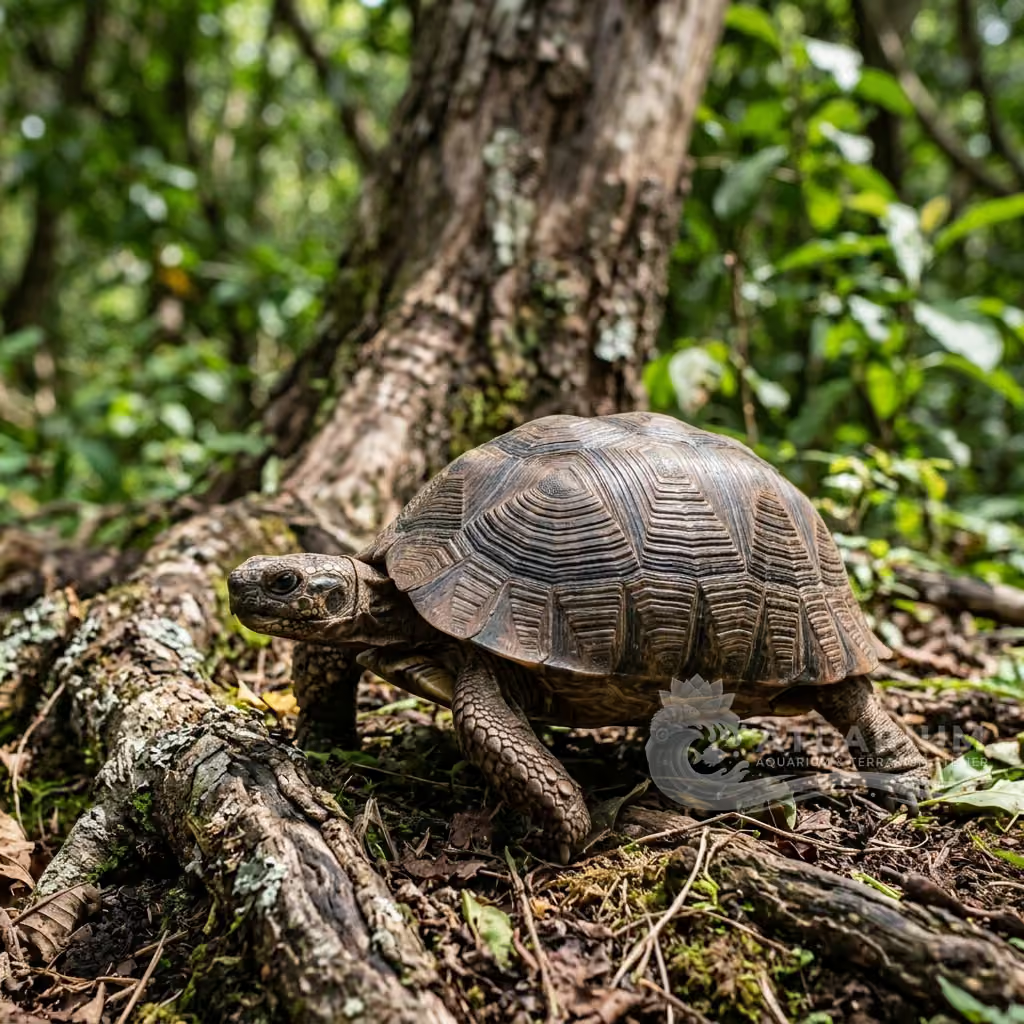
Morphology: Compared to the eastern subspecies, this nominate subspecies is smaller, with adult females usually measuring between 13 and 15 centimeters and males being even smaller (11-13 cm). The carapace is highly domed and features a bright yellow-gold or intense orange background with highly contrasting, sharp black markings. A key diagnostic feature is the distinct 'keyhole' or 'mushroom' pattern on the 5th vertebral scute, along with two continuous, parallel black bands running along the plastron.

Soins, reproduction et cohabitation
Terrarium Setup: While it is highly preferable to keep them outdoors in large, secure pens year-round, indoor housing requires an open-top 'tortoise table' (rather than enclosed glass vivariums, which restrict air circulation) with minimum dimensions of 200x100 cm for an adult. The ideal substrate is a 15-20 cm deep mix of untreated topsoil and coco coir or fine sand (about 30% sand), allowing the tortoise to dig. Provide shelters such as hollow logs, cork bark, and live or artificial drought-tolerant plants.
Lighting and Heating: Indoors, high-output UVB lighting (such as a T5 HO 10% or 12% bulb mounted at the correct distance) is essential and should be on a 12-hour photoperiod. Heating must establish a linear thermal gradient: a cool end around 20-22°C and a hot basking zone of 30-32°C directly under a basking spotlight. Nighttime temperatures can drop to 16-18°C, mimicking the natural Mediterranean temperature drop.
Humidity and Hydration: Average ambient humidity should be around 50-60%, slightly higher (up to 70%) for tank-raised hatchlings to prevent dehydration and support smooth shell development. A very shallow water dish must always be accessible for the tortoise to drink and soak in safely without risk of drowning. Weekly lukewarm baths are highly beneficial for hydration.
Feeding and Supplementation: A strict herbivore requiring a high-fiber, low-protein, and low-fat diet with a high calcium-to-phosphorus ratio. The ideal diet consists of wild weeds and leafy greens (dandelion, plantain, mallow, chicory, clover). Avoid fruit, vegetables, bread, oats, or commercial cat/dog foods. Supplement their diet with pure calcium carbonate (cuttlefish bone always available) and dust food with calcium and vitamin D3 twice a week.
Compatibility: Males are highly territorial and aggressive, especially during the breeding season when they constantly chase and bite females or fight with other males. Multiple males should never be housed together in confined spaces. The ideal ratio is one male to at least 3-4 females in large spaces, or housing individuals separately to avoid stress.
Health and Common Diseases: Metabolic Bone Disease (MBD) is the primary concern caused by lack of UVB lighting or dietary calcium, leading to a soft, deformed carapace. Other common issues include respiratory infections from drafty or overly damp enclosures, and intestinal parasite overgrowth. Hibernation must be managed carefully by monitoring weight loss, which should not exceed 10% of their pre-hibernation weight.

Origine et répartition géographiques
Testudo hermanni hermanni, commonly known as the Western Hermann's tortoise, is native to southern Europe. Its geographic range is concentrated in the western portion of the Mediterranean basin, including eastern Spain, southern France, Italy (including the large islands of Sardinia and Sicily), and several coastal island groups. It primarily inhabits Mediterranean-type environments such as dry maquis, holm oak woodlands, coastal sand dunes covered with shrubby vegetation, and traditional low-intensity agricultural lands exposed to direct sunlight.
Origine
Europe, Méditerranée et Asie occidentale

Profil de reptile
- Régime alimentaire
- Herbivore
- The Western Hermann's Tortoise is a strict terrestrial herbivore, grazing continuously on a low-energy, high-fiber diet. Natural foraging primarily involves broadleaf weeds, Mediterranean scrub, clovers, dandelions, and various wild flowers. Maintaining appropriate calcium-to-phosphorus ratios in their leafy diet is paramount, while fruit or animal protein must be strictly avoided to prevent severe shell deformities and organ failure.
- Taille adulte
- 15 cm
- Mode de vie/microhabitat
- Terrestrial
- This animal leads a terrestrial lifestyle, predominantly dwelling on the ground rather than climbing trees or spending time in the water. It traverses the forest floor, grasslands, or desert terrain in search of food, mates, and secure hiding spots beneath rocks, logs, or dense underbrush. In a terrarium setting, providing a large horizontal footprint is essential, along with a deep, appropriate substrate that allows for natural foraging and resting behaviors. While they may occasionally climb low-lying obstacles, their enclosure should be designed to maximize usable floor space.
- Cycle d'activité
- Diurnal
- This species exhibits a predominantly diurnal activity pattern, meaning it is most active during the daylight hours. Throughout the day, it is frequently observed exploring its enclosure, foraging for food, and actively seeking out basking spots to thermoregulate its body temperature. Providing appropriate full-spectrum lighting and adequate heat gradients during the day is critical to simulate its natural solar cycle. As evening approaches and temperatures drop, the animal will typically retreat to a secure hide or burrow to rest and conserve energy until the next morning.
- Sociabilité
- Solitary
- While generally considered solitary wanderers, Western Hermann's Tortoises tolerate overlapping home ranges and occasionally congregate around premium basking or foraging spots. However, males are notoriously territorial and aggressive towards both rival males and potential mates. Therefore, providing ample space with visual barriers is strictly required if managing a small captive group.
- Reproduction
- Oviparous
- Reproduction follows a strict seasonal oviparous pattern, heavily influenced by their Mediterranean climate. After waking from winter brumation, males engage in vigorous, sometimes aggressive, courtship involving ramming and biting the females. The female subsequently digs a flask-shaped nest to deposit 2 to 6 hard-shelled eggs, relying completely on the sun-warmed earth for successful incubation.
- Tolérance aux manipulations
- Display only
- This animal is considered a display-only species, meaning it strongly dislikes being handled and becomes heavily stressed by human contact. They are either far too delicate to be handled safely or possess highly defensive traits that make interactions stressful and potentially harmful for both the animal and the keeper. Interaction should be strictly limited to visual observation through the enclosure glass, and physical handling should only occur during absolute emergencies or unavoidable health checkups. Appreciating their natural behaviors from a distance is the best approach to ensuring their well-being.
- Brumation
- Requise
- This species naturally undergoes brumation—a reptile's equivalent to hibernation—during the colder winter months. To ensure optimal health and reproductive viability, keepers must carefully orchestrate a gradual cooling period, slowly lowering the ambient temperatures and reducing light cycles to mimic seasonal changes. During this dormancy phase, the animal's metabolism slows down significantly; it will cease eating and become highly inactive, sometimes for several months. Food must be completely withheld well in advance of cooling to prevent undigested matter from rotting in its stomach.
- Mue
- Regular
- Shedding (or molting) occurs regularly as the animal grows, with frequency decreasing as it reaches adulthood. Under normal enclosure conditions, providing a standard, moderate humidity level alongside a designated humid hide—a small, enclosed space filled with damp sphagnum moss—is entirely sufficient to facilitate a clean, complete shed. Prior to shedding, the animal's colors will appear dull, and its eyes may turn a cloudy, opaque blue. During this phase, it is crucial not to handle or feed the animal, allowing it to rest and shed its skin naturally in one uninterrupted piece.

Espèces associées
Recommandations regroupées par proches parents, compagnons et soins similaires.