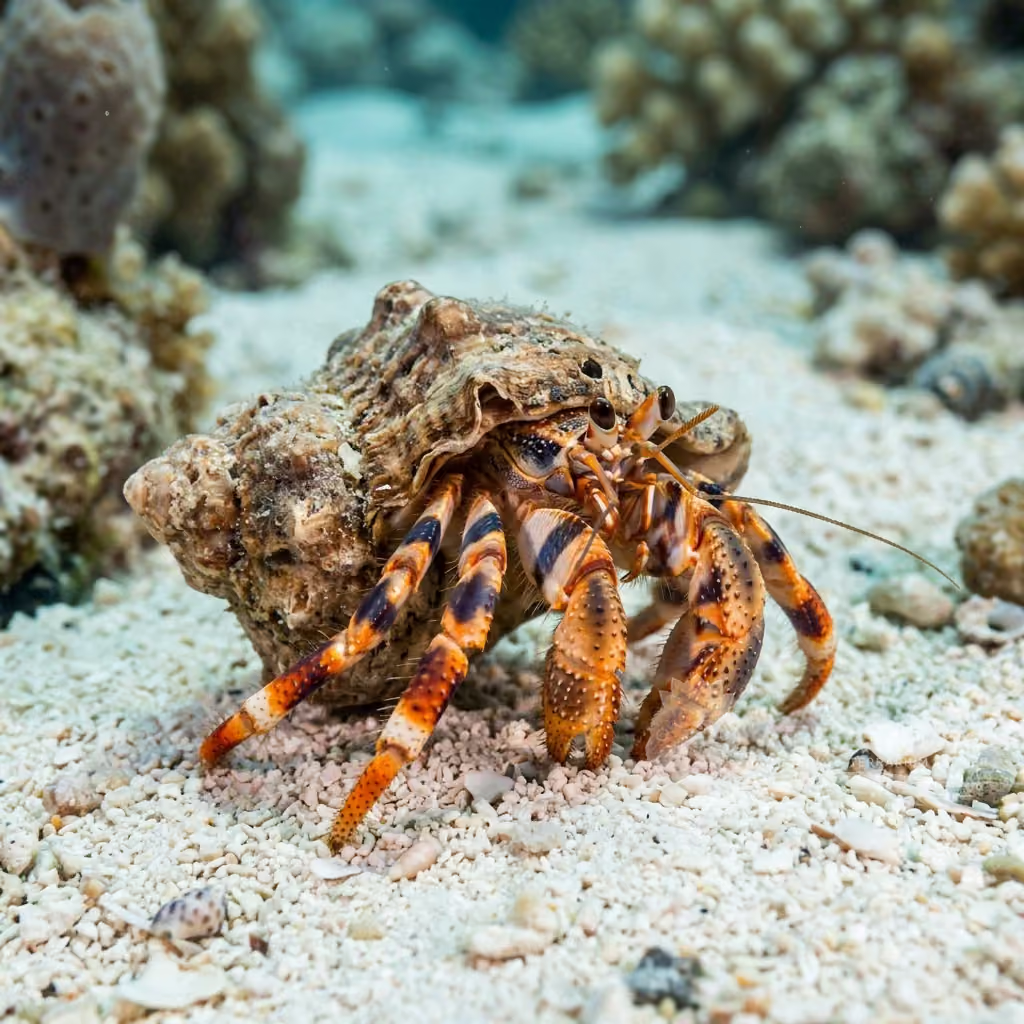
Nassa mud snail
Nassarius obvelatus
A classic zombie snail that lives beneath the sand, rising like a submarine when food enters the water. A critical detritivore, it requires a soft sand bed to bury itself and aerate the substrate.
Température de l’eau
22 - 28 °C
Valeur du pH
8.1 - 8.4
Type d'eau
Marin
Type d'invertébré
Freshwater snail
Taille adulte
1,8 cm
Groupe minimal
>= 1
KH
8 - 12 dKH
Rôle écologique
Herbivore
Sensibilité au cuivre
High

Description de l'espèce
Geographical Origin and Habitat: Widely distributed in the tropical waters of the Indo-Pacific, from East Africa and the Red Sea to northern Australia, the Philippines, and French Polynesia. It inhabits shallow coastal waters, sandy lagoons, seagrass beds, and intertidal mud flats at depths of 0 to 15 meters.
Taxonomy: Nassarius obvelatus is a gastropod mollusk belonging to the family Nassariidae, genus Nassarius. Commonly known as the Nassa mud snail or dog whelk. It is characterized by a long, flexible siphon used to detect chemical scent trails of decaying organic matter in the water.
Social Behavior: A peaceful, harmless scavenger that spends most of its time buried beneath the sand bed. It performs a vital ecosystem service by aerating the substrate and preventing the buildup of anaerobic toxic zones. When food is introduced, they emerge rapidly from the sand like tiny submarines.
Coloration and Sexual Dimorphism: Features a robust, ribbed, oval-conical shell. Shell colors range from grayish-white to light beige or tan, occasionally marked with darker brown spiral bands. There is no visible external sexual dimorphism; males and females are morphologically identical.

Soins, reproduction et cohabitation
Tank Setup: Suitable for nano reefs and larger aquariums starting from 30-50 liters (10-15 gallons). The primary requirement is a soft sand bed of at least 4-6 cm in depth, allowing the snail to bury itself completely. Coarse or rocky substrates should be avoided as they prevent burrowing.
Diet and Feeding: Strictly a detritivore and scavenger. It does not consume healthy algae but eagerly feeds on leftover fish food (frozen, flakes, pellets), organic waste, and dead animal matter. It is a critical component of the aquarium's clean-up crew to prevent ammonia spikes.
Water Quality: Requires standard, stable marine parameters: salinity/specific gravity of 1.023-1.025, temperature of 22-27°C (72-81°F), pH of 8.1-8.4, and dKH of 8-12. As with all invertebrates, it is highly sensitive to copper treatments. Calcium levels should be monitored for shell strength.
Compatibility and Tankmates: Exceptionally reef-safe. Compatible with peaceful community fish, corals, and other non-predatory invertebrates. Avoid housing with snail-eating predators such as triggerfish, puffers, large wrasses, or aggressive hermit crabs.
Aquarium Breeding: Spawning can occur in home aquariums, with females laying small, capsule-like eggs in transparent sheets on the glass or rocks. However, the planktonic larvae are usually removed by filtration or eaten by corals, so they rarely reach adulthood in a standard setup.
Risks and Diseases: The main risk is starvation in sterile tanks with no fish population or very low feeding rates. They are highly sensitive to osmotic shock, so slow drip acclimation is necessary when introducing them to a new aquarium.

Origine et répartition géographiques
Widely distributed in the tropical waters of the Indo-Pacific, from East Africa and the Red Sea to northern Australia, the Philippines, and French Polynesia. It inhabits shallow coastal waters, sandy lagoons, seagrass beds, and intertidal mud flats at depths of 0 to 15 meters.
Origine
Océans tropicaux et récifsAfrique et MadagascarAsie du Sud et du Sud-EstAustralie, Nouvelle-Guinée et Océanie

Profil d'invertébré
- Régime alimentaire
- Carnivore
- Scavenger of meaty foods and carrion.
- Rôle écologique
- Herbivore
- Incredible sand sifter. Prevents substrate compacting.
- Taille adulte
- 1.8 cm
- Risque de saut
- Yes
- Burrows in the sand. Does not jump.
- Sensibilité aux chocs
- Medium
- Requires stable water chemistry.
- Calcium et minéraux
- Medium
- Needs calcium to maintain its shell.
- Mue
- Shell growth
- Snails do not molt. Instead, their shell grows continuously throughout their lifespan as they extract calcium from the water to add layers of calcium carbonate. They do not shed any exoskeleton.
- Reproduction
- Oviparous
- While they often lay small egg capsules on hard surfaces, captive breeding is extremely difficult. The eggs hatch into pelagic larvae that usually do not survive the filtration systems in home aquariums.
- Compatibilité et compagnons
- Reef safe
- Completely reef safe. These peaceful scavengers spend most of their time burrowing in the sand bed to keep it clean, and they will never harm healthy corals, fish, or other invertebrates.

Espèces associées
Recommandations regroupées par proches parents, compagnons et soins similaires.