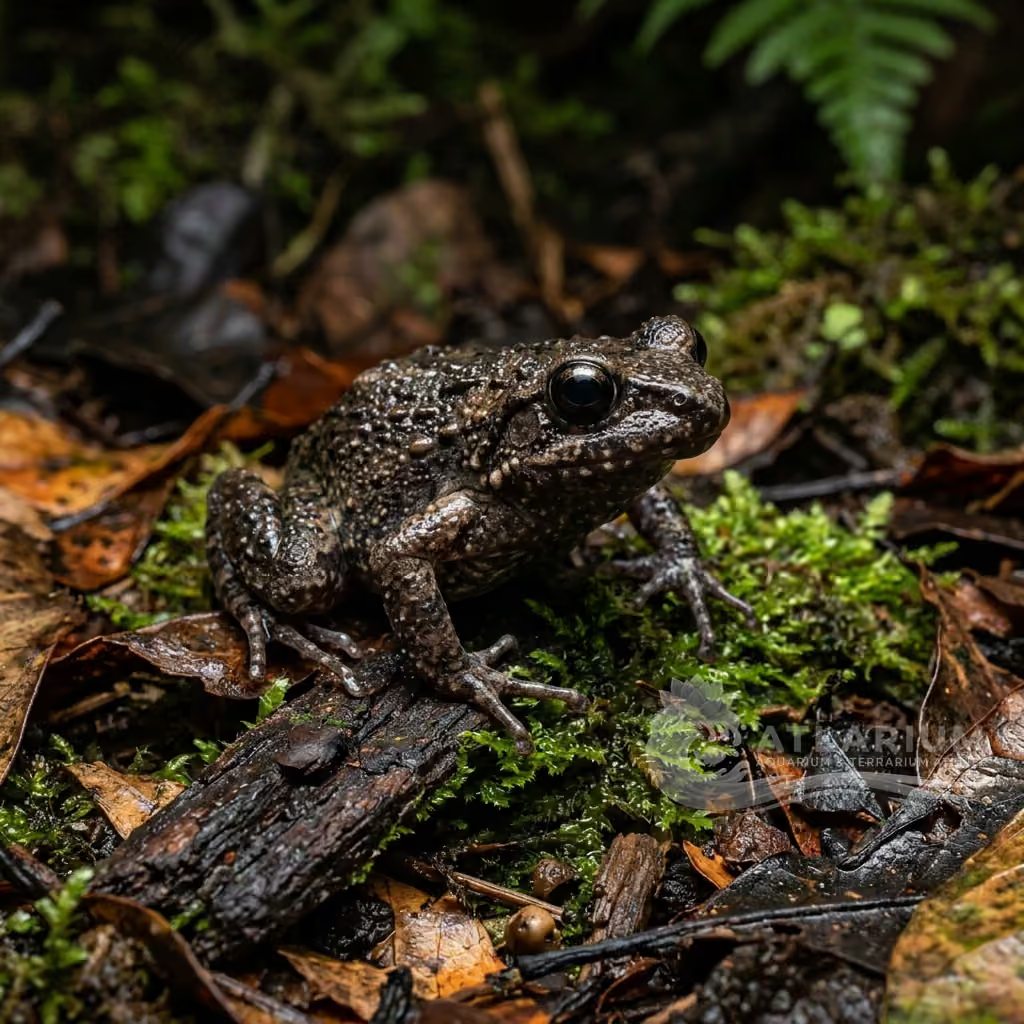
Green Pacman frog — Standard / Green
Ceratophrys cranwelli
A renowned terrestrial South American horned frog, famously known for its perfectly round body, voracious appetite, and an unbelievably massive mouth.
Environment
Terrestrial
Humidity
60 - 80 %
Day temperature
24 - 29 °C
Night temperature
20 - 26 °C

Species description
Geographical Origin and Habitat: Ceratophrys cranwelli is native to the Chaco region of South America, which spans northern Argentina, Bolivia, Paraguay, and southwestern Brazil. This species inhabits dry deciduous forests, semi-arid scrublands, and seasonal floodplains. During dry seasons, it burrows deep into the soil and secretes a protective cocoon made of dead skin sheets to prevent water loss (estivation), emerging only when rains return.
Taxonomy and Genetics: Belonging to the family Ceratophryidae and the genus Ceratophrys. The 'Standard / Green' morph represents the wild-type coloration of the species, featuring genes that express stable green and brown pigments. While selective captive breeding has produced many color variants (morphs), the standard green form remains one of the hardiest and most popular.
Behavior and Habits: It is a strictly sedentary ambush predator. It spends nearly its entire life half-buried in the soil, waiting patiently for prey to wander close. It has a highly aggressive feeding response, attempting to consume anything that moves within its reach. Primarily nocturnal, it remains quietly alert in its burrow during daylight hours.
Morphology: Displays a unique body shape consisting of a round, heavy body, short limbs, and a massive head that accounts for nearly half of the frog's total mass. The mouth is exceptionally wide, featuring tooth-like bony projections on the upper jaw. Pointed skin folds resemble horns above each eye. Adult females reach 10-15 cm, while males are significantly smaller.

Care, breeding and tankmates
Terrarium Setup: Due to their inactive lifestyle, a terrarium of 50x30x30 cm is sufficient for an adult. The substrate is the most vital component: use moist coconut fiber, peat, or sphagnum moss at a depth of at least 8-10 cm to allow natural burrowing behavior. Avoid gravel or small pebbles, which can be swallowed accidentally and lead to fatal impaction.
Lighting and Heating: Strong UVB is not required, but a low-output (2%) UVB bulb is highly recommended to support skeletal development. Daytime temperatures should range from 25°C to 28°C on the warm side, dropping to 20-22°C at night. Heat mats must be attached to the side or back of the terrarium, never on the bottom, as the frog burrows to cool down.
Humidity and Hydration: Humidity must be kept high, between 70% and 80%, by spraying the terrarium with dechlorinated water once or twice daily. A shallow, wide water bowl must be provided. The water depth should not exceed the frog's chin level, as Pacman frogs are very poor swimmers and can drown in deep water.
Feeding and Supplementation: A voracious carnivore. Juveniles should be fed crickets, roaches, and earthworms every other day. Adults can eat larger insects, silverside fish, and occasional thawed pinky or fuzzy mice (no more than once a month to prevent obesity and liver disease). Dust prey items with calcium and D3 powder twice a week for juveniles and once a week for adults.
Compatibility: This species must be housed strictly alone. Pacman frogs are notorious cannibals and will actively attack and attempt to eat any tankmate, including their own species, regardless of size. Keeping two frogs in the same enclosure will almost certainly result in the death of one or both.
Health and Common Diseases: Prone to Metabolic Bone Disease (MBD) if calcium and D3 levels are deficient. Toxic Out Syndrome is another common issue, caused by the buildup of ammonia from waste in the substrate; therefore, the substrate must be completely replaced every 4-6 weeks. Handle the frog as little as possible, as human skin oils can harm their porous skin.

Geographic origin and distribution
Ceratophrys cranwelli is native to the Chaco region of South America, which spans northern Argentina, Bolivia, Paraguay, and southwestern Brazil. This species inhabits dry deciduous forests, semi-arid scrublands, and seasonal floodplains. During dry seasons, it burrows deep into the soil and secretes a protective cocoon made of dead skin sheets to prevent water loss (estivation), emerging only when rains return.
Origin
Extra-Amazon South America

Amphibian profile
- Diet
- Carnivore
- Pacman frogs are ambush predators with a massive appetite, eating insects, worms, and appropriately sized rodents. Juveniles should be fed a staple of gut-loaded crickets or roaches, while adults can handle larger prey like nightcrawlers and occasional mice. Dusting food with calcium and vitamins is critical, but avoid overfeeding to prevent obesity.
- Life expectancy
- 6-15 years
- Adult size
- 12 cm
- Lifestyle/Microhabitat
- Terrestrial
- Terrestrial and burrowing, they require a deep, moisture-retaining substrate like coconut fiber or sphagnum moss. They do not need a large enclosure but do require distinct moisture and temperature gradients. Provide a shallow water dish that they can easily enter and exit.
- Activity cycle
- Nocturnal
- Mostly nocturnal or crepuscular, they remain inactive during the day to avoid desiccation. They will become alert when food is introduced, regardless of the time of day. Their activity is primarily limited to eating and burying themselves.
- Sociality
- Gregarious
- They are extremely sedentary, spending most of their time half-buried in the substrate waiting for prey to pass by. They can be aggressive feeders and will lunge at anything that moves near their mouth. They are solitary animals and should be housed individually to prevent cannibalism.
- Reproduction
- Oviparous
- Breeding is difficult in captivity and requires a specific cycling process involving a dry period followed by heavy simulated rain. Males call loudly to attract females to shallow water where amplexus occurs. Females can lay thousands of eggs, and the resulting tadpoles are highly carnivorous and cannibalistic.
- Toxicity
- Harmless
- The Standard / Green Pacman Frog is entirely non-toxic and possesses no venom glands. They rely on camouflage and their biting capability for defense rather than chemical deterrents. While their bite can be surprisingly strong and painful due to odontoid projections (tooth-like structures) in their jaw, it is not venomous. Keepers should wash their hands before and after handling or feeding to protect the frog's sensitive skin and maintain good hygiene. They pose no toxic threat to humans or other household pets.
- Life stage
- Metamorphosis
- The Pacman Frog begins its life as an aquatic, carnivorous tadpole that requires separation from siblings due to cannibalistic tendencies. Once metamorphosis is complete, the Standard / Green juvenile froglet grows extremely fast if fed properly. They reach sexual maturity and near adult size within 10 to 12 months, depending on feeding frequency and temperature. Adult Pacman frogs are large, heavily built, and predominantly sedentary, capable of living 10 to 15 years under optimal care conditions. Throughout their life stages, maintaining proper humidity and substrate moisture is vital.
- Handling tolerance
- Display only
- Handling of the Standard / Green Pacman Frog should be strictly minimized and generally avoided unless absolutely necessary for cleaning or health checks. Their skin is extremely delicate and easily absorbs toxins, oils, or soaps from human hands, which can lead to illness. Additionally, their aggressive feeding response means a moving finger can easily be mistaken for food, resulting in a painful bite. If handling is required, wearing moistened, powder-free nitrile gloves is highly recommended. Scooping the frog gently from behind or using a small container to move them is safer than picking them up directly.
- Brumation
- Not required
- In the wild, Cranwell's Horned Frogs undergo a period of dormancy known as estivation during the dry season, encasing themselves in a tough cocoon of shed skin to retain moisture. In captivity, this is not strictly necessary for the Standard / Green morph unless breeding is intended, and it carries significant risks if not managed correctly. If the enclosure becomes too dry or cold, the frog may enter this state involuntarily. It is safer to maintain consistent, optimal temperatures and humidity year-round to keep the frog active and eating. If estivation occurs, the frog should be slowly rehydrated with warm misting over several days.
- Molting
- Periodic
- The Standard / Green Pacman Frog sheds its skin regularly as it grows, a process that happens more frequently in rapidly growing juveniles. The shedding process involves the frog making a series of stretching and wiping motions with its limbs to peel the old skin off its body. It is completely normal for the frog to eat its shed skin, which helps recycle nutrients back into its system. Providing a shallow soaking dish and maintaining proper ambient humidity are essential to ensure the shed comes off cleanly in one piece. Patches of retained shed indicate that the enclosure is too dry and needs immediate adjustment.

Related species
Recommendations grouped by close relatives, companion choices, and similar care.