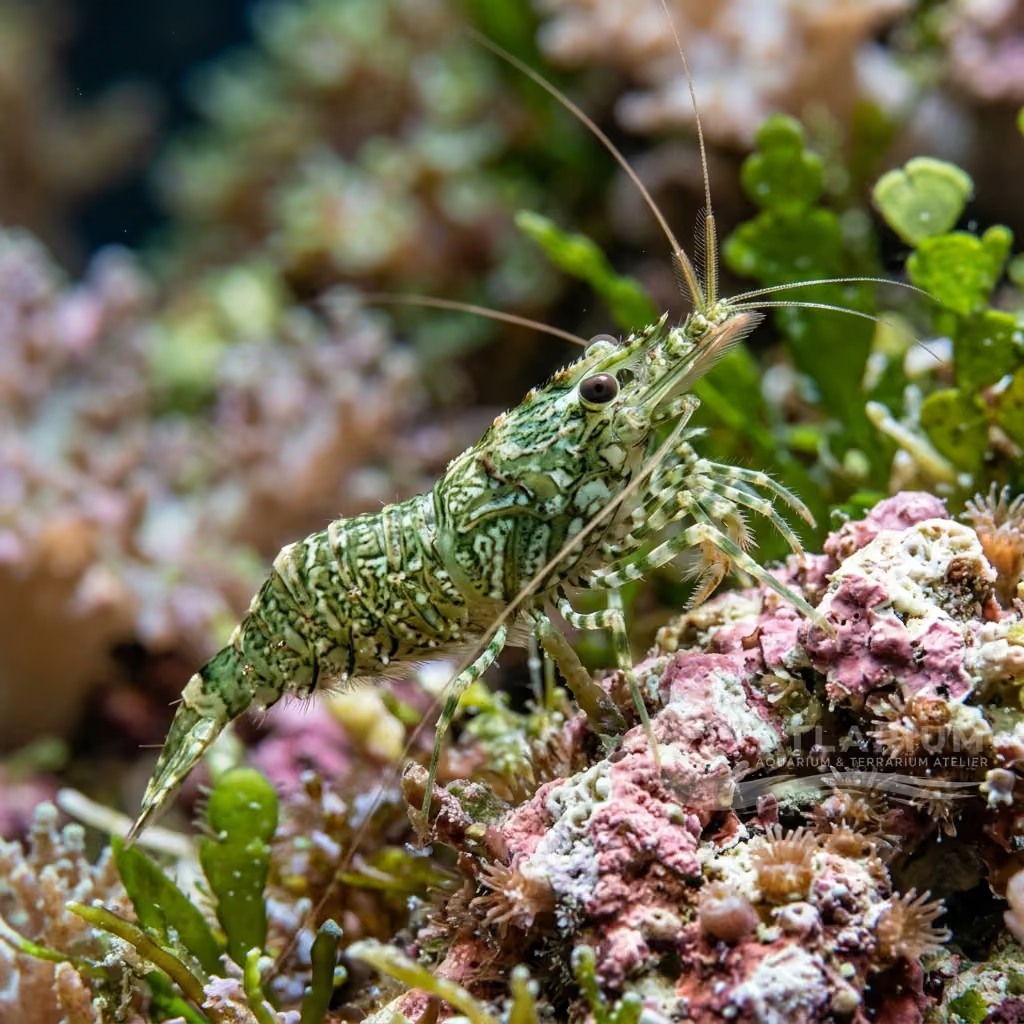
Feeble shrimp
Palaemon debilis
Extremely adaptable to freshwater, brackish, or marine setups, this lively shrimp is a versatile scavenger. It requires an environment with complex hiding places like roots and marine macroalgae.
Wassertemperatur
20 - 28 °C
pH-Wert
7.8 - 8.4
Wassertyp
Meerwasser / Brackwasser
Wirbelloser Typ
Marine shrimp
Erwachsenengröße
3,5 cm
Mindestgruppe
>= 4
KH
8 - 12 dKH
Ökologische Rolle
Scavenger
Kupferempfindlichkeit
High

Artbeschreibung
Geographical Origin and Habitat: Palaemon debilis is widely distributed along the tropical and subtropical coasts of the Indo-Pacific. It is found from the Red Sea and East African coasts to the Hawaiian Islands, Ryukyu Islands, and French Polynesia. It primarily inhabits shallow coastal habitats with minimal or no current, such as mangrove forests, coastal lagoons, river estuaries, tide pools, and seagrass beds. As a highly euryhaline species, it is capable of surviving and thriving in fresh, brackish, and marine waters, even colonizing hypersaline coastal pools.
Taxonomy: It belongs to the class Malacostraca, order Decapoda, family Palaemonidae, and genus Palaemon. The physical structure is typical of palaemonid shrimps, characterized by a slender and flexible body with a well-developed, serrated rostrum on the head that is slightly curved upward. It reaches a total adult length usually ranging between 4 and 5 centimeters, with long, thin walking legs adapted for searching the substrate.
Social Behavior: It is a gregarious, shy but active species that feels secure when housed in groups of several individuals (at least 5-10 specimens). It exhibits completely peaceful behavior and shows no form of aggression or territoriality toward conspecifics or other tankmates. It spends the day walking on plants, rocks, and sand, tirelessly searching every crevice for organic remains.
Coloration and Sexual Dimorphism: The body is almost completely transparent or glassy, with thin dark or brownish longitudinal lines and small spots scattered on the claws and walking legs. This transparency serves as an extraordinary defense against predators. Adult females are easily distinguished from males as they are noticeably larger and, during the breeding season, carry a green or yellowish egg mass under their abdomen.

Pflege, Zucht und Mitbewohner
Tank Setup: Being extremely adaptable, it can be kept in freshwater, brackish, or marine aquariums with a minimum capacity of 30 liters. The tank must offer numerous hiding places made with rocks, driftwood, mangrove roots, or hardy plants like Anubias and Microsorum (in freshwater) or Caulerpa algae (in brackish/marine water). A fine sand or fine gravel substrate is ideal to allow it to walk without injury. It is advisable to use filter intakes equipped with a sponge cover to prevent the shrimps from being sucked in.
Diet and Feeding: It is an omnivorous scavenger. It actively consumes all types of detritus, leftover fish food, algae, and decaying organic matter. It readily accepts sinking pellets for fish or crustaceans, spirulina powder or flakes, and small pieces of frozen food like mysis or chopped krill. It never attacks fish or other live organisms, making it perfect for keeping the aquarium clean of decomposing organic matter.
Water Quality: It displays exceptional tolerance to water parameters. It can live in salinities from 0 (freshwater) to 35 ppt (marine water), although brackish conditions (salinity between 10 and 20 ppt, specific gravity 1.007-1.015) are ideal. The temperature should be maintained between 20°C and 28°C, with a stable pH between 7.5 and 8.2. It requires well-oxygenated water and, though very hardy, is sensitive to high levels of ammonia, nitrites, and especially copper, which must be strictly avoided.
Compatibility and Tankmates: It is compatible with small, peaceful fish suited to the same conditions, such as guppies and platies (in freshwater), or mollies and gobies (in brackish water), or tiny gobies and pipefish (in marine water). Co-habitation with medium-to-large predatory fish like cichlids, angelfish, large crustaceans, or predatory crabs should be strictly avoided, as they will easily hunt and consume it.
Aquarium Breeding: Breeding is possible and relatively easy in brackish or marine conditions. The female carries the fertilized eggs under her pleopods for about 2-3 weeks until they hatch. The released larvae are planktonic and require brackish or marine water rich in phytoplankton and rotifers to complete their larval molting stages before settling on the bottom as fully metamorphosed young shrimps. Breeding in pure freshwater is virtually impossible due to poor larval survival.
Risks and Diseases: The primary risk lies in issues related to shedding the exoskeleton, which can occur if the water is deficient in iodine, calcium, or magnesium. Regularly dosing these elements is recommended to promote proper calcification of the new shell. It is sensitive to heavy metal buildup in the water, especially copper, which is found in many fish medications. Another risk is thermal stress caused by sudden temperature shifts during water changes.

Geografische Herkunft und Verbreitung
Palaemon debilis is widely distributed along the tropical and subtropical coasts of the Indo-Pacific. It is found from the Red Sea and East African coasts to the Hawaiian Islands, Ryukyu Islands, and French Polynesia. It primarily inhabits shallow coastal habitats with minimal or no current, such as mangrove forests, coastal lagoons, river estuaries, tide pools, and seagrass beds. As a highly euryhaline species, it is capable of surviving and thriving in fresh, brackish, and marine waters, even colonizing hypersaline coastal pools.
Ursprung
Tropische Ozeane und RiffeAfrika und MadagaskarOstasien

Wirbelloses Profil
- Diät
- Omnivore
- Palaemon debilis is primarily an opportunistic omnivore that constantly scavenges the substrate. Its diet consists of detritus, uneaten fish food, and naturally occurring biofilm in the aquarium. Supplemental feedings of sinking pellets or blanched vegetables can help maintain optimal health.
- Ökologische Rolle
- Scavenger
- In its natural habitat, Palaemon debilis acts as a crucial part of the cleanup crew. It helps to process waste materials and keeps the environment free from decaying organic matter. In captivity, it provides the exact same valuable sanitation services.
- Erwachsenengröße
- 3.5 cm
- Sprungrisiko
- Yes
- While not notorious jumpers, Palaemon debilis can easily escape if startled by predators or abrupt light changes. A tight-fitting lid is always recommended to ensure they stay safely within the aquarium. Escaped shrimp will quickly desiccate and perish if they breach the water surface.
- Stoßempfindlichkeit
- Medium
- Palaemon debilis is remarkably sensitive to sudden shifts in water parameters such as temperature and salinity. A slow drip acclimation is highly recommended when introducing this invertebrate to a new system. Rapid fluctuations can lead to shock, failed molts, or sudden death.
- Kalzium und Mineralien
- High
- Maintaining adequate calcium levels is essential for Palaemon debilis to develop a strong exoskeleton. Calcium deficiencies can result in molting problems and leave the shrimp vulnerable to predators or disease. Regular water changes and calcium-rich diets can support healthy carapace formation.
- Häutung
- Periodic
- Molting is a critical and stressful period in the life cycle of Palaemon debilis. After shedding its exoskeleton, it will instinctively seek hiding places until its new shell hardens. The discarded molt should be left in the tank, as the shrimp will consume it to reclaim valuable minerals.
- Reproduktion
- Oviparous
- Breeding Palaemon debilis in captivity can be challenging depending on the specific larval stages required. Females often carry fertilized eggs under their pleopods until they are ready to hatch. Depending on the species, the young may hatch as miniature adults or undergo complex planktonic stages.
- Kompatibilität & Tankkameraden
- Peaceful
- Palaemon debilis is generally peaceful but vulnerable to being eaten by larger, aggressive fish. It is best housed with other small, peaceful tankmates and plenty of hiding spots. Care should be taken to avoid housing it with natural invertebrate predators.

Verwandte Arten
Empfehlungen gruppiert nach nahen Verwandten, Auswahl von Begleitern und ähnlicher Betreuung.