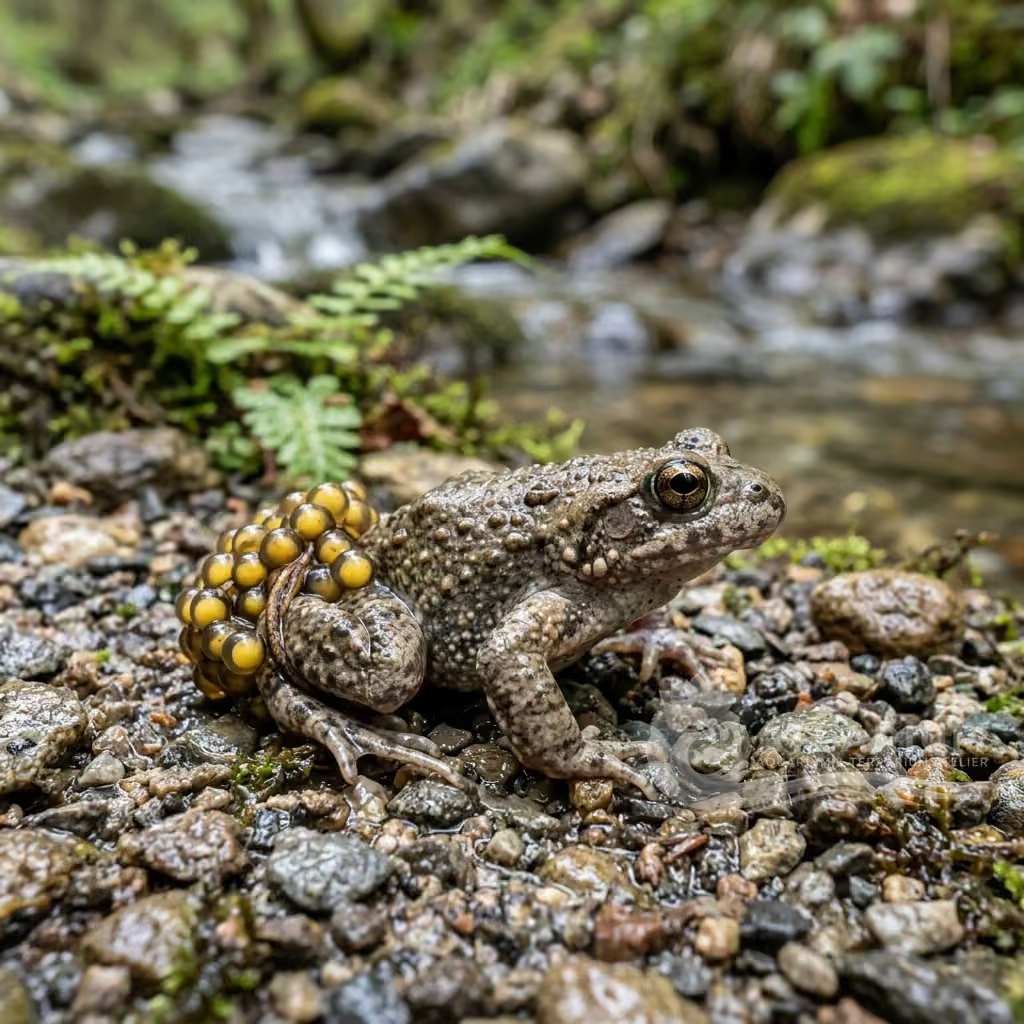
Dainty green tree frog
Ranoidea gracilenta
The Dainty Green Tree Frog is a slender, vividly green amphibian with bright yellow eyes. A graceful climber of the Australian rainforest, it requires a humid, vertically oriented arboreal habitat.
Umgebung
Terrestrisch
Luftfeuchtigkeit
60 - 80 %
Tagestemperatur
24 - 27 °C
Nachttemperatur
21 °C
Umgebungstemperatur
24 - 27 °C
Mindestgehäuse
>= 45 L

Artbeschreibung
Geographical Origin and Habitat: The dainty green tree frog (Litoria gracilenta), also known as the graceful tree frog, is native to eastern Australia, ranging from northern Queensland down to northern New South Wales. This species inhabits warm rainforests, wet sclerophyll forests, coastal swamps, and humid suburban gardens. It is closely tied to riparian vegetation, spending its life resting on leaves of trees and shrubs near waterbodies.
Taxonomy and Genetics: Belongs to the family Pelodryadidae (Austro-Papuan tree frogs) and the genus Litoria. Genetically, it belongs to a species complex of green tree frogs (such as Litoria chloris) but is distinguished by its distinct male vocalizations and genetic markers confirming its unique evolutionary lineage. There are no currently recognized subspecies.
Behavior and Habits: An arboreal, nocturnal amphibian that is most active during periods of warm weather and high rainfall. During the day, it rests by flattening its body against the undersides of large leaves to minimize moisture loss. At night, it emerges to forage for insects. Males are known for their loud, nasal breeding calls, which they emit in large choruses near temporary pools.
Morphology: This is a small to medium-sized tree frog, with adults measuring between 3 and 4.5 centimeters in length. It features a slender body with a rounded snout and large eyes with a golden iris and horizontal pupil. The dorsal coloration is a uniform bright leaf-green, while the flanks, inner thighs, and ventral surfaces are vibrant yellow or orange.

Pflege, Zucht und Mitbewohner
Terrarium Setup: Requires a vertically oriented terrarium (minimum 45x45x60 cm for a small group of 2-3 frogs). The setup should replicate a humid forest canopy, featuring thin climbing branches, vertical cork bark, and live plants with sturdy leaves (like Pothos, Bromeliads, or Sansevieria) for sleeping platforms. Use coconut fiber mixed with damp sphagnum moss as the substrate.
Lighting and Heating: Maintain daytime temperatures between 24 and 27 °C near the top of the enclosure, with a cooler area of 20-22 °C at the bottom. Night temperatures can safely drop to 18 °C. Use a low-wattage basking bulb or heating element, ensuring it is screened to prevent burns. A 2.0% UVB bulb is recommended to support general health.
Humidity and Hydration: Requires high humidity levels of 70% to 80%, peaking at 90% at night. Mist the enclosure twice daily with dechlorinated tap water or reverse osmosis water. A shallow water bowl, no deeper than 2 cm, must be kept on the terrarium floor for hydration, and the water must be replaced daily to ensure cleanliness.
Feeding and Supplementation: Strictly insectivorous. Feed a variety of small live insects, such as size-appropriate crickets, roaches, and flies (prey size should not exceed the width between the frog's eyes). Dust prey with a calcium and vitamin D3 supplement twice a week for adults and daily for growing juveniles.
Compatibility: Safe to house in small groups of the same species, provided there is enough space and perching areas for all individuals. Do not co-house with other frog species due to the risk of disease transmission and competitive stress. Keep away from predatory or larger terrarium animals.
Health and Common Diseases: Highly susceptible to chytridiomycosis (a fatal fungal infection) and bacterial skin infections if the enclosure is kept too dirty or lacks proper airflow. Good ventilation via mesh panels is critical. Nutritional deficiencies from a lack of calcium and UVB will result in Metabolic Bone Disease (MBD).

Geografische Herkunft und Verbreitung
The dainty green tree frog (Litoria gracilenta), also known as the graceful tree frog, is native to eastern Australia, ranging from northern Queensland down to northern New South Wales. This species inhabits warm rainforests, wet sclerophyll forests, coastal swamps, and humid suburban gardens. It is closely tied to riparian vegetation, spending its life resting on leaves of trees and shrubs near waterbodies.
Ursprung
Australien, Neuguinea und Ozeanien

Amphibienprofil
- Diät
- Insectivore
- The Dainty green tree frog is an insectivorous amphibian with a keen appetite for flying and crawling prey. In their natural habitat, they consume a variety of small insects including moths, flies, beetles, and occasional spiders. In captivity, a balanced diet should consist of crickets, dubia roaches, and waxworms, all of which must be appropriately sized to fit between the frog's eyes. It is essential to dust these feeder insects with calcium and vitamin D3 supplements to prevent metabolic bone disease and ensure proper growth.
- Lebenserwartung
- 5-10 years
- Erwachsenengröße
- 4.5 cm
- Lebensstil/Mikrohabitat
- Arboreal
- This species leads a highly arboreal lifestyle, spending the vast majority of its life in the canopy of rainforests, wet sclerophyll forests, and even agricultural areas like banana plantations. They rely on their large, adhesive toe pads to effortlessly scale smooth leaves and tree trunks. They require a habitat with plenty of moisture and broad-leaved plants to provide resting sites and protection. In captivity, a tall terrarium with lush foliage, climbing branches, and high humidity is essential for their well-being.
- Aktivitätszyklus
- Nocturnal
- Dainty green tree frogs are strictly nocturnal, resting during the day to avoid the heat of the sun and minimize water loss. During daylight hours, they typically sleep with their limbs tucked tightly against their bodies, flattening themselves onto green leaves to blend in perfectly. As the sun sets and humidity rises, they awaken to hunt for insects and, in the case of males, vocalize to establish territory or attract mates. They are most active on warm, rainy, or highly humid nights.
- Sozialität
- Solitary
- These frogs exhibit a generally calm and sedentary behavior, preferring to remain still to avoid detection by predators. Their bright green coloration acts as an excellent camouflage against the leafy backgrounds they inhabit. While they are capable jumpers when escaping danger, they more commonly move with deliberate, crawling motions along branches and leaves. They are mostly solitary creatures, only gathering in significant numbers during the breeding season.
- Reproduktion
- Oviparous
- Breeding usually commences during the wet season, triggered by warm temperatures and heavy rainfall. Males assemble near permanent or semi-permanent water bodies, such as swamps or slow-flowing creeks, to emit their drawn-out, mournful, 'waaaa' mating calls. Following amplexus, females lay their eggs in a gelatinous mass that floats on the surface of the water or attaches to submerged plants. The tadpoles develop in the water over a period of several months before completing metamorphosis.
- Toxizität
- Harmless
- The Dainty green tree frog is completely harmless and does not produce toxic secretions. Their primary defense is their excellent camouflage and ability to jump into dense cover. Like all amphibians, their skin is sensitive to oils and salts. Human contact should be minimized to prevent skin damage.
- Lebensphase
- Metamorphosis
- Aquatic eggs quickly hatch into tadpoles that graze on aquatic plants and algae. The tadpole stage is relatively brief, adapting to breeding in ephemeral pools. Upon completing metamorphosis, the miniature frogs take to the trees. They reach adult size within a year and can live for several years.
- Handhabungstoleranz
- Display only
- The Dainty green tree frog is considered a display-only species. Their delicate skin is highly permeable and easily damaged by the natural oils, salts, and chemicals on human hands. Handling induces severe stress and should be strictly avoided except during essential health checks or enclosure transfers.
- Brumation
- The Dainty green tree frog originates from relatively stable tropical or subtropical environments and does not undergo a true brumation. They require consistently warm and stable temperatures year-round to maintain proper digestion, metabolic activity, and overall immune health.
- Häutung
- Periodic
- High ambient humidity (typically 70-90%) is critical for the Dainty green tree frog. Like most amphibians, they routinely shed their outer layer of skin and rely on moisture to prevent it from sticking or restricting movement. They often consume the shed skin for nutrient recycling.

Verwandte Arten
Empfehlungen gruppiert nach nahen Verwandten, Auswahl von Begleitern und ähnlicher Betreuung.