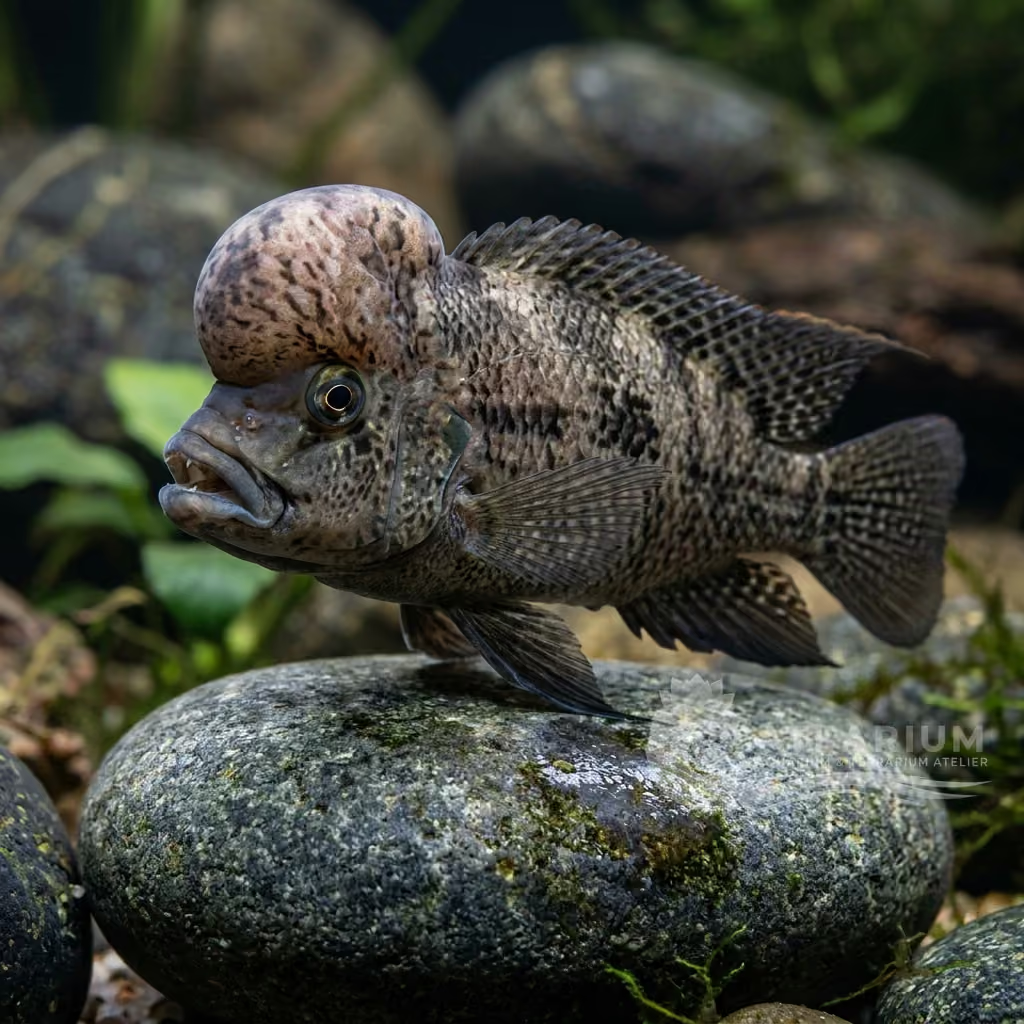
Reticulated Hillstream Loach / Tiger Hillstream Loach
Sewellia lineolata
Resembling a tiny stingray, this hydrodynamic loach thrives in pristine, torrential hillstream rapids. It continuously grazes on boulder biofilm and requires intense water flow to survive.
Température de l’eau
20 - 24 °C
Valeur du pH
6.5 - 7.5
Type d'eau
Eau douce
Niveau dans le bac
Fond
Taille adulte
6 cm
Volume minimal du bac
>= 60 L
Groupe minimal
>= 1
GH
5 - 15 dGH
KH
2 - 7 dKH
TDS
95 - 295 ppm
Conductivité
148 - 461 uS/cm

Description de l'espèce
Geographical Origin and Habitat: Central Vietnam hill and mountain streams. Lives directly in the riffles and small waterfalls, scraping submerged boulders under the forest canopy.
Taxonomy and Morphology: Gastromyzontidae (6 cm). An evolutionary marvel: body flattened into a hydrodynamic suction cup. Fused horizontal pectoral and pelvic fins form a continuous skirt resembling a freshwater stingray. Fast water flowing over its body actively pins it to the rocks.
Social Behavior: Diurnal and territorial. Must be kept in groups (4-5+). Males engage in spectacular, harmless pushing contests ('capping') trying to cover each other with their fin skirts to establish feeding hierarchies.
Coloration and Sexual Dimorphism: Stunning maze-like or tiger-striped reticulated pattern of gold, beige, and pitch black. Viewed from above, males have 'square' shoulders due to nuptial tubercles; females are smoothly aerodynamic and wider.

Soins, reproduction et cohabitation
Aquarium Setup: Requires a 100+ liter 'Hillstream' setup. Torrential flow via wavemakers (15-20x tank turnover per hour). Use smooth, round boulders of various sizes and high lighting to grow green algae patches on the rocks for grazing.
Diet and Feeding: Biofilm/Aufwuchs grazer and micro-predator. Scrapes rocks/glass non-stop. Doesn't eat hair algae, but the microorganisms inside it. Must be supplemented with sinking Repashy gels smeared on stones, high-quality bottom wafers, and frozen bloodworms.
Water Quality: Zero tolerance for ammonia/nitrite or low oxygen. pH 6.5-7.5. Cool to mild temperatures: 20-24°C. At 26°C+, they suffer severe respiratory distress unless oxygenation is massive.
Compatibility and Cohabitation: Only for hillstream setups (Danios, White Clouds, Stiphodon gobies). Unfit for Discus/Angelfish tanks due to completely opposite temperature and current needs.
Aquarium Breeding: Spontaneous in proper setups. Eggs drop into coarse river gravel where parents cannot reach them. Fry emerge fully formed months later.
Risks and Diseases: Starvation in new, sterile tanks. Asphyxiation in hot, slow-moving water. Lethal sensitivity to standard aquarium medications due to lack of scales.

Origine et répartition géographiques
Central Vietnam hill and mountain streams. Lives directly in the riffles and small waterfalls, scraping submerged boulders under the forest canopy.
Origine
Amérique du NordAsie du Sud et du Sud-EstAsie de l'Est

Profil de poisson
- Tempérament
- Semi-aggressive
- They are highly active, peaceful towards other species, and immensely entertaining to watch. Males will squabble over prime grazing real estate, but these disputes never result in injury. They are entirely harmless to both plants and community fish.
- Régime alimentaire
- Omnivore
- Their primary diet consists of the aufwuchs—the biofilm and algae growing on rocks and glass. This must be supplemented with high-quality sinking algae wafers, repashy gel food, and occasional blanched vegetables. A mature tank with natural algae growth is essential before adding them.
- Espérance de vie
- 5-10 years
- Taille adulte
- 6 cm
- Ratio des sexes
- Group
- They can be kept in mixed groups without issues, but having more females than males can reduce territorial squabbling. Males can be territorial with each other, engaging in harmless parallel swimming battles to establish dominance. A group of five or more is highly recommended.
- Fréquence d'alimentation
- Twice daily
- Because they are continuous grazers, they should have constant access to biofilm and algae. Supplemental feeding of wafers or gel food can be offered once a day. Ensure that the food sinks and stays anchored in the high current.
- Charge biologique
- Low
- The Reticulated Hillstream Loach has a very low bioload. They are small and process primarily algae and biofilm, meaning they produce minimal waste. However, they require pristine water quality to survive, so excellent filtration is still mandatory.
- Courant
- Stagnant
- They are adapted for life in torrential streams and absolutely require high water flow. A specialized river-manifold system or strong powerheads must be used to create a unidirectional current. Extremely high dissolved oxygen levels are critical for their survival.
- Risque de saut
- Yes
- They are not prone to jumping, as their specialized body shape naturally pins them to surfaces in strong currents. They spend their time suctioned to the glass, rocks, or broad leaves. A standard lid is sufficient for an aquarium housing these loaches.
- Reproduction
- Oviparous
- Breeding frequently occurs spontaneously in well-maintained setups with the correct riverine conditions. Males will establish territories and perform intricate dances to attract females. The fry will hide in the substrate and feed on microscopic organisms without needing special parental care.
- Compatibilité et compagnons
- Peaceful
- They are peaceful and excel in community tanks specifically designed to simulate fast-flowing rivers. Good tank mates include White Cloud Mountain Minnows, Danios, and small peaceful gobies. Do not keep them with large, aggressive fish or species that cannot tolerate high flow rates.
- Niveau dans le bac
- Bottom
- They spend their time on smooth surfaces across all levels of the tank, including the glass and large rocks. They do not swim freely in the water column very often. Providing smooth river stones is essential for them to graze and rest upon comfortably.

Modèles et paramètres scientifiques
FishBase
Fenêtre sur les données scientifiques officielles de l’espèce
FishBase v25.04Données synchronisées le : 15/06/2026
- Niveau trophique
- 2,7 ± 0,24 se
- Singularité phylogénétique (PD50)
- 0.5001
- Relation bayésienne longueur-poids
- a = 0.00646, b = 3.11
- VulnérabilitéVulnérabilité faible (10 / 100)

Galerie d'images
Images sous licence liées à l'espèce ou, lorsqu'elles sont indiquées, au taxon représentatif le plus proche.

Espèces associées
Recommandations regroupées par proches parents, compagnons et soins similaires.