Sakishima habu
Protobothrops elegans
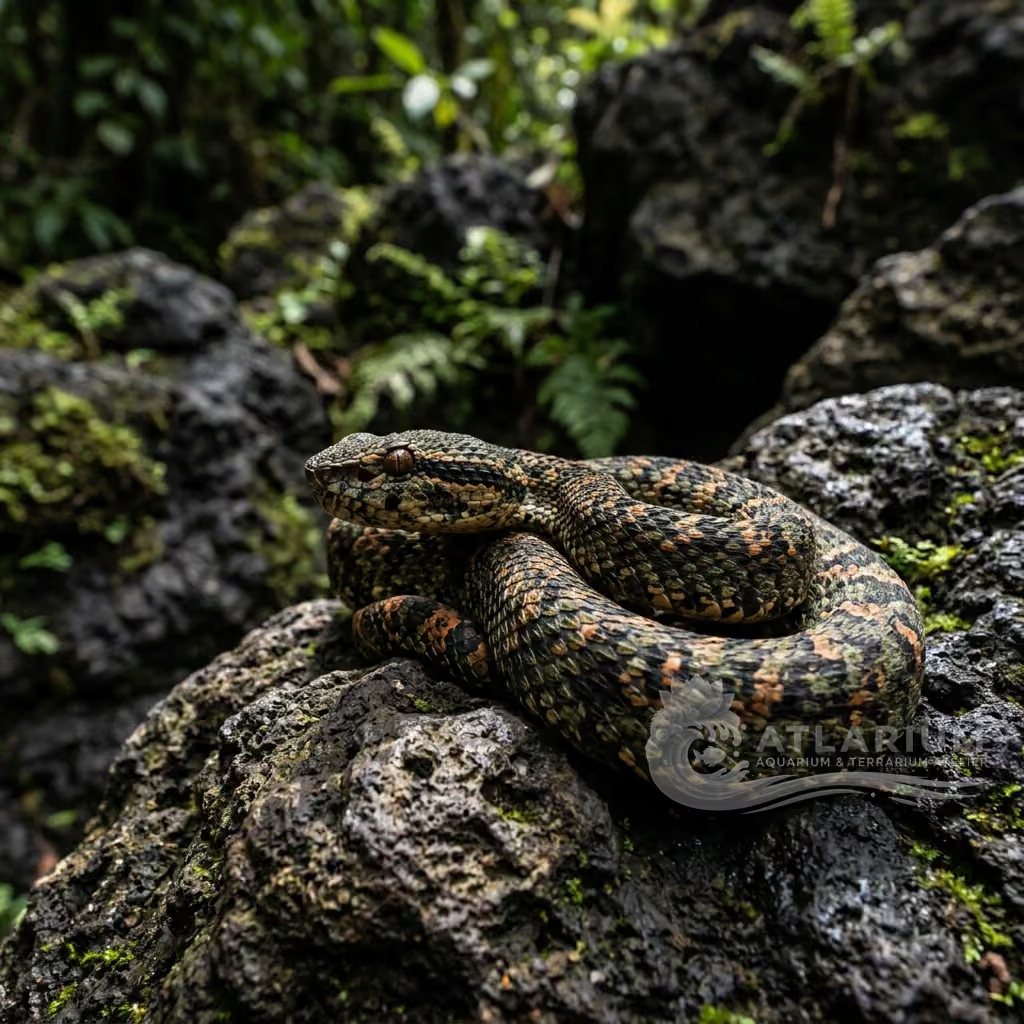
A highly venomous and intensely patterned pitviper originating from the southern Japanese Ryukyu islands, visually striking with its intricate, dark diamond-shaped patterns.
Umgebung
Terrestrisch
Luftfeuchtigkeit
60 - 80 %
Tagestemperatur
25 - 29 °C
Nachttemperatur
21 - 24 °C
Erwachsenengröße
90 cm

Artbeschreibung
Geographical Origin and Habitat: The Sakishima habu is a venomous pitviper endemic to the Sakishima Islands, which form the southern group of the Ryukyu Archipelago in Japan. It inhabits diverse environments, including subtropical forests, grasslands, agricultural fields (especially sugarcane fields), and areas near human villages.
Taxonomy and Genetics: Belonging to the family Viperidae and subfamily Crotalinae. The genus Protobothrops includes several highly venomous Asian pitvipers. Genetic research shows that Protobothrops elegans evolved in geographic isolation within the Sakishima islands, adapting to prey on local small vertebrates.
Behavior and Habits: Primarily a nocturnal and terrestrial snake, although it is capable of climbing low bushes. During the day, it shelters under rocks, fallen logs, crevices, or stone walls. It is an active hunter that preys on rodents, lizards, and small birds, locating them using its heat-sensing loreal pits.
Morphology: Features a slender yet muscular body with a distinct, elongated triangular head. Adult specimens typically reach a length between 60 and 120 centimeters. The color pattern consists of a greyish-brown or reddish-brown base color, marked by complex, dark brown or black dorsal geometric blotches.

Pflege, Zucht und Mitbewohner
Terrarium Setup: As a venomous snake of medical significance, a highly secure, locked terrarium (minimum 100x50x60 cm) is mandatory. The substrate should be coco coir or peat moss kept slightly damp. Provide sturdy, well-secured climbing branches and multiple dry hide boxes at different thermal zones on the floor.
Lighting and Heating: Provide a thermal gradient with a cool end at 24-25°C and a warm basking spot at 28-30°C using a protected heating element. Night temperatures can drop to 20-22°C. Provide low-intensity lighting for a natural 12-hour photoperiod to avoid stress to this nocturnal predator.
Humidity and Hydration: Maintain moderate to high humidity between 65% and 80%. Mist the enclosure regularly with dechlorinated water to facilitate healthy shedding and respiratory function. A heavy, spill-proof water bowl filled with clean water must always be present and cleaned daily.
Feeding and Supplementation: Readily accepts appropriate-sized rodents (mice or small rats) in captivity. Feed adults once every 10-14 days, and juveniles weekly. Vitamin or calcium supplements are not necessary if the snake is fed high-quality, whole feeder rodents regularly.
Compatibility: Strictly solitary. Do not house with other snakes. Aggressive territorial behavior and feeding accidents are significant risks. Handling must be avoided except when absolutely necessary, and only by trained keepers using professional snake hooks, tongs, and shifting boxes.
Health and Common Diseases: Susceptible to skin infections and scale rot if the substrate is allowed to remain soggy. Respiratory issues can develop from poor air circulation and high humidity. Incomplete sheds can be treated by temporary humidity boosts. The venom is potent and requires immediate medical attention.

Geografische Herkunft und Verbreitung
The Sakishima habu is a venomous pitviper endemic to the Sakishima Islands, which form the southern group of the Ryukyu Archipelago in Japan. It inhabits diverse environments, including subtropical forests, grasslands, agricultural fields (especially sugarcane fields), and areas near human villages.
Ursprung
Ostasien

Reptilienprofil
- Diät
- Carnivore
- The feeding ecology of Sakishima habu is characterized by its highly specialized predatory behavior. As a strict carnivorous, this species primarily targets rodents, frogs, and various small lizards. Its sensory adaptations, including advanced olfactory mechanisms and, in some cases, heat-sensing pits, allow it to detect the minute physiological signatures of its prey with remarkable precision. This predatory efficiency plays a crucial role in maintaining the trophic balance within its natural habitat.\n\nIn terms of foraging strategy, Sakishima habu demonstrates an energy-conserving ambush technique. By remaining motionless for extended periods, the snake capitalizes on its cryptic coloration to blend seamlessly into its surroundings. Once an unsuspecting prey item approaches within strike range, the snake delivers a rapid, venomous bite. The venom initiates both immobilization and preliminary digestion, which is vital for consuming rodents, frogs, and various small lizards efficiently.\n\nDigestive physiology in this species is highly adapted to process sporadic but substantial meals. After a successful hunt, Sakishima habu typically retreats to a secure microhabitat where the extended metabolic process of digestion can occur safely. This adaptation is particularly important given the variable availability of rodents, frogs, and various small lizards in its environment, allowing the snake to survive prolonged periods between feeding events.
- Erwachsenengröße
- 90 cm
- Lebensstil/Mikrohabitat
- Terrestrial
- A terrestrial to semi-terrestrial snake, it typically dwells on the forest floor, utilizing leaf litter, root systems, and low-lying vegetation for camouflage and ambush hunting. While they may occasionally ascend low shrubs, their enclosure should prioritize maximum floor space with abundant terrestrial hideouts to foster a sense of security.
- Aktivitätszyklus
- Nocturnal
- This species is primarily nocturnal, remaining hidden during the daylight hours to avoid extreme heat and predators. As dusk approaches, the Protobothrops elegans becomes active, emerging from its diurnal retreat to forage and hunt. Enclosure lighting should reflect a natural day-night cycle, but the snake will exhibit its most natural active behaviors after the lights go out.
- Sozialität
- Solitary
- Behaviorally, Sakishima habu exhibits a distinctly solitary lifestyle. Interactions with conspecifics are generally rare and primarily confined to the breeding season or incidental encounters in areas of high resource overlap. This solitary nature minimizes intraspecific competition for food and optimal thermoregulatory sites, which is essential for survival in its specific ecological niche.\n\nThe daily activity pattern and spatial distribution of Sakishima habu are deeply influenced by its semi-arboreal to terrestrial behavior, using stealth to ambush prey. Whether utilizing leaf litter, rocky crevices, or arboreal perches, the snake's primary defensive strategy is avoidance and camouflage. However, if cornered or directly threatened, it will not hesitate to display defensive behaviors, which may include physical posturing, hissing, and ultimately striking.\n\nThermoregulation is a critical aspect of its solitary existence. Sakishima habu carefully selects microhabitats that offer the ideal gradient of temperature and humidity, balancing the need to warm its body for digestion with the imperative to remain hidden from natural predators. This continuous spatial adjustment underscores the complex, self-reliant nature of its semi-arboreal to terrestrial behavior, using stealth to ambush prey lifestyle.
- Reproduktion
- Viviparous
- The reproductive strategy of Sakishima habu is defined by its oviparous nature. This specific reproductive modality—laying clutches of eggs, in contrast to the viviparity seen in many related groups—is a critical evolutionary adaptation that maximizes the survival rate of the offspring in its native environment. The physiological investment required for this reproductive cycle dictates much of the female's seasonal behavior and energy allocation.\n\nEnvironmental cues such as temperature fluctuations and seasonal precipitation often trigger the onset of the mating season. During this period, males may engage in complex chemosensory trailing to locate receptive females. Following successful copulation, the gestation or incubation period begins, heavily dependent on optimal microclimatic conditions. The specifics of laying clutches of eggs, in contrast to the viviparity seen in many related groups ensure that the developing embryos are protected during their most vulnerable stages.\n\nUpon emergence, the neonates of Sakishima habu are fully formed and equipped with the necessary venom and instinctual behaviors to survive independently. There is typically no extended parental care post-birth or post-hatching, meaning the juveniles must immediately navigate the challenges of predation and foraging. This life-history strategy highlights the evolutionary trade-offs between offspring quantity and the intensive physiological costs of reproduction.
- Handhabungstoleranz
- Display only
- Due to its highly potent and medically significant venom, the Protobothrops elegans is strictly a display-only species. Under no circumstances should this snake be free-handled. All interactions, enclosure maintenance, and feeding must be performed using professional snake hooks, secure lockable terrariums, and strict safety protocols to prevent life-threatening envenomation.
- Brumation
- Nicht erforderlich
- To replicate its natural seasonal cycles, a winter brumation period is highly recommended, especially if breeding is desired. Temperatures should be gradually reduced to roughly 12-15°C (53-59°F) over several weeks, during which feeding is completely halted to prevent rotting of undigested food in the gut. This cooling period typically lasts 2 to 3 months.
- Häutung
- Regular
- Shedding cycles occur periodically as the snake grows. During the shedding phase, bumping the ambient humidity by lightly misting the enclosure and ensuring access to a large water bowl helps hydrate the skin. A healthy molt should peel off entirely in one piece; retained spectacles or skin patches indicate insufficient hydration.

Verwandte Arten
Empfehlungen gruppiert nach nahen Verwandten, Auswahl von Begleitern und ähnlicher Betreuung.