Lemon damselfish
Pomacentrus moluccensis
An active, yellow damselfish associated with branching corals. Best kept in a 150L tank in small groups, requiring moderate flow and plenty of coral-like shelter.
Wassertemperatur
23 - 28 °C
pH-Wert
8.1 - 8.4
Wassertyp
Meerwasser
Tankfüllstand
Unten und in der Mitte
Erwachsenengröße
9 cm
Mindesttankvolumen
>= 100 L
Mindestgruppe
>= 1

Artbeschreibung
Geographical Origin and Habitat: Pomacentrus moluccensis is widely distributed throughout the tropical Indo-West Pacific, from the eastern Indian Ocean and Andaman Sea to Fiji, Tonga, north to the Ryukyu Islands of Japan, and south to the Great Barrier Reef in Australia. This species strictly inhabits sheltered lagoons, reef flats, and outer reef slopes at depths ranging from 1 to 15 meters. It is almost always found in close association with branching corals, particularly Acropora species, which provide immediate refuge from predators.
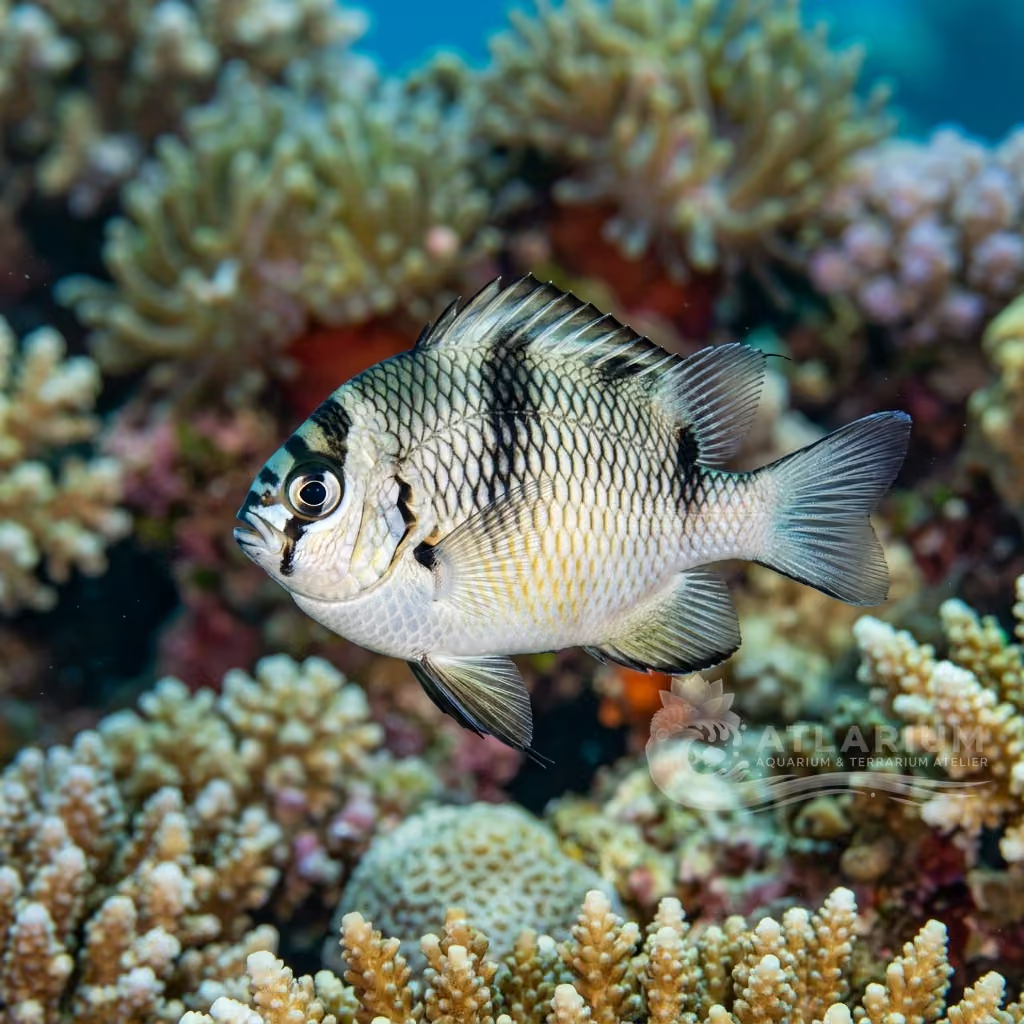
Taxonomy and Morphology: This species belongs to the family Pomacentridae, subfamily Pomacentrinae. It features a laterally compressed, oval, and compact body typical of damselfishes, reaching a maximum length of 9 cm. Its mouth is small with fine teeth suited for feeding on plankton. It is morphologically similar to Pomacentrus amboinensis, but can be distinguished by the absence of a dark spot at the base of the pectoral fin and differences in fin shape.
Social Behavior: Highly active and territorial, Pomacentrus moluccensis lives in small, loose groups centered around branching coral colonies. Within these groups, individuals establish a strict size-based dominance hierarchy. While they display intraspecific aggression to defend their specific micro-territories, they are relatively tolerant compared to other damselfish species. They rarely venture far from their host coral.
Coloration and Sexual Dimorphism: The species exhibits a vibrant, uniform lemon-yellow coloration across its entire body and fins. Some specimens may display tiny blue or violet spots on the head and gill covers. There is no obvious physical sexual dimorphism, although males may show heightened coloration and active swimming displays during the spawning period to court females.

Pflege, Zucht und Mitbewohner
Aquarium Setup: A minimum tank size of 150 liters is recommended to house a small group of these active fish. The aquarium should be aquascaped with plenty of live rock and branching corals (either live or artificial) to mimic their natural habitat and provide essential shelter. A sandy substrate and moderate to strong water flow are ideal for replicates of their reef environment.
Diet and Feeding: In the wild, they feed on plankton in the water column and occasionally scrape benthic algae. In captivity, they are opportunistic feeders that accept a wide range of foods, including high-quality flake food, pellets, and frozen foods like mysis shrimp, brine shrimp, copepods, and spirulina-infused formulations. Feeding multiple times a day in small portions is recommended.
Water Quality: Requires standard, stable marine aquarium parameters: temperature between 23 and 27 °C, pH of 8.1 to 8.4, and salinity between 1.020 and 1.025. Efficient filtration and regular water changes are necessary to keep dissolved organic levels, such as nitrate and phosphate, to a minimum, as they are sensitive to sudden water parameter swings.
Compatibility and Cohabitation: While territorial, it is one of the less aggressive damselfishes, making it suitable for community reef tanks. It is completely reef-safe and will not harm corals or mobile invertebrates. Keep with active, robust tankmates such as other pomacentrids, clownfish, gobies, and dwarf angels. Avoid housing with very large predators that could easily swallow them.
Aquarium Breeding: Breeding in home aquariums is achievable. Males will prepare and clean a flat substrate site, such as a rock surface or empty shell, and court females. The female deposits adhesive eggs, which the male fertilizes and aggressively guards. The male fans the eggs with his fins to provide oxygenation until they hatch in about 3 to 5 days.
Risks and Diseases: This is an exceptionally hardy and disease-resistant species, making it a great choice for beginners. However, poor water quality or severe stress can make them susceptible to common marine parasites such as marine ich (Cryptocaryon irritans) and marine velvet (Amyloodinium). A varied diet and stable conditions are key to their longevity.

Geografische Herkunft und Verbreitung
Pomacentrus moluccensis is widely distributed throughout the tropical Indo-West Pacific, from the eastern Indian Ocean and Andaman Sea to Fiji, Tonga, north to the Ryukyu Islands of Japan, and south to the Great Barrier Reef in Australia. This species strictly inhabits sheltered lagoons, reef flats, and outer reef slopes at depths ranging from 1 to 15 meters. It is almost always found in close association with branching corals, particularly Acropora species, which provide immediate refuge from predators.
Ursprung
Tropische Ozeane und RiffeNordamerikaSüd- und SüdostasienOstasienAustralien, Neuguinea und Ozeanien

Fischprofil
- Temperament
- Territorial
- This fish is best described as spunky, bold, and highly territorial. Once the Pomacentrus moluccensis claims a specific cave or rock, it will vigorously defend it against fish much larger than itself. Despite its small size, its attitude commands respect from other tank inhabitants. Careful planning of tank mate introduction is required to manage its assertive personality.
- Diät
- Omnivore
- This species is a highly adaptable omnivore that will aggressively consume almost any food offered. Its diet should consist of a varied mix of high-quality marine flakes, pellets, frozen mysis, and brine shrimp. It also benefits from the inclusion of algae-based foods or spirulina to round out its nutritional needs. In a mature reef, it will supplement its diet by picking at microfauna and algae on the rocks.
- Lebenserwartung
- 3-10 years
- Erwachsenengröße
- 9 cm
- Geschlechterverhältnis
- Solitary
- Due to its territorial nature, it is strongly advised to keep only a single specimen per tank. Housing multiple individuals of the Pomacentrus moluccensis usually results in relentless fighting until only one remains. If a male-female pair naturally forms, they may tolerate each other, but this is difficult to guarantee. Only very large aquariums with massive amounts of rockwork can safely support more than one.
- Fütterungsfrequenz
- Twice daily
- Feeding the Pomacentrus moluccensis once or twice a day is perfectly sufficient for maintaining its health and vigor. It is an opportunistic feeder that will quickly rush to the surface at feeding time. Care should be taken to ensure that shyer tank mates receive their share, as this fish is very fast and competitive. Overfeeding is rarely necessary due to its rugged metabolism.
- Bioload
- Low to Medium
- The Pomacentrus moluccensis has a relatively low to moderate bioload, making it suitable for a wide range of aquarium sizes. It is incredibly hardy and its waste output is easily managed by standard biological filtration. Even in smaller tanks, it rarely causes significant spikes in nitrates or phosphates. This resilience makes it a popular choice for both new setups and established reef systems.
- Fluss
- Strong
- It is highly adaptable to various flow conditions, thriving in both moderate and strong currents. The Pomacentrus moluccensis will often use areas of moderate flow to forage while retreating to calmer spots within the rockwork to rest. Variable wave patterns help simulate its natural coastal or reef environments. Ensuring there are flow-sheltered zones is just as important as providing strong water movement.
- Sprungrisiko
- No
- Reproduktion
- Oviparous
- In its natural habitat, the Pomacentrus moluccensis is a demersal spawner, laying adhesive eggs on hard substrates. The male takes on the responsibility of fiercely guarding the nest, becoming highly aggressive toward any approaching animals. Spawning in the home aquarium is somewhat common, though raising the microscopic fry is rarely successful without dedicated rearing tanks. The male's enhanced aggression during this period can cause temporary unrest in the aquarium.
- Kompatibilität & Tankkameraden
- Semi-aggressive
- While generally considered reef-safe, the Pomacentrus moluccensis can exhibit semi-aggressive behavior towards its tank mates. It will not harm corals or mobile invertebrates, but it fiercely protects its chosen territory from other fish. It is best housed with fish of similar or slightly larger size and temperament. Avoid keeping it with overly timid species that could be easily stressed by its territorial displays.
- Tankfüllstand
- Middle/Bottom
- The Pomacentrus moluccensis generally hovers in the lower to middle levels of the water column, staying relatively close to its claimed territory. It uses the rockwork as a central base of operations, darting out to feed or chase away intruders. It rarely swims extensively in the open upper water, preferring the security of nearby crevices. Its strong association with the substrate defines its daily behavior.

Wissenschaftliche Modelle & Parameter
FishBase
Zugang zu den offiziellen wissenschaftlichen Daten der Art
FishBase v25.04Daten synchronisiert am: 15.06.2026
- Trophäenniveau
- 2,4 ± 0,1 se
- Belastbarkeit
- Hoch (weniger als 15 Monate)
- Phylogenetische Einzigartigkeit (PD50)
- 0.5
- Bayessche Längen-Gewichts-Beziehung
- a = 0.02951, b = 2.96
- AnfälligkeitGeringe Anfälligkeit (10 / 100)

Verwandte Arten
Empfehlungen gruppiert nach nahen Verwandten, Auswahl von Begleitern und ähnlicher Betreuung.