Strawberry conch
Conomurex luhuanus
The Strawberry Conch is a hardworking marine snail that sifts through sandbeds to consume detritus and algae. It needs a mature, deep sand substrate to thrive.
Température de l’eau
24 - 28 °C
Valeur du pH
8.1 - 8.4
Type d'eau
Marin
Type d'invertébré
Marine snail
Taille adulte
6 cm
Groupe minimal
>= 1
Rôle écologique
Scavenger
Sensibilité au cuivre
High

Description de l'espèce
Geographical Origin and Habitat: The Strawberry Conch (*Conomurex luhuanus*) is a highly active, utterly fascinating marine gastropod natively endemic to the warm, shallow coastal waters, expansive sandy lagoons, and seagrass beds of the vast Indo-Pacific Ocean (ranging from Japan down to Australia). Their natural biotope is defined by endless stretches of fine aragonite sand, where they spend their entire lives plowing through the soft substrate to consume cyanobacteria, diatoms, and detritus.
Taxonomy: Scientifically classified within the Strombidae (True Conchs) family, they possess a morphology unlike any common aquarium snail. Fully mature adults reach a maximum shell length of 5.0 to 7.0 centimeters (2.0-2.8 inches).
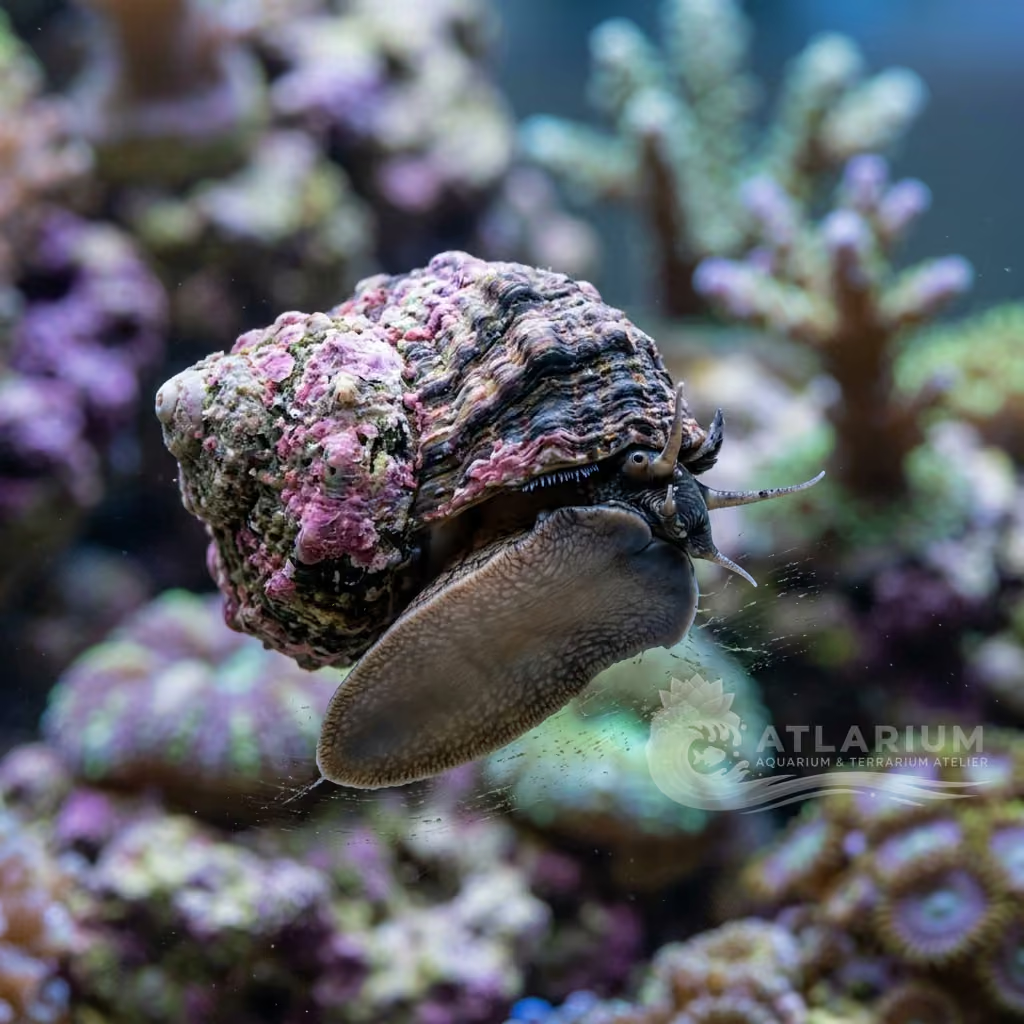
Fascinating Adaptation: They possess two highly developed, prominent eye stalks that independently peer out from beneath the shell, giving them excellent vision. Instead of gliding on a flat foot, they possess a claw-like, sickle-shaped operculum.
Social Behavior: They are entirely benthic, intensely active, and strictly diurnal (active during the day). Their method of locomotion is extraordinary and often startling to new aquarists. Because they lack a standard gliding foot, they use their sickle-shaped operculum to violently vault or "leap" across the sand bed. When threatened, they can leap several inches at a time to escape predators. They spend their days using a long, trunk-like proboscis to vacuum the sand surface like a biological elephant.
Coloration and Sexual Dimorphism: Sexual dimorphism is visually non-existent without dissection. Their coloration is striking and gives them their common name. The exterior of the conical shell is typically a mottled, highly disruptive pattern of tan, beige, and dark brown, designed for camouflage on the sand. However, the smooth, flared inner lip of the shell opening is a shocking, vibrant, deeply saturated strawberry-red or dark orange. Their large, cartoonish eyes are vividly colored and highly expressive.

Soins, reproduction et cohabitation
Tank Setup: The aquarium architecture MUST accommodate their absolute biological necessity for expansive, open sand. A minimum 110-liter (30-gallon) marine aquarium is strictly required.
CRITICAL REQUIREMENT: The tank MUST possess an established, wide-open sand bed (at least 2 inches deep) composed of fine, soft aragonite sand. They CANNOT be kept in bare-bottom tanks or tanks with coarse crushed coral, as they will be unable to vault across the substrate and will suffer lethal stress.
Diet and Feeding: They are the undisputed champions of sand-bed cleaning. They are omnivorous scavengers but lean heavily toward herbivory. They use their trunk-like proboscis to consume massive quantities of cyanobacteria (red slime algae), brown diatoms, green film algae, and uneaten meaty detritus directly from the sand surface.
CRITICAL WARNING: They are voracious eaters; in a clean tank, they WILL quickly starve to death. They MUST be supplemented with sinking algae wafers.
Water Quality: As highly active marine mollusks, they are sensitive to water chemistry fluctuations. They demand stable tropical heat (24-27°C / 75-81°F). Specific gravity (salinity) MUST be maintained precisely between 1.023 and 1.025. They require hard, highly alkaline water (pH 8.1 - 8.4) with flawless Calcium (400-450 ppm) to maintain their thick, heavy shells. Their constant vaulting and vacuuming of the sand bed prevents toxic hydrogen sulfide gas pockets from forming.
Compatibility and Tankmates: Compatibility is universally absolute for peaceful reef tanks. They are 100% reef-safe, entirely ignoring all corals and fish.
CRITICAL WARNING: Their jerky, leaping movements frequently attract the attention of predators. They MUST NEVER be housed with Pufferfish, Triggerfish, or large, aggressive Wrasses. Furthermore, aggressive Hermit Crabs will actively hunt them, flip them over, and kill them to steal their highly desirable, thick shells.
Aquarium Breeding: Breeding the Strawberry Conch in captivity is exceedingly rare for home hobbyists. Mating involves internal fertilization. The female will eventually lay long, tangled, gelatinous strings containing thousands of tiny eggs directly onto the sand bed or a flat rock. These eggs eventually hatch into microscopic, pelagic veliger larvae. Raising these delicate larvae through their complex planktonic stages requires specialized phytoplankton cultures and is practically impossible at home.
Risks and Diseases:
CRITICAL TOXICITY WARNING: Like all marine snails, they are immediately and fatally hypersensitive to COPPER (Cu) and heavy metals. They will die instantly in tanks treated with copper medications. The second major risk is lethal starvation; they are frequently purchased to clean a tank, only to starve weeks later when the algae is gone. Maintain a strict ratio of no more than ONE Conch per 30 gallons of open sand bed area.

Origine et répartition géographiques
The Strawberry Conch (*Conomurex luhuanus*) is a highly active, utterly fascinating marine gastropod natively endemic to the warm, shallow coastal waters, expansive sandy lagoons, and seagrass beds of the vast Indo-Pacific Ocean (ranging from Japan down to Australia). Their natural biotope is defined by endless stretches of fine aragonite sand, where they spend their entire lives plowing through the soft substrate to consume cyanobacteria, diatoms, and detritus.
Origine
Océans tropicaux et récifsAmérique du NordAsie de l'Est

Profil d'invertébré
- Régime alimentaire
- Carnivore
- The diet of Conomurex luhuanus must be carefully managed to ensure robust health, vibrant coloration, and long-term survival in captivity. In its natural environment, it has specific foraging habits that should be replicated as closely as possible in the aquarium. Supplementing its diet with high-quality, targeted commercial foods or fresh preparations ensures it receives necessary vitamins and minerals. Care should be taken not to overfeed, as uneaten food will quickly degrade water quality and harm the animal.
- Rôle écologique
- Scavenger
- Within its native ecosystem, Conomurex luhuanus plays a vital biological role that contributes to the overall stability of the environment. Whether acting as a scavenger, filter feeder, predator, or prey, it helps to efficiently cycle nutrients through the food web. Its natural behaviors prevent the over-accumulation of organic waste or the unchecked growth of specific prey populations. Introducing this species to a home aquarium often replicates these beneficial ecological functions, promoting a cleaner and more balanced system.
- Taille adulte
- 6 cm
- Risque de saut
- Yes
- While not generally known for jumping out of the water like some fish, Conomurex luhuanus can exhibit sudden, frantic escape responses when startled. Crabs and snails, in particular, may deliberately climb above the waterline and explore beyond the rim of an open aquarium. To prevent tragic accidents and desiccation, a well-fitted lid or tight netting is highly recommended for any tank housing this species. Providing adequate hiding spaces also reduces the likelihood of panic-induced erratic movements.
- Sensibilité aux chocs
- High
- Aquarists must be aware that Conomurex luhuanus is exceptionally sensitive to rapid fluctuations in its surrounding water parameters. Sudden shifts in temperature, specific gravity, pH, or dissolved organics can induce severe physiological shock, leading to rapid decline or death. A prolonged and careful drip acclimation process is highly recommended whenever moving this animal between systems. Maintaining pristine and unwavering water conditions is arguably the single most critical factor for its successful husbandry.
- Calcium et minéraux
- Medium
- Proper mineral balance is crucial for Conomurex luhuanus, as it requires consistent access to dissolved calcium and related trace elements for physiological maintenance. Depending on its specific biology, calcium is utilized for building external shells, hardening exoskeletons after molting, or supporting skeletal growth. In enclosed aquarium systems, these essential minerals can be rapidly depleted and may require regular supplementation. Routine water testing is encouraged to ensure that general hardness or specific calcium levels remain within the optimal range.
- Mue
- Shell growth
- For invertebrate species that undergo ecdysis, Conomurex luhuanus requires a safe and stress-free environment to successfully shed its old exoskeleton. During and immediately following a molt, the animal's new shell is soft, leaving it extremely vulnerable to physical damage and predation. It is important to provide ample hiding spaces where it can retreat until its body fully hardens. If applicable, the discarded exoskeleton should be left in the tank, as the animal will often consume it to reclaim vital minerals.
- Reproduction
- Oviparous
- The reproductive strategies of Conomurex luhuanus are varied and often highly adapted to its natural environmental conditions. Breeding efforts in a captive aquarium setting can range from straightforward to exceedingly difficult, often depending on specific larval requirements. Successful rearing of young frequently involves managing microscopic planktonic stages and specialized diets away from the main display tank. Nevertheless, captive propagation remains a rewarding endeavor that helps reduce the reliance on wild-caught specimens.
- Compatibilité et compagnons
- Verify
- Careful consideration of tank mates is required to ensure the safety and wellbeing of Conomurex luhuanus in a community setup. It should generally be housed with peaceful species that will not relentlessly harass it, nip at its appendages, or view it as a food source. Conversely, its own predatory or territorial instincts must be evaluated to ensure it does not harm smaller or slower-moving tank inhabitants. Observation during the initial introduction period is vital to confirm a harmonious balance within the aquarium.

Galerie d'images
Images sous licence liées à l'espèce ou, lorsqu'elles sont indiquées, au taxon représentatif le plus proche.

Espèces associées
Recommandations regroupées par proches parents, compagnons et soins similaires.