Hydrocotyle cf. tripartita
Hydrocotyle cf. tripartita
Fast-growing creeping plant known as 'Japan', famous for its clover-like leaves. Flattens to the substrate and creates a beautiful carpet under intense light.
Wassertemperatur
20 - 28 °C
pH-Wert
6 - 7.5
Wassertyp
Süßwasser
Licht
Mittel
CO2
Mittel
Erwartete Höhe
10 cm
Erwartete Breite
10 cm
GH
4 - 20 dGH
KH
0 - 14 dKH

Artbeschreibung
Geographical Origin and Habitat: Hydrocotyle cf. tripartita (often sold commercially as *Hydrocotyle* sp. "Japan" or "Australia") is an amphibious plant whose exact taxonomy and wild geographic origin remain debated, although its origin in Southeast Asia or Oceania (Queensland, Australia) is strongly credited. It thrives in swampy areas, shaded stream edges, and moist muddy soils, growing indifferently as a creeping emersed species or completely submerged during seasonal floods.
Taxonomy & Genetics: It is a dicotyledon belonging to the Araliaceae family (formerly Apiaceae). The abbreviation "cf." (confer) indicates that the botanical identification is not definitive, and the plant is currently associated with *tripartita* due to its leaf shape. Genetically, it is predisposed to marked plagiotropic (horizontal) growth and furious rooting at every internode, making it an exceptional weed.
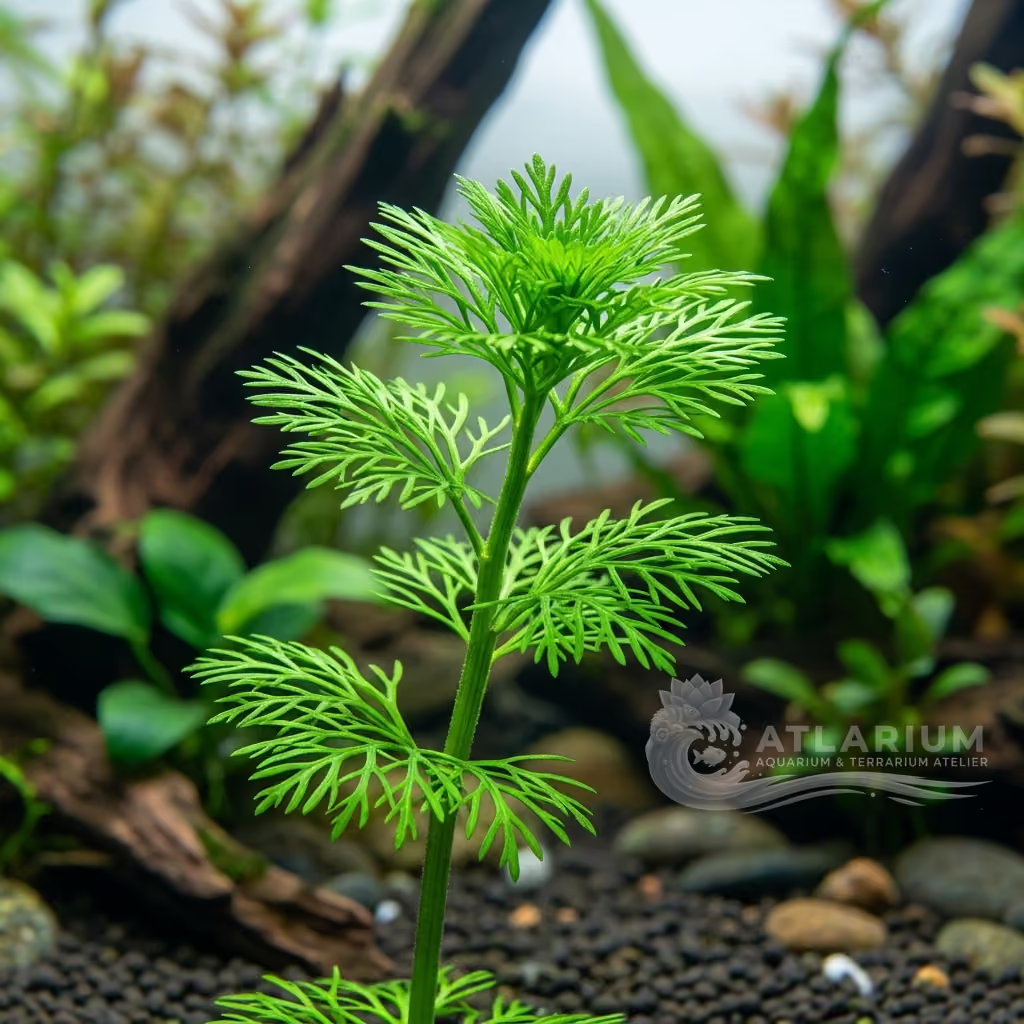
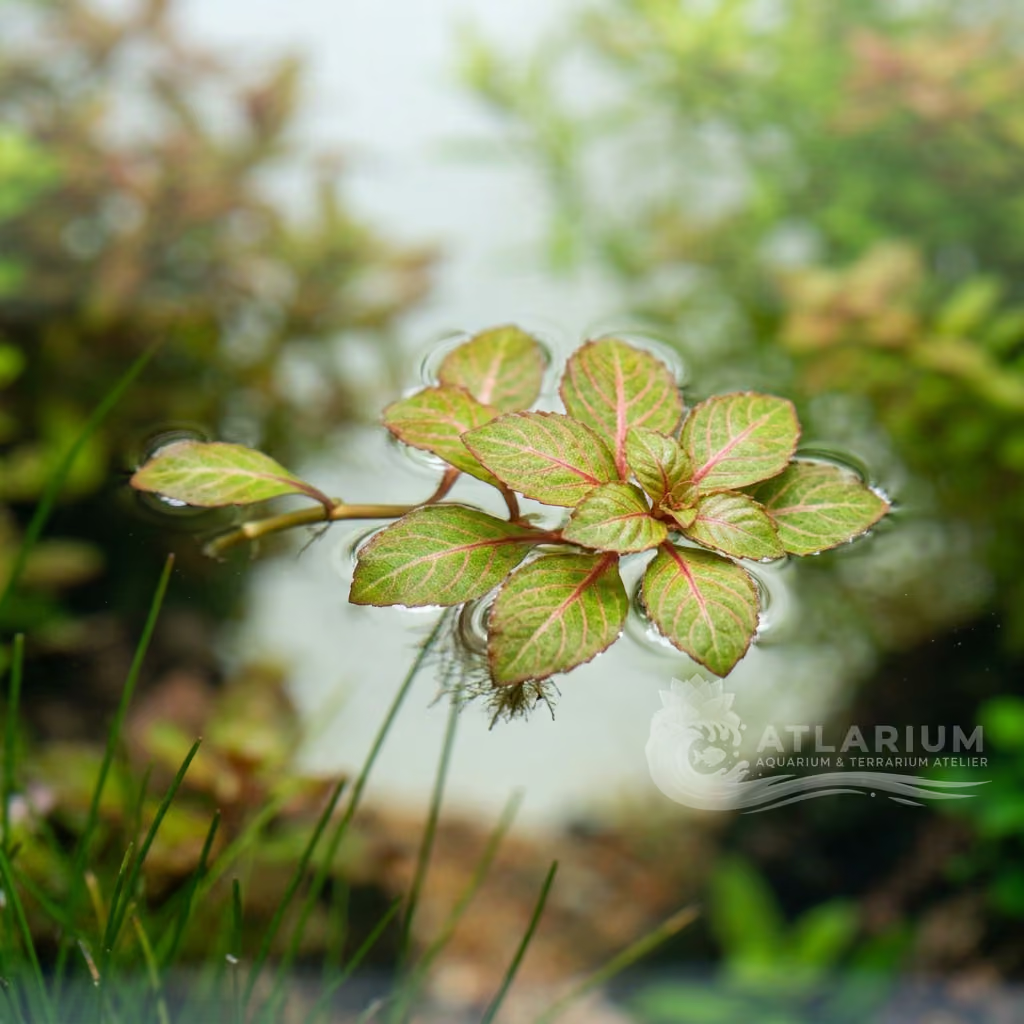
Physical Structure: The architecture is not erect caulescent, but creeping. The stems are thread-like, transparent, and succulent stolons that branch out like a horizontal cobweb. Thin white roots grow downwards from the nodes, and long petioles (up to 5-10 cm) grow upwards, terminating in the leaf blade. The leaf is unmistakable: small (1-2 cm), trilobate (divided into three deeply incised lobes, resembling an asymmetrical clover).
Color & Texture: The entire plant is a bright, luminous green, almost translucent, which gives great freshness to the layout. It does not show red or brown chromatic variations. The leaf texture is smooth, silky, and slightly wavy at the edges, impressively resembling a microscopic tuft of parsley or underwater cilantro.

Pflege, Zucht und Mitbewohner
Lighting & CO2: A highly plastic plant par excellence. Under weak or medium light and without CO2, it will tend to grow vertically in search of light, with long petioles and wide, spaced-out leaves. Under blinding light (PAR > 80) and massive CO2 injections, it unleashes its true "Japan" nature: the runners flatten to the ground, the petioles shorten to a few millimeters, and the leaves shrink, forming a dense and extremely intricate green lawn.
Nutrition & Substrate: A ravenous consumer of nitrogen (N) and potassium (K). It prefers to extract nutrients massively from the water column through its dense adventitious roots, although the use of a fertile allophane substrate astonishingly speeds up its lateral colonization. If the leaves yellow at the edges or turn white, the aquarium is in severe macronutrient or iron deficiency.
Water Chemistry: Totally indifferent and adaptable. It survives and grows at pH ranging from 5.5 to 7.5 and withstands soft water (osmosis) as well as very hard calcareous water (GH > 15). Optimal is a thermal range between 20°C and 28°C. Given its massive metabolic rate, it acts as a perfect phytodepurator, actively lowering the organic load in the tank.
Space Management & Placement: Its versatility of use has made it very famous in Aquascaping. It can be planted in the foreground to form a soft ruffled lawn, left to cascade from driftwood (weeping/liana effect) as it clings beautifully to branches, or wedged into rock crevices as an epiphytic bush. If not kept in check, it will creep and invade the entire surface of the tank, intertwining with all other plants.
Pruning: Pruning is brutal and frequent. The dense cushions must be thinned out by cutting entire sections of runners and pulling them away with your hands to prevent the lower layers from dying due to a lack of light (causing the entire carpet to detach). The removed portions reconnect in a few hours if left to float or replanted elsewhere. Remember to thin out often to let the base breathe.
Risks & Diseases: Besides the risk of "suicide by self-inflicted asphyxiation" if not pruned, the greatest danger is filamentous algae, which love to tangle in the maze of its thin stems, making mechanical removal impossible without uprooting the entire plant. An army of Neocaridina or Caridina japonica shrimp is the ideal prevention. It is demanding in Potassium (K), a deficiency of which punctures the old leaves.

Geografische Herkunft und Verbreitung
Hydrocotyle cf. tripartita (often sold commercially as *Hydrocotyle* sp. "Japan" or "Australia") is an amphibious plant whose exact taxonomy and wild geographic origin remain debated, although its origin in Southeast Asia or Oceania (Queensland, Australia) is strongly credited. It thrives in swampy areas, shaded stream edges, and moist muddy soils, growing indifferently as a creeping emersed species or completely submerged during seasonal floods.
Ursprung
Australien, Neuguinea und OzeanienSüd- und Südostasien

Pflanzenprofil
- Platzierung
- Vordergrund
- It is extremely versatile and can be used as a foreground carpet, a midground bush, or draped over hardscape. Pushing it down into the substrate encourages a carpeting effect. It looks exceptionally natural when allowed to weave through rocks and wood.
- Botanische Form
- Stängel
- This plant features distinct, clover-like leaves that are deeply divided into three lobes. The leaves grow on creeping runners that form dense mats. Its bright green coloration adds a very fresh look to the aquascape.
- Wachstum
- Schnell
- Its growth rate is fast under high light and CO2 injection. It can quickly cover the foreground or overtake smaller plants if not managed. In lower tech setups, its growth is steady but more manageable.
- Substrat
- Mittel
- Hydrocotyle cf. tripartita requires a fine-grained, nutrient-rich aqua soil to effectively form its signature dense, carpet-like growth. The plant produces runners that root at every single node, utilizing the shallow top layer of the substrate for rapid nutrient uptake. A soft, loose soil composition allows these nodal roots to grab hold easily and spread horizontally without resistance. Although a deep substrate is not strictly necessary, an even layer of 2-3 cm provides the perfect foundation for a compact, creeping mat.
- Säulendüngung
- Empfohlen
- It is an active feeder from the water column and benefits from a comprehensive liquid fertilizer. Potassium and iron are particularly important to keep the leaves bright green and free of pinholes. Regular dosing ensures rapid, healthy runner development.
- Wurzeldüngung
- Keine
- While it absorbs many nutrients through the water column, it also roots deeply into the substrate at each node. A nutrient-rich aquasoil will significantly boost its growth and density. Root tabs can be helpful in inert substrates.
- Trimmen
- Gelegentlich
- Trimming can be done by simply cutting the runners that spread too far. To maintain a low carpet, it can be aggressively trimmed like a hedge. Thinning out thick mats prevents the lower layers from rotting due to lack of light.
- Ausbreitung
- Stecklinge, Ausläufer
- Propagation is as simple as cutting a piece of a runner that contains at least one node and a leaf. Replant the cutting into the substrate, and it will quickly spread. It will also naturally propagate as it creeps along the bottom.
- Empfindlichkeit
- Mäßig
- It is generally hardy but can suffer from yellowing leaves if macronutrients are deficient. It may grow leggy and reach for the surface in low light conditions. It is relatively resistant to algae as long as it is growing actively.
- Layoutrolle
- Mittelgrund, Vordergrund, Nano
- It plays a fantastic role as a versatile carpeting plant or an accent plant creeping over hardscape. Its clover-like appearance provides a unique texture that softens the transitions between different zones. It is highly favored in Nature Aquarium style layouts.

Bildergalerie
Lizenzierte Bilder, die mit der Art oder, wenn markiert, mit dem nächstgelegenen repräsentativen Taxon verknüpft sind.

Verwandte Arten
Empfehlungen gruppiert nach nahen Verwandten, Auswahl von Begleitern und ähnlicher Betreuung.