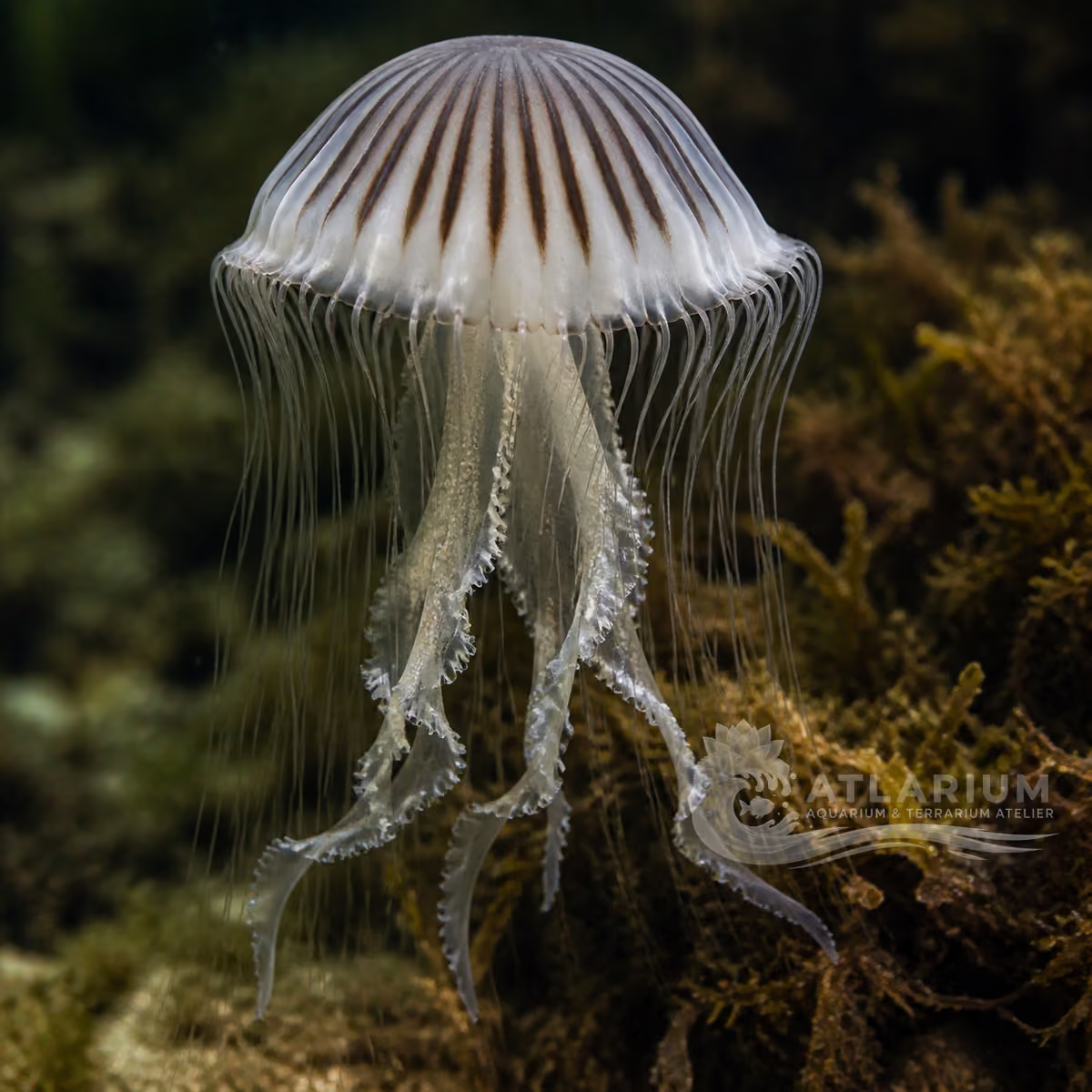
Crown jelly
Cephea cephea
Crown jelly (Cephea cephea) is a cnidarian medusa documented in public institutions; it needs specialist care and intact tissue in controlled flow.
pH-Wert
8 - 8.4
Wassertyp
Meerwasser
Wirbelloser Typ
Jellyfish
Giftig
Yes
Erwachsenengröße
60 cm
Ökologische Rolle
Pelagic plankton predator
Kupferempfindlichkeit
Extreme

Artbeschreibung
Geographic Origin and Biotope: Cephea cephea is documented in tropical Indo-Pacific and Red Sea waters. It is a gelatinous water-column animal tied to local conditions that must not be generalized.
Taxonomy and Morphology: WoRMS accepts Cephea cephea in class Scyphozoa, order Rhizostomeae, family Cepheidae. It has a robust bell and fused oral arms without long marginal tentacles.
Social Behaviour: This is not a conventional aquarium community animal: it drifts or swims in the water column, and repeated contact with conspecifics, walls or décor can damage tissue. Any display group needs a density selected by experienced staff.
Colouration and Sexual Dimorphism: Transparency and the features evoked by the common name “Crown jelly” aid observation, but color and form vary with life stage, food and lighting. Sex cannot be identified reliably from the medusa's external appearance.

Pflege, Zucht und Mitbewohner
Aquarium Setup: A dedicated kreisel or pseudokreisel without sharp edges is required, with laminar flow that suspends Cephea cephea without sweeping it against a surface. Intakes, drains and overflows need fine even guards; free bubbles and abrasive décor are excluded. Care remains specialist and normally institutional.
Feeding and Diet: Offer suitably sized live or enriched planktonic prey in frequent small feeds; rotifers, copepods and Artemia nauplii are common professional reference foods. Remove excess promptly without suctioning tissue.
Water Quality: The professional manual gives 32–35 ppt and pH 8–8.4 for most marine medusae; the source population must still be checked. Stability, oxygenation and control of ammonia, nitrite and heavy metals take priority over an undocumented target.
Compatibility and Coexistence: Use a species-only system: fish, crustaceans, corals, anemones and other gelatinous species can prey, be stung, compete for food or cause abrasion. Prevent collisions and crowding even among conspecifics.
Aquarium Breeding: The cycle alternates a planula, benthic polyp and pelagic medusa; polyps, ephyrae or young medusae need separate vessels, flows and foods.
Risks and Disease: The main risk is mechanical damage to tissue made almost entirely of water, followed by starvation, fouled screens and osmotic shock. Nematocysts remain active on detached tentacles; catalog level: mildly-venomous. Avoid contact and maintain the appropriate sting-response protocol.

Geografische Herkunft und Verbreitung
Diese Art stammt aus: tropical Indo-Pacific and Red Sea waters.
Ursprung
Tropische Ozeane und Riffe

Wirbelloses Profil
- Diät
- Planktivore
- Planktivorous: it requires correctly sized live or enriched prey and several controlled feedings.
- Ökologische Rolle
- Pelagic plankton predator
- A planktonic predator and food-web resource in the pelagic ecosystem; it is not a cleanup animal.
- Erwachsenengröße
- 60 cm
- Sprungrisiko
- No
- Stoßempfindlichkeit
- Extreme
- Extremely sensitive to rapid changes in temperature, salinity, pH and flow; acclimation must be slow and observed.
- Giftig
- Yes
- Häutung
- No
- It does not molt; growth directly remodels the gelatinous tissue.
- Reproduktion
- Alternating polyp–medusa generations
- Alternating generations with a benthic polyp phase and a pelagic medusa phase.
- Kompatibilität & Tankkameraden
- Species only
- Professional species-only system; community-aquarium pairings are not appropriate.

Verwandte Arten
Empfehlungen gruppiert nach nahen Verwandten, Auswahl von Begleitern und ähnlicher Betreuung.