Rubber Ducky Isopod
Cubaris sp. 'Rubber Ducky'
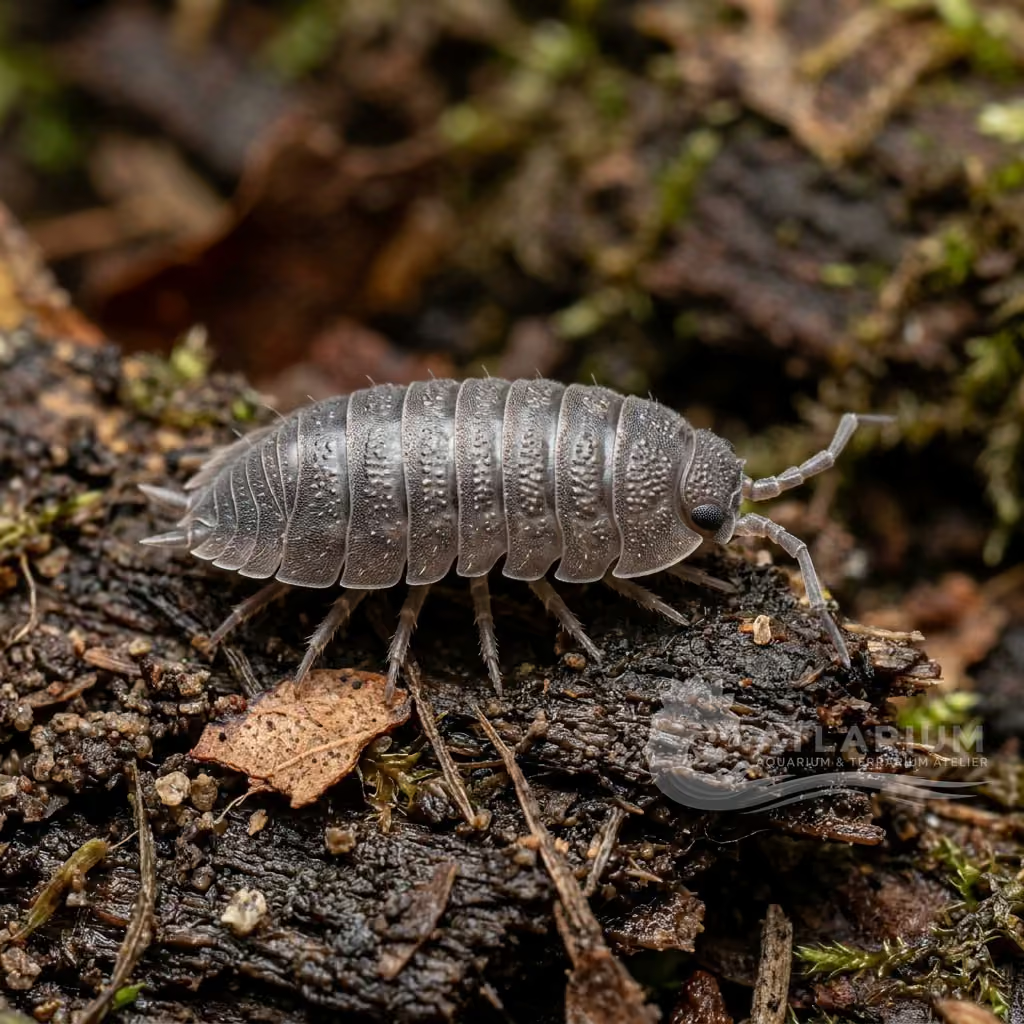
The 'Rubber Ducky' Isopod. The Holy Grail and the most famous (and expensive) isopod in the world (0.6 inches). It belongs to the Asian Cubaris group. Its face, composed of a yellow snout surmounted by a gray/bluish carapace with neon yellow extremities, eerily resembles the smiling face of a bath rubber ducky. It demands extreme tropical environments, dark pure limestone caves, and is notorious for sudden mortality and very slow reproduction in captivity.
Environnement
Terrestre
Humidité
75 - 95 %
Température ambiante
25 °C
Température diurne
22 - 26 °C
Température nocturne
18 - 20 °C
Profondeur du substrat
>= 8 cm

Description de l'espèce
Geographical Origin and Habitat: Very deep unviolated karst caves and dripping limestone rock walls wrapped in the tropical jungle of Thailand.
Taxonomy and Genetics: Family Armadillidae. (The Asian Jewel Isopods). Different from the European Armadillidium, the Cubaris are the pinnacle of Asian conglobating evolution: they have extreme domed shells and unique facial masks. The 'Rubber Ducky' have not yet been formally described by official science, remaining classified as Cubaris 'species'.
Behavior and Habits: Timid expensive rock miners. Incredibly cryptic and underground. Rubber Duckies viscerally detest light and spend 95% of their life clinging upside down to limestone stones buried in wet peat. They do not explore and instantly conglobate into perfect balls if touched. Gestation is atrociously slow (months) and broods rarely exceed 6-10 tiny babies a year.
Morphology: Total very rounded enameled dome (Up to 0.6 inches / 1.5 cm). The face is a living biological meme: the head ('the beak') is of an enameled acid yellow, with two small lateral black eyes that create the illusion of a 'smiling face'. The central body is slate gray/dark bluish, closed at the rear by another band (the rear) of bright neon yellow. They look like candies or plastic toys.

Soins, reproduction et cohabitation
Terrarium Setup: Guidance about terrarium setup for Cubaris sp. 'Rubber Ducky' must rely exclusively on the parameters and sources listed on this record.
Lighting and Heating: Guidance about lighting and heating for Cubaris sp. 'Rubber Ducky' must rely exclusively on the parameters and sources listed on this record.
Humidity and Hydration: Guidance about humidity and hydration for Cubaris sp. 'Rubber Ducky' must rely exclusively on the parameters and sources listed on this record.
Feeding and Supplementation: Guidance about feeding and supplementation for Cubaris sp. 'Rubber Ducky' must rely exclusively on the parameters and sources listed on this record.
Compatibility and Coexistence: Guidance about compatibility and coexistence for Cubaris sp. 'Rubber Ducky' must rely exclusively on the parameters and sources listed on this record.
Health and Common Diseases: Guidance about health and common diseases for Cubaris sp. 'Rubber Ducky' must rely exclusively on the parameters and sources listed on this record.

Origine et répartition géographiques
Very deep unviolated karst caves and dripping limestone rock walls wrapped in the tropical jungle of Thailand.
Origine
Amérique centrale et CaraïbesEurope, Méditerranée et Asie occidentaleAsie du Sud et du Sud-Est

Profil d'invertébré terrestre
- Régime alimentaire
- Detritivore
- This species thrives on a varied diet rich in decaying organic matter. They primarily consume high-quality leaf litter and soft rotting wood. Supplemental calcium and occasional vegetable scraps are essential for maintaining proper health and a strong exoskeleton.
- Taille adulte
- 2 cm
- Mode de vie/microhabitat
- Terrestrial
- They are robust terrestrial invertebrates that thrive in a well-maintained terrarium environment. A distinct moisture gradient is crucial to prevent both fatal dehydration and harmful fungal infections. They spend the vast majority of their time navigating the complex microhabitats of the damp forest floor.
- Cycle d'activité
- Nocturnal
- This species is primarily active during the night and the dimmer crepuscular hours. They typically remain hidden during the peak daylight hours to conserve vital moisture and avoid predators. Providing a natural day-night light cycle helps regulate their natural foraging and resting behaviors.
- Sociabilité
- Gregarious
- Rubber Ducky Isopods display charmingly shy behavior, spending the vast majority of their time burrowed deep within the substrate. They are a profoundly social species and will often cluster together beneath pieces of cork bark or limestone. This clustering behavior helps them conserve moisture and regulate their body temperature. When startled or threatened, their primary defense is to tightly conglobate into a perfect, impenetrable sphere.
- Reproduction
- Oviparous
- Reproduction occurs consistently throughout the year when kept under optimal terrarium conditions. Females incubate their developing eggs within a specialized ventral brood pouch known as a marsupium. The young emerge as fully formed miniatures and require stable moisture to survive their initial delicate molts.
- Venimeux
- No
- Tolérance aux manipulations
- Tolerant
- Handling should be kept to an absolute minimum to avoid causing unnecessary stress. Their incredibly delicate bodies and limbs can be easily injured by improper or forceful grasping. If relocation is absolutely necessary, gently move them by scooping up the bark or leaf they are resting on.
- Brumation
- They generally do not require any brumation period when kept in a controlled captive environment. Maintaining stable and appropriately warm temperatures ensures continuous year-round activity and breeding success. It is important to avoid extreme cold to prevent potential and sudden colony crashes.
- Mue
- Periodic
- Molting occurs in two very distinct phases to allow the isopod continuous mobility during the process. Adequate environmental humidity is absolutely essential for them to successfully shed their old exoskeleton without complications. They will usually consume their freshly shed skin in order to rapidly reclaim lost calcium.

Galerie d'images
Images sous licence liées à l'espèce ou, lorsqu'elles sont indiquées, au taxon représentatif le plus proche.

Espèces associées
Recommandations regroupées par proches parents, compagnons et soins similaires.