Hydrocotyle vulgaris
Hydrocotyle vulgaris
Common marsh pennywort that adapts easily to various light levels. Under intense lighting and CO2, it creeps tightly along the ground to form a dense carpet.
Température de l’eau
4 - 30 °C
Valeur du pH
5 - 7.5
Type d'eau
Eau douce
Lumière
Moyenne - Élevée
CO2
Faible - Élevée
Hauteur attendue
10 cm
Largeur attendue
15 cm
GH
2 - 21 dGH
KH
0 - 15 dKH

Description de l'espèce
Geographical Origin and Habitat: Hydrocotyle vulgaris, commonly known as marsh pennywort or common pennywort, is native to a wide range that includes Europe, North Africa, and Western Asia. It is a typically riparian and semi-aquatic plant, growing spontaneously in damp and muddy environments such as lake shores, marshes, peat bogs, and slow-flowing ditches. Its ability to live both completely submerged and in emersed form on water-saturated soils makes it extremely versatile.
Taxonomy & Genetics: It belongs to the family Araliaceae (previously placed in Apiaceae). The generic name Hydrocotyle comes from Greek and means 'water cup', referring to the slight depression in the center of the round leaves. Genetics and morphology are stable; it is a resilient species equipped with a robust genome that allows it to adapt to cold and temperate climates, resisting harsh winter temperatures in outdoor ponds.
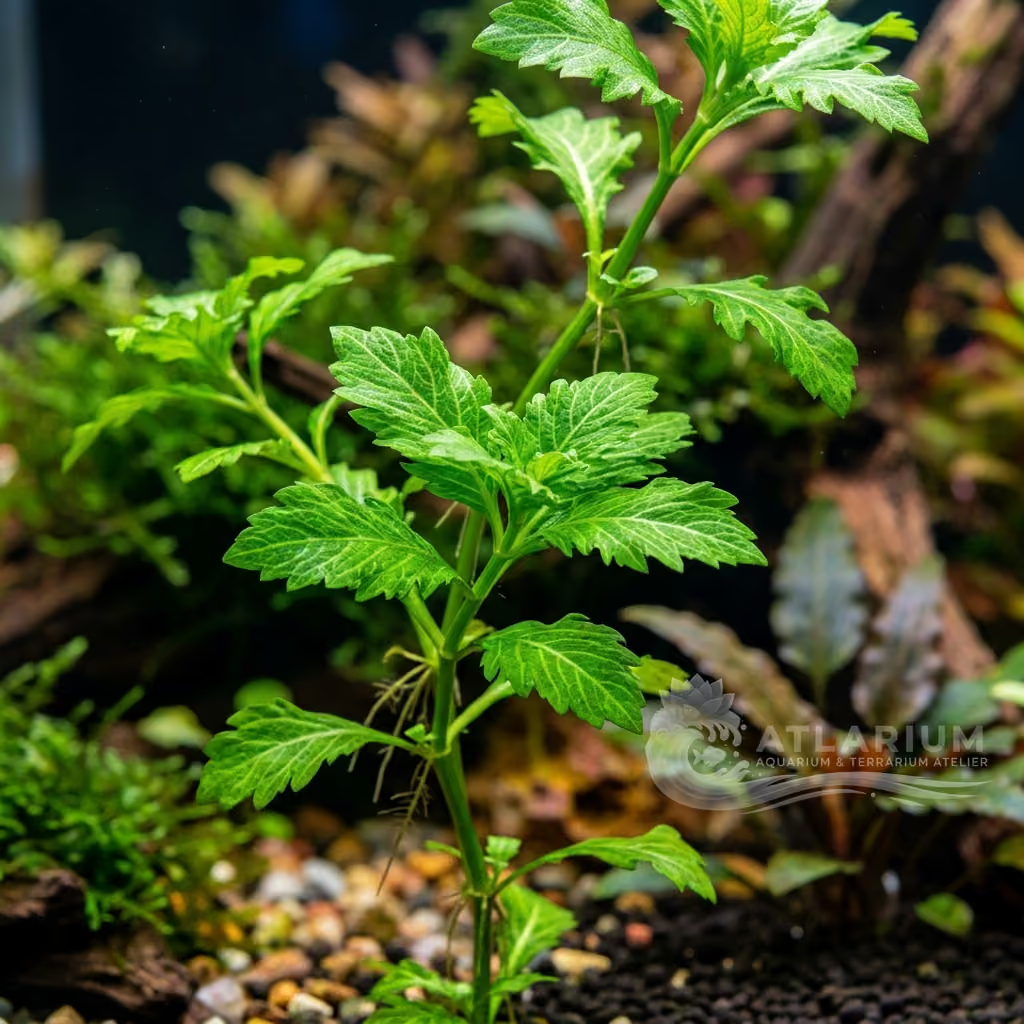
Physical Structure: It features a thin and flexible creeping stem or stolon that runs horizontally on the substrate or intertwines in the water. From each node of the stolon, anchoring roots and vertical petioles develop, bearing a single leaf at the apex. The leaves are peltate, meaning the petiole inserts exactly in the center of the lower leaf blade, giving the leaf its typical umbrella or circular shield shape.
Color & Texture: The leaves display a bright, uniform, and glossy green coloration. The upper surface is smooth and water-repellent, while the margins are slightly lobed or crenate. The texture is leathery in emersed growth and slightly thinner and more flexible in submerged growth. Under intense light, the leaf blade assumes an almost glassy and highly decorative appearance.

Soins, reproduction et cohabitation
Lighting & CO2: Tolerates a wide range of light intensities, from medium to very high. Under intense light and CO2 injection, the plant maintains a very low and compact habit, creeping along the ground and creating a dense carpet. In low light conditions, the petioles tend to elongate significantly towards the surface, assuming a messy habit.
Nutrition & Substrate: It is not particularly demanding regarding the substrate, as it is able to absorb nutrients both from the roots that dig in and directly from the
Water Chemistry: It is an exceptionally tolerant plant. It can survive water temperatures between 4°C and 30°C, tolerating even harsh winters if planted in outdoor ponds. The ideal pH ranges from 5.0 to 7.5, with a tolerated water hardness (KH) of 0 to 15 dKH. It prefers clean water but tolerates moderate organic loads well.
Space Management & Placement: Perfect for the foreground and midground in the aquarium. Due to its creeping habit and rapid growth, it can quickly colonize large areas, intertwining with the layout. It is exceptional for paludariums, ripariums, and Wabi-Kusa, where it grows vigorously out of the water climbing on rocks.
Pruning: It is pruned simply by cutting unwanted stolons with sharp scissors. Frequent pruning helps to contain expansion and maintain a dense carpet. Portions of cut stolon containing at least one node with leaves and roots can be replanted elsewhere to propagate the plant.
Risks & Diseases: The main risk is uncontrolled growth that can suffocate slower neighboring plants. If nutrients are insufficient, the leaves tend to shrink and lose their typical green gloss. Submerged leaves can be subject to algae attacks if fertilization is not balanced or in the presence of stagnant water.

Origine et répartition géographiques
Hydrocotyle vulgaris, commonly known as marsh pennywort or common pennywort, is native to a wide range that includes Europe, North Africa, and Western Asia. It is a typically riparian and semi-aquatic plant, growing spontaneously in damp and muddy environments such as lake shores, marshes, peat bogs, and slow-flowing ditches. Its ability to live both completely submerged and in emersed form on water-saturated soils makes it extremely versatile.
Origine
Europe, Méditerranée et Asie occidentale

Profil de plante
- Emplacement
- Plan intermédiaire
- It is best suited for the midground or background depending on the tank size. Unlike H. verticillata, it tends to grow more erratically and less uniformly upright. It looks very natural when planted along the edges of hardscape or trailing over wood.
- Forme botanique
- runner
- It has round, shallowly scalloped leaves attached to the stem near the center but slightly offset, unlike the perfectly centered H. verticillata. The leaves are light green and slightly more crinkled. The stems grow from a creeping rhizome-like runner.
- Croissance
- Rapide
- Its growth rate is relatively slow to moderate when fully submerged. It grows much faster in a terrarium or paludarium setting where its leaves are above the water. In the aquarium, it requires patience to form a dense stand.
- Substrat
- Faible
- Hydrocotyle vulgaris is a marsh plant that easily adapts to a variety of substrates, including basic sand, gravel, or standard potting soil in terrarium setups. In aquatic environments, its roots lightly anchor into the top layer of the substrate, supporting its horizontal creeping habit. A shallow depth of 3 cm is generally adequate, as the roots do not penetrate deeply but instead spread widely just beneath the surface. Providing a moderately fertile substrate ensures healthier leaves, though it is quite resilient in nutrient-poor conditions.
- Fertilisation de la colonne d'eau
- Recommandée
- Liquid column fertilization is necessary to keep it healthy underwater. It relies on the water column for trace elements and potassium to maintain sturdy stems. Regular dosing prevents the older leaves from decaying prematurely.
- Fertilisation racinaire
- Facultative
- Root tabs or a nutrient-rich substrate are very beneficial. It develops an extensive root system along its runners. Providing nutrients at the root level helps it establish and adapt to submerged conditions more effectively.
- Taille
- Régulière
- Trimming consists of cutting back runaway runners and removing old, yellowing leaves. Simply snip the stems near the base. It is generally a low-maintenance plant that only needs occasional tidying.
- Propagation
- Boutures
- Propagation is very easy by dividing the runners. Simply cut a piece of the runner that has roots and a few leaves. Replant it into the substrate to start a new cluster.
- Sensibilité
- Modérée
- It is somewhat challenging to adapt to fully submerged conditions and may melt initially. It requires good lighting to prevent the stems from rotting. It is quite tolerant of cooler water temperatures, reflecting its native European habitats.
- Rôle dans le décor
- Plan intermédiaire
- Its role is mostly as a textural accent in natural or biotope layouts. It provides a wild, slightly untamed look compared to more orderly foreground plants. It works exceptionally well in paludariums where it can grow out of the water.

Espèces associées
Recommandations regroupées par proches parents, compagnons et soins similaires.