Echinodorus horizontalis
Aquarius horizontalis
Echinodorus horizontalis is a legendary wild-type sword featuring incredibly unique leaves that grow horizontally to the substrate, creating a commanding low canopy.
Wassertemperatur
20 - 28 °C
pH-Wert
6 - 8
Wassertyp
Süßwasser
Licht
Mittel
CO2
Niedrig
Erwartete Höhe
30 cm
Erwartete Breite
50 cm
GH
4 - 20 dGH
KH
2 - 15 dKH

Artbeschreibung
Geographical Origin and Habitat: Endemic to the immensely vast Amazon basin across northern South America, deeply inhabiting the tropical regions of Brazil, Colombia, and Peru. Echinodorus horizontalis is a legendary, true wild-type aquatic swamp plant. It completely dominates heavily shaded, slow-moving jungle streams and intensely flooded terrestrial forested areas beneath the dense Amazonian canopy. It is a highly specialized amphibious survivor, perfectly evolved to maximize light capture in deeply shaded, nutrient-rich environments by growing its leaves horizontally rather than vertically.
Taxonomy & Genetics: Scientifically classified within the Alismataceae family, E. horizontalis is a massive, true wild-type Echinodorus species, not a commercial hybrid. Taxonomically, its specific name ("horizontalis") directly describes its unique biological adaptation: the leaves grow almost perfectly parallel to the substrate to maximize surface area for light absorption. Genetically, it completely lacks the biological mechanism to produce intense red pigments, relying entirely on maximizing chlorophyll exposure across its massive, horizontally deployed green leaves.
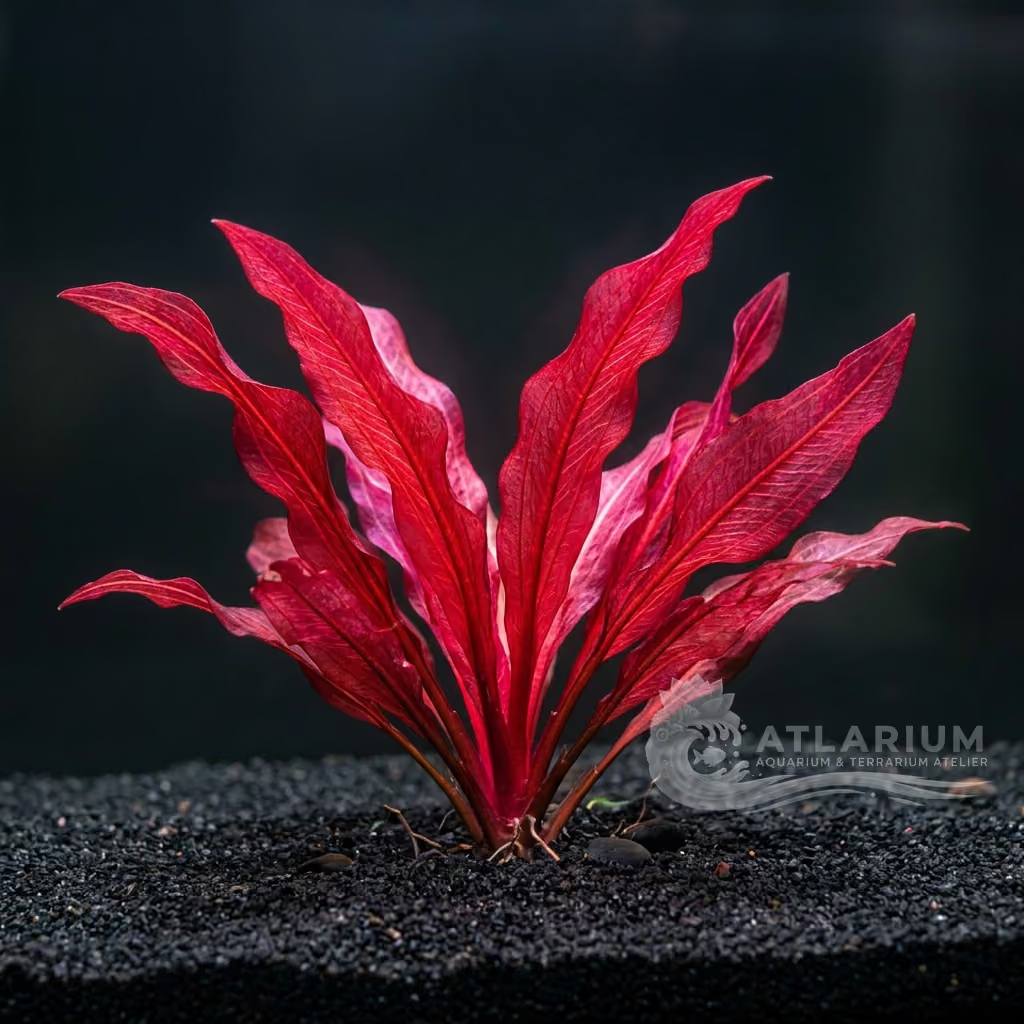
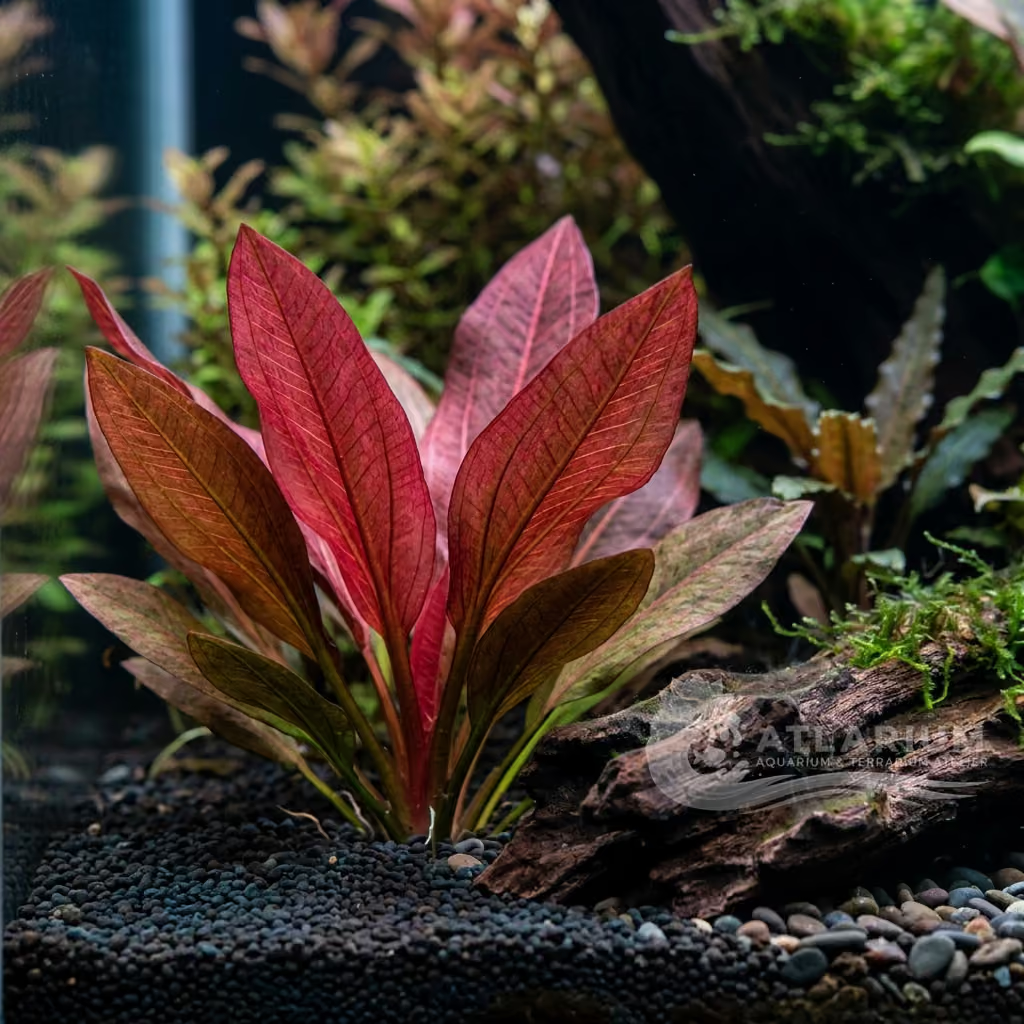
Physical Structure: The architectural structure of E. horizontalis is aggressively sprawling, heavily structural, and strictly horizontal. It is a gigantic rosette plant completely lacking vertical stems. The foundation is a massive, incredibly thick, tuberous subterranean rhizome that deploys an aggressive, deep-reaching root system. The leaves emerge directly from the crown on distinct, stiff petioles that explicitly bend outward at a sharp angle. The foliage is the defining structural feature: strictly heart-shaped (cordate), massive (up to 30 cm long), and deployed almost flat.
Color & Texture: The coloration is distinctly pure, solid, and incredibly robust. Grown submerged under standard lighting, the massive, horizontally splayed heart-shaped leaves are an unwavering, solid, deep olive-green to a vibrant apple-green depending on light intensity. New emerging leaves may display a very faint reddish-bronze blush, but they quickly transition to a solid green as they mature. The texture is intensely rigid, heavily leathery, and deeply "bullate" (hammered/dimpled) across the entire massive leaf surface.

Pflege, Zucht und Mitbewohner
Lighting & CO2: It is an incredibly resilient, shade-adapted species perfectly suited for beginner, low-tech aquariums. It will effortlessly survive and maintain its strictly horizontal shape in deeply shaded environments beneath taller plants. To unlock its massive, sprawling rosette shape and heavily hammered texture, medium-intensity LED lighting is recommended; intense light will violently flatten it further against the substrate. Pressurized CO2 is completely unnecessary for its survival, but moderately speeds up its massive growth.
Nutrition & Substrate: As a highly specialized, colossal Amazon Sword, E. horizontalis is a terrifyingly aggressive, obligate root feeder. Its massive root system strictly demands a very deep (minimum 7 cm / 3 inches), heavily nutrient-dense substrate. It absolutely demands premium aquasoil or a highly mature gravel bed heavily enriched with iron and macro-nutrient root tabs directly beneath the massive tuber. If starved of root nutrients, the deeply dimpled, horizontal green leaves will quickly turn pale yellow, rot, and dissolve.
Water Chemistry: Originating from the deeply shaded, acidic regions of the Amazon basin, it is practically invincible regarding standard water parameters. It thrives effortlessly in heated tropical aquariums (22-28°C) and is exceptionally adaptable, comfortably tolerating both extremely soft, highly acidic blackwater and rock-hard, highly alkaline tap water (pH 6.0 - 8.0). The single most critical environmental requirement is absolute chemical stability. It drastically prefers stable parameters over perfectly optimized ones. It demands moderate water flow.
Space Management & Placement: Due to its absolute monstrous width (capable of reaching 40-50 cm in diameter) and strictly horizontal growth habit, this plant is an extreme, dominant centerpiece exclusively for very wide, deep aquariums (minimum 200 liters). It MUST be planted singularly directly in the midground, with absolutely no small plants placed underneath it. Because it grows as a massive, sprawling, horizontal umbrella, it will violently shadow and choke out anything directly beneath its massive heart-shaped leaves.
Pruning: Pruning is a simple, massive, and highly necessary procedure. Never attempt to trim a rigid, hammered horizontal leaf in half; the cut edge will instantly turn black, rot, and destroy the aesthetic. To prune dead, yellowing, or excessively massive older outer leaves that are shadowing the entire tank floor, you must reach down to the absolute base of the massive rosette and cleanly snap or slice the stiff petiole directly at the crown. It rarely spreads via runners; instead, it slowly forms an impenetrable core.
Risks & Diseases: The absolute greatest threat to E. horizontalis is Green Spot Algae (GSA) and nutrient starvation. Because the highly rigid, heavily dimpled leaves grow horizontally and live for years, they act as massive landing pads catching debris and devastating Green Spot Algae if phosphate levels drop. Once GSA aggressively spots the tough leaves, it is physically impossible to clean off and ruins the deep green aesthetic. The second risk is nutrient starvation; if root tabs run out, it will violently melt.

Geografische Herkunft und Verbreitung
Endemic to the immensely vast Amazon basin across northern South America, deeply inhabiting the tropical regions of Brazil, Colombia, and Peru. Echinodorus horizontalis is a legendary, true wild-type aquatic swamp plant. It completely dominates heavily shaded, slow-moving jungle streams and intensely flooded terrestrial forested areas beneath the dense Amazonian canopy. It is a highly specialized amphibious survivor, perfectly evolved to maximize light capture in deeply shaded, nutrient-rich environments by growing its leaves horizontally rather than vertically.
Ursprung
Amazonas, Orinoco und GuayanaExtra-Amazonas-Südamerika

Pflanzenprofil
- Platzierung
- Mittelgrund
- With its characteristic horizontal growth habit, this plant is best placed in the midground or foreground depending on the aquarium size. It provides excellent cover and a unique visual texture without growing excessively tall. Careful placement is needed to ensure it doesn't shade out smaller, lower-growing plants beneath its spreading foliage.
- Botanische Form
- Rosette
- This species is notable for its distinct horizontal to oblique leaf orientation, distinguishing it from typical upright sword plants. The leaves are typically broad, ovate to somewhat heart-shaped, and a bright, vibrant green. This spreading rosette form creates a broad, bushy profile that is highly attractive in aquascapes.
- Wachstum
- Langsam
- The growth rate is generally moderate. Under optimal conditions with good lighting, CO2, and nutrient availability, it steadily produces new leaves, maintaining a full appearance. In lower-tech setups, the growth slows down, but the plant remains relatively undemanding and easy to maintain with occasional pruning of older leaves.
- Substrat
- Hoch
- A nutrient-rich substrate is essential for Aquarius horizontalis, as it relies heavily on its root system for nutrient uptake. An ideal substrate is a high-quality planted aquarium soil or a fine gravel bed deeply enriched with root tabs. The substrate must be deep enough to comfortably accommodate the plant's robust roots and provide stable anchoring.
- Säulendüngung
- Empfohlen
- Supplemental column fertilization is beneficial to provide readily available trace elements and micronutrients. A balanced liquid fertilizer helps maintain overall plant vitality and supports healthy leaf coloration, serving as a secondary nutrient source to complement substrate feeding.
- Wurzeldüngung
- Erforderlich
- Root feeding is the primary and most crucial method for fertilizing Aquarius horizontalis. Regular insertion of nutrient-dense root tabs into the substrate near the root mass is highly recommended. This ensures a consistent supply of essential macronutrients directly to the robust root system.
- Trimmen
- Regelmäßig
- Trimming is usually restricted to removing old, damaged, or heavily shaded outer leaves. Always cut the leaf stem cleanly at its origin point on the crown to prevent rotting tissue from degrading water quality. Its horizontal growth means it rarely needs topping or height control.
- Ausbreitung
- Rhizomteilung, Samen
- Propagation is primarily achieved through adventitious plantlets that form along runners or inflorescences. Once these plantlets develop an adequate root system and several leaves, they can be separated and planted. Division of a mature rhizome is an alternative but less common propagation method.
- Empfindlichkeit
- LOW
- It is somewhat more sensitive to poor water quality and nutrient depletion than the classic Amazon Sword. Its flat leaves gather detritus easily, which can invite algae if flow is inadequate. Ensure the crown is never buried beneath the gravel line to prevent rapid decomposition.
- Layoutrolle
- accent, Mittelgrund
- It provides a dramatic, structural focal point with its unique horizontal, umbrella-like canopy. The shaded area beneath its wide leaves creates a perfect natural refuge for shy bottom-dwellers and dwarf cichlids. It visually breaks up vertical lines in nature-style aquascapes.

Bildergalerie
Lizenzierte Bilder, die mit der Art oder, wenn markiert, mit dem nächstgelegenen repräsentativen Taxon verknüpft sind.

Verwandte Arten
Empfehlungen gruppiert nach nahen Verwandten, Auswahl von Begleitern und ähnlicher Betreuung.