Smallscale Archerfish
Toxotes microlepis
Famous for shooting water droplets to catch insect prey, this brilliant silvery archerfish needs a 250L brackish tank with a tight lid and overhanging plants to display its unique hunting behaviors.
Wassertemperatur
24 - 30 °C
pH-Wert
7 - 8.5
Wassertyp
Süßwasser / Brackwasser
Tankfüllstand
Oberfläche
Erwachsenengröße
15 cm
Mindesttankvolumen
>= 200 L
Mindestgruppe
>= 5
GH
10 - 25 dGH
KH
5 - 12 dKH
TDS
200 - 495 ppm
Leitfähigkeit
313 - 773 uS/cm

Artbeschreibung
Geographical Origin and Habitat: This species is native to Southeastern Asia, primarily in the Mekong and Chao Phraya river basins, as well as coastal rivers and wetlands of Thailand, Cambodia, Vietnam, and Indonesia. It inhabits coastal rivers, brackish estuaries, and mangrove swamps, adapting to fresh and brackish water.
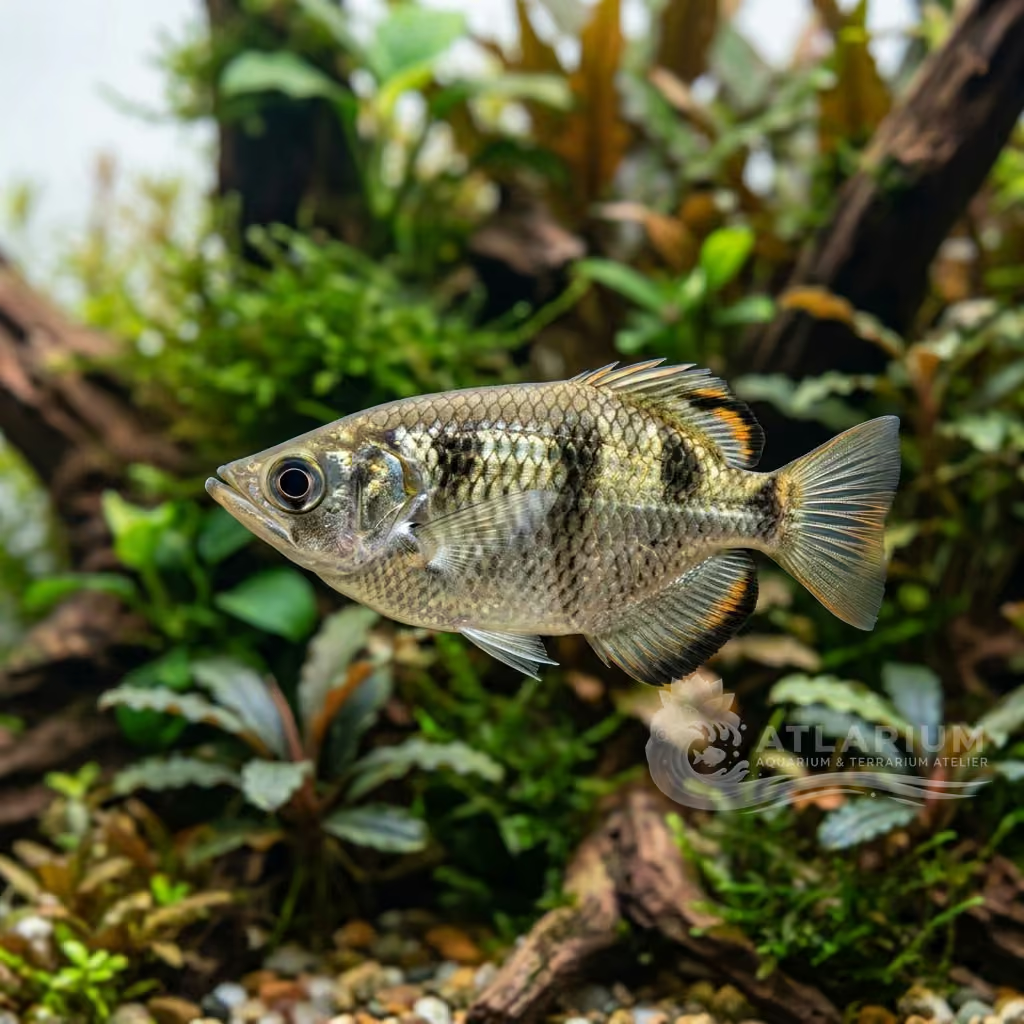
Taxonomy and Morphology: Member of the Toxotidae family. It features a laterally compressed body, a straight dorsal profile, and a large, protractile upward-pointing mouth adapted for shooting water droplets. Scales are notably smaller compared to other archerfish. Reaches about 15 centimeters.
Social Behavior: Peaceful toward fish of similar or larger size, but an active predator of smaller fish and insects. They live in small, loose schools that swim actively just below the surface, constantly scanning overhanging vegetation for potential prey.
Coloration and Sexual Dimorphism: Displays a brilliant silvery or golden body coloration, marked with 4-5 wedge-shaped vertical black bars extending from the back down the flanks. The dorsal and anal fins are highlighted in yellow. No external sexual dimorphism is present.

Pflege, Zucht und Mitbewohner
Aquarium Setup: Requires a large tank of at least 250 liters with a broad water surface. It is essential to leave a 10-15 cm air space between the water surface and the tight-fitting cover to allow for their signature shooting behavior. Decorate with overhanging roots and floating plants.
Diet and Feeding: Carnivorous and insectivorous. In the wild, they feed on insects, spiders, and small fish. In captivity, feed live insects (crickets, fruit flies, mealworms) along with frozen foods such as krill, mysis, and chopped shrimp. Sinking pellets are ignored; they prefer food floating on the surface.
Water Quality: Euryhaline species that can live in hard freshwater or low-salinity brackish water (recommended SG 1.002-1.005). Maintain temperature between 24 and 28 °C, pH 7.0 to 8.2, and water hardness GH 10-25. Excellent biological filtration and high oxygenation are required.
Compatibility and Cohabitation: Suitable for community tanks with robust, medium-sized fish that share similar water requirements, such as mollies, monos, targetfish, or knight gobies. Do not house with small species or small shrimps, as they will be eaten.
Aquarium Breeding: Captive breeding has not been successfully documented in home aquariums. In nature, they are pelagic spawners that release their eggs in brackish open waters, where the larvae drift toward sheltered coastal mangroves to develop.
Risks and Diseases: Exceptional jumpers that will escape through any open gap in the lid. Susceptible to mouth fungus and eye infections if the water quality is poor. Maintaining clean water and avoiding stress from aggressive tankmates are key preventative measures.

Geografische Herkunft und Verbreitung
This species is native to Southeastern Asia, primarily in the Mekong and Chao Phraya river basins, as well as coastal rivers and wetlands of Thailand, Cambodia, Vietnam, and Indonesia. It inhabits coastal rivers, brackish estuaries, and mangrove swamps, adapting to fresh and brackish water.
Ursprung
Süd- und Südostasien

Fischprofil
- Temperament
- Territorial
- Generally peaceful with appropriately sized tank mates. They can squabble among themselves during feeding. They will opportunistically prey on any fish small enough to swallow.
- Diät
- Carnivore
- Primarily insectivorous, eating bugs from the surface. They will also accept meaty pellets and frozen foods. Occasional live crickets encourage natural behavior.
- Lebenserwartung
- 8-12 years
- Erwachsenengröße
- 15 cm
- Geschlechterverhältnis
- Solitary
- Can be kept in groups or singly. No specific sex ratio is required for a group. Groups of five or more help disperse any mild aggression.
- Fütterungsfrequenz
- Twice daily
- Feed one to two times daily. Only feed what they can consume in a few minutes. Overfeeding can lead to rapid water quality decline.
- Bioload
- Medium to High
- This fish has a moderate to high bioload. They eat a lot and produce corresponding waste. Strong biological filtration is required.
- Fluss
- Strong
- They prefer moderate to low water flow. This allows the surface to remain relatively calm. A calm surface helps them spot and shoot at prey.
- Sprungrisiko
- Yes
- Extremely high jump risk. They literally leap from the water to catch prey. A tight-fitting, heavy lid is absolutely mandatory.
- Reproduktion
- Oviparous
- Breeding in captivity is extremely rare. They likely require specific salinity and temperature triggers. Fry care details are largely unknown.
- Kompatibilität & Tankkameraden
- Community
- Good with similar-sized peaceful or semi-aggressive fish. Smaller fish will be eaten. Keep with other brackish species.
- Tankfüllstand
- Top
- They strictly inhabit the top levels of the tank. They are always looking upwards for food. Ample surface area is crucial for them.

Wissenschaftliche Modelle & Parameter
FishBase
Zugang zu den offiziellen wissenschaftlichen Daten der Art
FishBase v25.04Daten synchronisiert am: 15.06.2026
- Trophäenniveau
- 3,2 ± 0,46 se
- Belastbarkeit
- Hoch (weniger als 15 Monate)
- Phylogenetische Einzigartigkeit (PD50)
- 0.5156
- Bayessche Längen-Gewichts-Beziehung
- a = 0.0166, b = 3
- AnfälligkeitGeringe Anfälligkeit (10 / 100)

Verwandte Arten
Empfehlungen gruppiert nach nahen Verwandten, Auswahl von Begleitern und ähnlicher Betreuung.